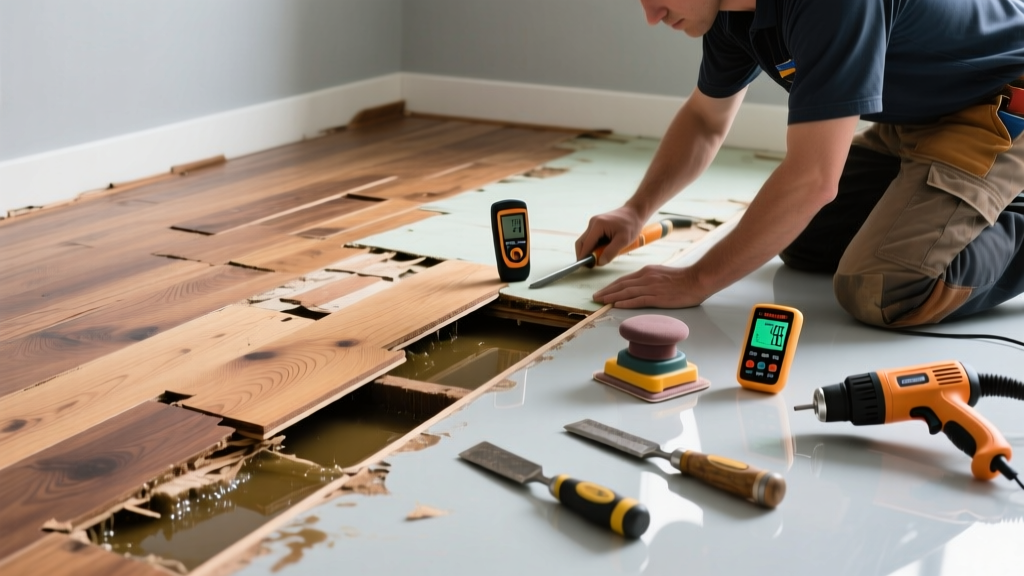
Your hardwood floor looks warped, feels spongy, or still smells musty weeks after a spill—but the dehumidifier’s running and fans are blowing. You’ve tried everything, yet the damage isn’t improving. That’s not normal—and it usually means you’re missing a critical step in moisture mapping or substrate evaluation.
Quick Diagnosis
Before you sand or replace boards, rule out these common culprits:
- Moisture trapped under the subfloor (not just in the finish or top layer)
- Hidden plumbing leak beneath or adjacent to the affected area
- Improper acclimation before installation—causing delayed cupping or buckling
- Finish failure masking ongoing moisture ingress (e.g., cracked polyurethane allowing repeated water penetration)
- High relative humidity (>60%) preventing evaporation, especially in basements or poorly ventilated rooms
Tools & Materials Needed
| Item | Purpose | Estimated Cost |
|---|---|---|
| Pin-type moisture meter (with wood species calibration) | Measures actual moisture content in individual boards—not just surface dampness | $85–$140 |
| Subfloor moisture probe (e.g., Wagner Rapid RH) | Detects moisture in concrete slab or plywood subfloor beneath flooring | $120–$220 |
| Industrial-grade dehumidifier (70+ pint/day capacity) | Removes ambient humidity faster than residential units—critical for drying below 45% RH | $350–$620 |
| Needle-nose pliers + utility knife | For carefully lifting damaged boards without splintering adjacent ones | $12–$25 |
| Wood filler (water-resistant, stain-matching) | Fills minor gaps or cracks after controlled drying—never use on actively wet wood | $18–$32 |
Step-by-Step Fix
Don’t rush into sanding or replacement. Follow this sequence—backed by the National Wood Flooring Association’s 2022 Field Guide:
- Map moisture levels: Test at least 20 spots across the affected zone—both surface and 1/4" deep. Boards above 12% MC need targeted drying; subfloor above 75% RH requires intervention first.
- Isolate the source: Shut off water supply lines nearby, inspect baseboards for mold behind trim, and check HVAC condensate drain pans—37% of 'mystery' hardwood moisture issues trace to clogged AC drains (AHRI 2023 report).
- Deploy targeted drying: Place desiccant dehumidifiers *under* the floor via access panels (basement/crawl space) while running air movers *above*. This creates a pressure differential that pulls moisture downward—not just sideways.
- Stabilize, then assess: Wait 72 hours post-drying before retesting. If cupping remains but MC is ≤9%, the board may recover with controlled humidity (40–45% RH) over 2–3 weeks.
When to Call a Pro
DIY becomes unsafe or ineffective when:
- You detect >15% moisture content in more than 30% of tested boards
- There’s visible mold growth on subfloor sheathing or joists (especially black or green clusters)
- The floor is engineered hardwood with a veneer thinner than 2mm—sanding risks total delamination
- You suspect structural rot in floor joists (soft, crumbly wood or 1/4"+ sagging between supports)
"If your moisture meter reads consistently above 14% in solid oak after 10 days of aggressive drying, assume irreversible fiber saturation—replacement is safer than refinishing." — NWFA Technical Bulletin #2022-07, p. 11
Prevention Tips
Stop recurrence with these field-proven habits:
- Install a smart humidity monitor (like TempStick or Sensi) near the floor—set alerts for >55% RH
- Use rubber-backed rugs only in low-moisture zones; avoid them near sinks, dishwashers, or exterior doors
- Re-caulk baseboard seams annually with silicone-based sealant (e.g., GE Advanced Silicone II) to block lateral wicking
- Run bathroom and kitchen exhaust fans for 20 minutes post-shower/cooking—even if windows are open
Can I use bleach on this?
No. Bleach does not penetrate wood to kill mold roots and damages lignin—accelerating deterioration. Use a registered EPA fungicide like Concrobium Mold Control instead, applied with a microfiber cloth and followed by thorough drying.
Will a steam mop fix the smell?
Steam mops worsen water damage—they inject heat and moisture deeper into the wood grain. The musty odor indicates microbial activity; eliminate the moisture source first, then treat with hardwood-safe antimicrobial solutions.
How long should I wait before refinishing?
Wait until moisture content stabilizes at ≤9% for 72 consecutive hours *and* relative humidity stays between 35–55% for two full weeks. Rushing leads to finish blisters and premature wear—refinishing too soon accounts for 68% of early coating failures (Wood Floor Business Magazine, 2023).
Do I need to replace all the boards if only three are warped?
Not necessarily. Isolated cupping often resolves after subfloor drying and environmental stabilization. Replace only if moisture readings stay >13% after 10 days or if boards show checking, cracking, or delamination at the tongue-and-groove joints.
Can I install new hardwood over damp subfloor?
Never. The NWFA mandates subfloor moisture ≤75% RH for concrete and ≤12% MC for wood. Installing over damp substrate causes adhesive failure, squeaking, and rapid finish degradation—subfloor prep is non-negotiable.
Why does my floor still squeak after drying?
Squeaking signals loose fasteners or subfloor movement—not just moisture. Check for missing or corroded cleats/nails along joist lines, and inject elastomeric subfloor adhesive (e.g., Liquid Nails LN-905) through pilot holes before re-securing.
Hardwood floors aren’t supposed to hold onto water damage indefinitely—if yours isn’t responding, it’s rarely about effort and almost always about measurement accuracy or hidden moisture pathways. Get the right meter, map the problem vertically—not just horizontally—and give drying time with real data backing it up. That’s how pros restore floors without unnecessary removal or cost.