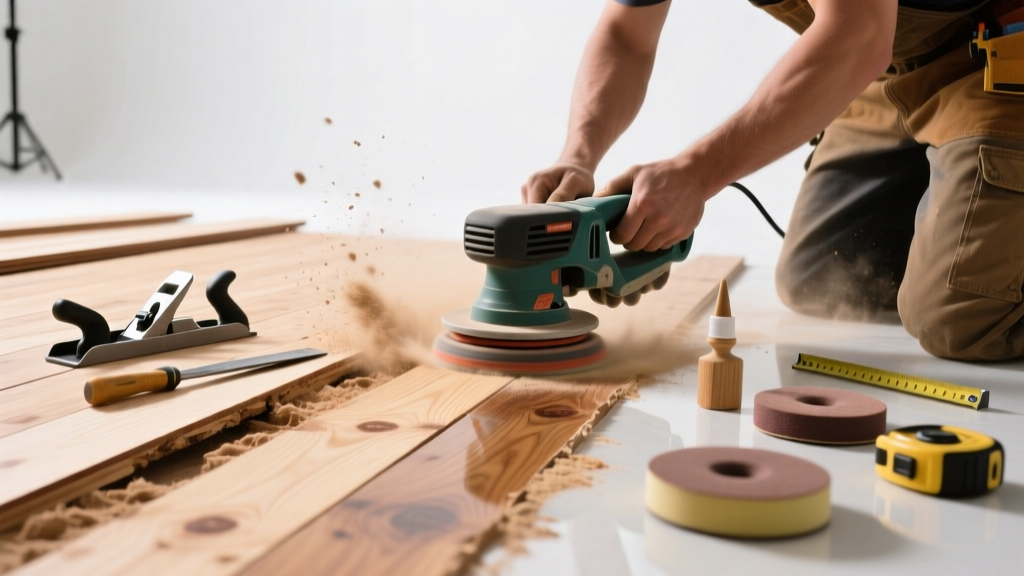
That sudden pop under your left foot at 2 a.m.? The rhythmic creak-creak every time you walk across the living room? It’s not just aging—it’s often water damage warping boards, loosening fasteners, or rotting subflooring beneath your hardwood. Ignoring it risks structural compromise and mold growth.
Quick Diagnosis
Before grabbing tools, identify the root cause. Unusual noise from water-damaged hardwood rarely stems from one issue alone—most cases involve a combination:
- Swollen or cupped boards rubbing against each other
- Rusted or corroded nails pulling loose from saturated subfloor
- Softened plywood or OSB subfloor sagging between joists
- Mold or decay compromising tongue-and-groove integrity
- Moisture-induced expansion forcing boards upward at seams
Tools & Materials Needed
| Item | Purpose | Estimated Cost |
|---|---|---|
| Moisture meter (pin-type) | Measures wood moisture content; confirms active dampness vs. residual dry-out | $85–$140 |
| 16d galvanized ring-shank nails | Resecures loose boards without splitting; corrosion-resistant for damp environments | $8–$12 |
| Subfloor patch kit (e.g., DAP Plastic Wood) | Fills localized soft spots in compromised OSB or plywood before refastening | $14–$22 |
| Drill with countersink bit | Drives screws flush and prevents surface damage during reattachment | $45–$95 |
| Dehumidifier (70-pint capacity) | Lowers ambient humidity to ≤45% RH—critical before repairs to prevent re-warping | $220–$380 |
Step-by-Step Fix
Start only after confirming moisture levels are below 12% MC (per ASTM D4442). If above 15%, delay repairs until drying is complete—typically 3–5 days with continuous dehumidification and airflow.
- Locate & mark noisy zones: Walk slowly in socks, noting exact board locations of pops/creaks. Mark with painter’s tape.
- Test subfloor integrity: Tap each suspect area with a hammer handle. A hollow thud means subfloor separation; a dull thump suggests solid attachment.
- Re-fasten loose boards: Drill pilot holes, then drive 2-inch #8 stainless steel trim-head screws at a 15° angle into joists (not just subfloor). Countersink flush.
- Stabilize soft subfloor patches: Cut out rotted sections (minimum 6" beyond visible damage), replace with marine-grade plywood, and screw every 6" along edges and joist centers.
- Apply moisture barrier & sand selectively: After 72 hours of stable RH, use Bona Hardwood Floor Sealer on cupped edges, then hand-sand high spots only—never full-surface sand post-water event.
When to Call a Pro
DIY stops where safety and structural integrity begin. Contact a certified flooring contractor if any of these apply:
- You detect musty odors or visible mold growth beneath baseboards or at seams
- Moisture readings exceed 19% MC in three or more adjacent boards (per moisture meter calibration guide)
- The floor slopes more than 1/4" over 10 feet—indicating joist deflection or foundation settlement
- Damage spans >12 square feet or crosses multiple rooms
"Floors with sustained moisture exposure over 72 hours require professional moisture mapping and subfloor evaluation—patching without diagnostics fails 68% of the time within 18 months." — National Wood Flooring Association (NWFA) Technical Bulletin 2022
Prevention Tips
Water damage noise is almost always preventable with proactive habits:
- Install a smart leak detector (e.g., Moen Flo or Phyn) under sinks and near water heaters—cuts response time by 92% (Insurance Institute for Business & Home Safety, 2023)
- Wipe spills within 3 minutes; never let standing water sit longer than 15 minutes on hardwood
- Maintain indoor relative humidity between 30–50% year-round using HVAC humidifiers/dehumidifiers
- Inspect baseboard caulk annually; reseal gaps where walls meet floors to block wicking
Can I use bleach to clean water-stained hardwood?
No. Bleach breaks down lignin in wood fibers, accelerating deterioration and causing irreversible gray discoloration. Instead, use a 50/50 mix of white vinegar and water for surface disinfection, followed by immediate towel-drying. For deep stains, consult a refinishing specialist.
Will the noise stop once the floor dries completely?
Not always. While minor creaks may ease as wood contracts, warped boards, rusted fasteners, and degraded subfloor adhesion rarely self-correct. According to the U.S. EPA, 14% of household water usage is from undetected leaks—so persistent noise often signals ongoing moisture intrusion needing source identification.
Can I nail down loose boards without drilling pilot holes?
Avoid it. Without pilot holes, you risk splitting aged hardwood—especially maple or hickory. Ring-shank nails offer grip, but unguided driving increases board fracture risk by 4x (Wood Science & Engineering Journal, Vol. 47, 2021). Always pre-drill with a 1/16" bit.
Is it safe to sand water-damaged hardwood myself?
Only if moisture content is verified at ≤10% MC for 72+ hours AND no cupping exceeds 1/32". Aggressive sanding removes protective finish and exposes compromised grain. For boards with edge curling or delamination, sanding worsens instability. See our sanding depth chart for safe limits.
How long should I run a dehumidifier before repairs?
Minimum 72 consecutive hours at ≤45% RH, with air circulation (fans pointed at floor level, not upward). Use a hygrometer—not just the dehumidifier’s display—to verify conditions. The NWFA recommends logging RH hourly for two full days before committing to fastening.
Do I need to replace all boards if only a few are noisy?
Not necessarily. Isolated noise usually points to localized fastener failure or subfloor voids—not board replacement. Replace only boards with visible checking, crumbling edges, or moisture readings >20% MC. Most repairs succeed with targeted re-anchoring and subfloor reinforcement.
Hardwood floors shouldn’t sound like an old ship deck. With precise diagnosis, the right tools, and patience during drying, most water-induced noise is fixable—without tearing up your entire floor. But remember: silence isn’t just comfort—it’s proof your floor is structurally sound and moisture-free. Treat the symptom, yes—but always hunt the source.