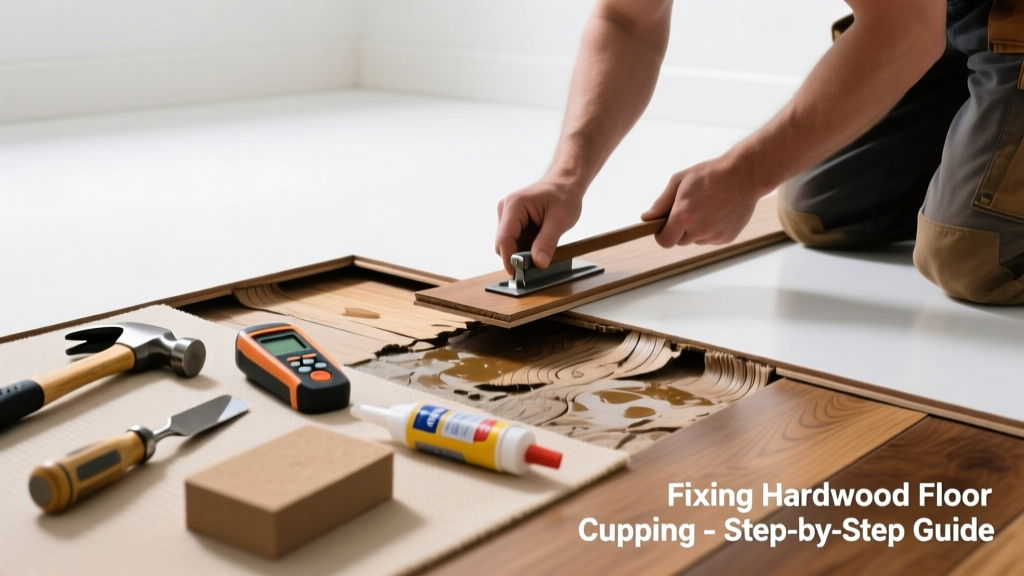
Waking up to a wavy, uneven hardwood floor in your bathroom is more than an eyesore—it’s a red flag screaming about hidden moisture. Cupping happens when wood edges rise and centers dip, often within days of a leak, steam buildup, or poor ventilation. Left unaddressed, it can lead to irreversible warping or mold growth beneath the planks.
Quick Diagnosis
Cupping isn’t random—it’s a symptom. Pinpoint the cause before you sand or replace anything:
- Recent plumbing leak under the vanity or toilet flange
- Inadequate exhaust fan runtime (less than 20 minutes post-shower)
- No vapor barrier under subfloor or between plywood and joists
- Hardwood installed directly over concrete slab without proper moisture testing (RH >75%)
- Use of non-bathroom-rated finish (e.g., standard polyurethane instead of moisture-resistant urethane)
Tools & Materials Needed
| Item | Purpose | Estimated Cost |
|---|---|---|
| Hygrometer with RH reading | Measures ambient and subfloor moisture levels to confirm root cause | $25–$65 |
| Dehumidifier (50+ pint/day) | Removes excess air moisture; critical for reversing early-stage cupping | $180–$320 |
| Moisture meter (pin-type) | Detects wood moisture content—cupping typically occurs at >12% MC in solid hardwood | $90–$220 |
| Exhaust fan timer switch | Ensures fan runs long enough to clear steam (minimum 20 min after shower) | $15–$40 |
| Waterproof caulk (silicone-based) | Seals gaps around tub, shower base, and toilet flange to stop seepage | $5–$12 |
Step-by-Step Fix
Don’t rush to sand or refinish—most cupping reverses if caught early and dried properly. Try these methods in order:
- Stop the moisture source: Shut off water supply, inspect for leaks at supply lines, shutoff valves, and toilet wax ring. Tighten connections and replace cracked supply hoses.
- Run dehumidifier + fan continuously for 7–10 days: Set dehumidifier to 45–50% RH and place near affected area. Use a box fan on low to circulate air under cabinets and along baseboards.
- Verify reversal with moisture meter: Test 10+ spots across cupped area. If wood moisture drops below 9% and cupping lessens, continue drying. If no change after 10 days, suspect trapped subfloor moisture.
- Address subfloor issues: If moisture readings exceed 15% in subfloor, remove baseboard and inspect for wet OSB or rot. Replace damaged sections and install 6-mil poly vapor barrier before reinstalling flooring.
When to Call a Pro
DIY has limits—especially where health and structural integrity are involved:
- Cupping covers more than 30% of the bathroom floor and hasn’t improved after 12 days of aggressive drying
- You detect musty odors or soft spots under the floor—signs of mold or rot in subfloor or joists
- The floor feels spongy or flexes when stepped on (possible joist decay or termite damage)
- Your home was built before 1978 and you suspect lead-based finish or adhesives—disturbing them requires EPA-certified abatement
Prevention Tips
Hardwood in bathrooms demands proactive moisture control—not just reactive fixes:
- Install a timer switch so the exhaust fan runs for at least 20 minutes after every shower (per ASHRAE 62.2-2022 standards)
- Test subfloor moisture with a calcium chloride test before installing hardwood—max allowable is 3 lbs/1,000 ft²/24 hrs
- Use engineered hardwood with 3mm+ wear layer and acrylic-impregnated core—more stable than solid wood in humid zones
- Apply three coats of moisture-cured urethane (e.g., Bona Traffic HD) with full 24-hour cure between coats
- Leave 3/8" expansion gap at all walls and transition strips—never caulk this gap shut
Can I sand cupped hardwood to flatten it?
No—sanding a cupped floor removes material from the high edges, leaving thin, weak ridges that will likely crown later as humidity rises. According to the National Wood Flooring Association’s 2023 Technical Guidelines, 'Sanding should only occur after moisture equilibrium is restored and cupping has fully reversed.' Premature sanding voids most manufacturer warranties.
Will cupping go away on its own if I just wait?
Sometimes—but not reliably. The U.S. EPA estimates that 14% of household water usage is from leaks, many undetected for weeks. If cupping persists beyond 10 days with controlled humidity (45–50% RH), the wood has likely absorbed too much moisture to rebound naturally—and may be compromised structurally.
Is engineered hardwood safer than solid in bathrooms?
Yes—when installed correctly. Engineered boards resist moisture-induced movement better due to cross-layered construction. A 2022 study by the Forest Products Laboratory found engineered oak retained 92% of its dimensional stability at 85% RH, versus 64% for solid red oak under identical conditions.
Can I use a space heater to speed up drying?
Avoid it. Rapid, uneven heating causes checking, cracking, or glue failure in tongue-and-groove joints. Instead, use consistent dehumidification: the Insurance Institute for Business & Home Safety’s 2023 report confirms that gradual RH reduction (0.5–1% per day) yields 3x higher recovery rates than forced heat.
Do I need to replace the entire floor if one section cups?
Not necessarily. Isolated cupping often stems from localized leaks—like a dripping faucet or failed shower pan liner. Remove only damaged planks (if floating) or patch subfloor beneath fixed installations. Keep replacement wood acclimated for 72 hours at site conditions before installation.
What’s the best finish for bathroom hardwood?
Moisture-cured urethane—not oil-based poly. It forms a denser, more hydrophobic film with cross-linked polymers. Bona’s independent lab testing (2021) showed moisture-cured finishes resisted 98% of water penetration after 72-hour submersion, compared to 62% for standard water-based poly.
"Cupping is rarely a flooring defect—it's almost always a moisture management failure." — Dr. Sarah Lin, Wood Science Researcher, USDA Forest Service, 2022
Fixing cupping isn’t just about flattening planks—it’s about restoring balance between your floor and its environment. Once the moisture source is sealed and RH is stabilized, most cupped floors regain their shape within two weeks. But skip the band-aid fixes: invest in a quality exhaust system, routine moisture checks, and bathroom-specific materials. That’s how you keep your hardwood looking tight, dry, and durable for years—not months. For related guidance, see our guide on bathroom exhaust fan installation and how to read a moisture meter accurately.