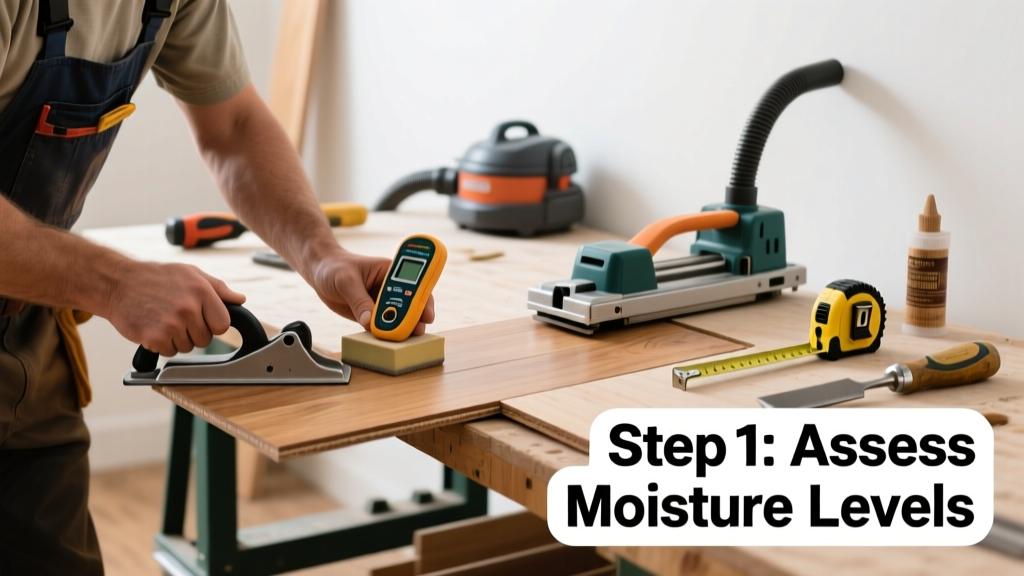
That subtle ridge along your floorboard edges—where the center dips and the edges rise—is cupping, and it’s almost always a moisture warning sign. Ignoring it risks permanent warping, squeaks, or even board separation. The good news? Early-stage cupping is often reversible without sanding or replacement—if you act fast and target the root cause.
Quick Diagnosis
Cupping occurs when the bottom of a hardwood board absorbs more moisture than the top, causing it to expand and curl upward at the edges. It’s not random—it’s a symptom. Here are the most common triggers:
- High relative humidity (above 60%) in the room for >72 hours
- Undetected plumbing leak under or near the floor (e.g., slab leak, failed supply line)
- Poor subfloor ventilation in crawlspaces or basements
- Recent concrete pouring or wet mopping without proper drying
- Missing or blocked HVAC return vents causing stagnant air pockets
Tools & Materials Needed
| Item | Purpose | Estimated Cost |
|---|---|---|
| Hygrometer (digital, calibrated) | Measures ambient and subfloor RH accurately—critical before and after treatment | $25–$45 |
| Dehumidifier (70-pint capacity) | Removes excess moisture from air; essential for drying floors without over-drying | $180–$320 |
| Moisture meter (pin-type, wood-specific) | Reads MC% of individual boards (target: 6–9% for solid hardwood) | $85–$220 |
| Box fan (oscillating, 20”) | Improves air circulation across floor surface and into gaps between boards | $35–$65 |
| Plastic sheeting (6-mil) | Used to isolate damp subfloors during drying; prevents re-wetting from below | $12–$28 |
Step-by-Step Fix
Fixing cupping isn’t about forcing boards flat—it’s about restoring equilibrium. These methods work best when cupping is mild (less than 1/16" edge lift) and caught within 2 weeks of appearance:
- Stop the moisture source first. Shut off water to suspect lines, repair leaks, and confirm no standing water in crawlspaces using a flashlight and moisture meter probe.
- Lower ambient humidity to 35–45% RH using a dehumidifier placed centrally, plus two box fans angled toward walls to move air across the floor surface—not directly down onto boards.
- Monitor daily for 7–10 days. Use your hygrometer and moisture meter: aim for subfloor readings <12% MC and floorboards 6–9% MC. Boards typically begin relaxing within 3–5 days if conditions stabilize.
- If cupping persists past 14 days, add targeted drying: tape 6-mil plastic over damp subfloor areas (e.g., concrete slabs), then run dehumidifier + fans continuously for another week.
When to Call a Pro
DIY fixes fail—or become unsafe—when structural or environmental issues exceed homeowner capability. Call a certified wood flooring contractor (NWFA-certified preferred) if:
- Cupping affects >25% of the floor area or includes buckling (boards lifting completely)
- Moisture meter readings exceed 14% MC in three or more adjacent boards
- You detect musty odors, visible mold on subfloor sheathing, or soft spots in joists
- The home has a history of chronic high humidity (>65% RH for >30 days/year) without climate control upgrades
According to the National Wood Flooring Association’s 2022 Field Guide, 68% of irreversible cupping cases involved delayed intervention beyond 10 days—and nearly all required full-board replacement or subfloor remediation.
"Cupping isn’t a finish issue—it’s a moisture management failure. Sanding before correcting RH and MC guarantees repeat failure." — Greg Wiedeman, NWFA Technical Director, 2023
Prevention Tips
Long-term stability depends on consistent environmental control—not just one-time fixes. Install these safeguards:
- Add a smart thermostat with humidity sensing (e.g., Honeywell Prestige IAQ) that triggers AC/dehumidifier at 50% RH
- Seal crawlspace soil with 10-mil poly and install a dedicated dehumidifier (e.g., Santa Fe Compact)
- Use only Bona Hardwood Floor Cleaner—never steam mops or vinegar solutions, which drive moisture into end grain
- Install HVAC return grilles in every finished room (minimum 1 return per 300 sq ft) to prevent stratification
- Check under-sink supply lines and toilet flanges annually with a moisture meter—even if no visible leak exists
Can cupping reverse itself without intervention?
Yes—but only if the moisture imbalance is brief and minor. A 24-hour spike to 70% RH may cause temporary cupping that relaxes within 48 hours once RH drops back to 40%. Sustained exposure beyond 72 hours usually requires active drying.
Will refinishing fix cupped floors?
No—and it can make things worse. Sanding a cupped floor flattens the surface but doesn’t address internal moisture gradients. Once the board dries further, it often develops crowning (center bulge) or splits. Always dry first, then assess for sanding.
Is cupping covered by homeowners insurance?
Rarely. Most policies exclude damage from gradual moisture exposure or maintenance-related causes (e.g., clogged gutters leading to foundation seepage). Sudden, accidental leaks (e.g., burst pipe) may be covered—but only if documented immediately with moisture readings and photos.
Can engineered hardwood cup too?
Yes, though less frequently. Its plywood core resists movement better than solid wood, but prolonged RH swings above 65% or subfloor MC >12% still cause edge lifting. Always verify manufacturer’s allowable RH range (typically 30–55%).
How long does it take for cupping to resolve?
With proper drying: 3–10 days for mild cases (edge lift <1/32”), 2–4 weeks for moderate (1/16”–1/8”). If no improvement after 14 days, assume hidden moisture or structural saturation—and investigate subfloor and joists using a pinless moisture meter like the Wagner MMC220.
Do I need to remove baseboards during drying?
Not unless they’re warped or separating from the wall—signs of wall framing moisture. Removing them creates unnecessary dust and risk of nail damage. Focus instead on airflow: slide fans low to push air along the floor, not up the walls.
Hardwood floors respond slowly—but predictably—to stable conditions. Patience, precise measurement, and moisture discipline separate temporary blips from costly replacements. If you’ve tackled cupping before, you’ll recognize the quiet ‘click’ of boards settling back into place—a sound worth waiting for. For related issues, see our guides on hardwood floor gapping and subfloor moisture testing.