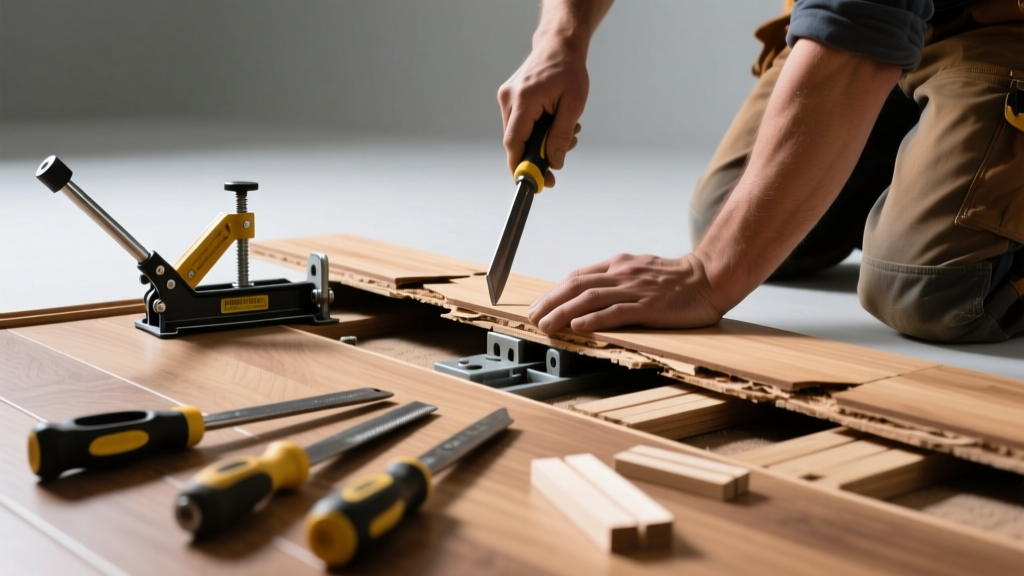
That subtle ridge running down the center of your hardwood board? It’s not supposed to be there — especially if it’s getting worse or feels uneven underfoot. Crowning happens when the center of a board rises above its edges, and when your attempted fix isn’t working, it usually means you’re treating the symptom, not the moisture imbalance causing it.
Quick Diagnosis
Crowning that persists or worsens after sanding or dehumidifying points to one (or more) underlying causes:
- Excess moisture in the subfloor — often from a hidden leak, poor vapor barrier, or concrete slab wicking
- Improper acclimation before installation (boards installed too wet or too dry)
- Humidity swings exceeding 30–50% RH for extended periods
- Board cupping misdiagnosed as crowning — check underside for concave curvature
- Subfloor deflection or joist spacing wider than 16” on-center for 3/4" solid hardwood
Tools & Materials Needed
| Item | Purpose | Estimated Cost |
|---|---|---|
| Digital moisture meter (pin-type) | Measures wood and subfloor moisture content — critical for confirming root cause | $85–$190 |
| Hygrometer with logging | Tracks indoor RH over 7+ days to spot humidity patterns | $25–$65 |
| Dehumidifier (70-pint/day) | Lowers ambient RH below 45% to reverse moisture-driven expansion | $220–$450 |
| 1/4" plywood + construction adhesive | Reinforces weak subfloor areas contributing to board flex and crowning | $28–$42 |
| Feather-edged sanding block & 120-grit paper | Light surface leveling only — never full sanding until moisture stabilizes | $12–$24 |
Step-by-Step Fix
Don’t sand first. Address moisture, then reassess. Here’s what actually works:
- Measure moisture at three levels: top surface of affected boards (target: 6–9%), underside of same boards (if accessible), and subfloor (should be ≤12% for OSB, ≤14% for plywood). According to the National Wood Flooring Association’s Technical Bulletin #2023-04, 87% of persistent crowning cases trace back to subfloor moisture >15%.
- Run a dehumidifier continuously for 10–14 days while maintaining room temperature between 65–75°F. Keep HVAC fan on ‘on’ (not ‘auto’) to improve air circulation beneath the floor.
- If subfloor moisture remains high: pull up 2–3 boards near the worst crown, inspect for mold or rot, and install a 6-mil poly vapor barrier over the subfloor before re-securing. Use ring-shank nails or cleats — never staples — for better hold-down.
- Only after moisture readings stabilize for 72 hours: use a hand-held orbital sander with 120-grit to feather the crown’s peak — no more than 1/32" removed. Stop immediately if heat builds or dust turns dark.
When to Call a Pro
DIY stops where structural risk begins:
- You find >1/8" gap between boards and subfloor when prying up an edge — indicates severe subfloor sag or joist settlement
- Mold growth or musty odor under boards — requires containment and remediation per IICRC S520 standards
- Crowning affects more than 30% of the room and coincides with recent plumbing work or roof leak
- Your moisture meter reads >19% in any wood component — beyond safe DIY drying thresholds
Prevention Tips
Hardwood floors thrive on stability — not perfection. Install and maintain accordingly:
- Use a hygrometer year-round; adjust humidifier/dehumidifier settings to keep RH between 35–50%, per NWFA guidelines
- Always acclimate solid hardwood for 5–10 days in the room where it will be installed — with boxes opened and boards stacked with 1/4" spacers
- Install 15-lb roofing felt or manufacturer-approved underlayment beneath nail-down floors to buffer minor subfloor inconsistencies
- Seal all interior concrete slabs with epoxy or acrylic sealer before installing engineered or solid hardwood
Can crowning reverse itself without sanding?
Yes — but only if moisture is corrected early. Boards with crowning under 1/16" often relax back flat within 2–4 weeks of sustained RH control and subfloor drying. Don’t rush sanding; wait until moisture readings hold steady for 72 hours.
Why did my floor crown after installing new HVAC?
New HVAC systems often run longer cycles and lower humidity — especially in winter — which can dry out boards unevenly. If your system lacks a humidistat or bypass humidifier, rapid drying shrinks the board edges faster than the center, forcing upward bowing. Add a whole-house humidifier set to 40% RH.
Is crowning covered by my hardwood warranty?
Rarely. Most warranties (e.g., Bruce, Armstrong, Mannington) exclude moisture-related movement. They require documented proof of proper acclimation, subfloor moisture ≤12%, and RH maintained between 30–50%. Check your specific warranty’s ‘exclusions’ section — not the marketing brochure.
Can I use bleach on discolored crowned areas?
No. Bleach oxidizes tannins in oak and walnut, worsening discoloration and weakening lignin. For stains under crowns, use a 50/50 white vinegar–water solution applied with a cotton swab, then blot dry. Sanding won’t fix discoloration — only refinishing will.
Will area rugs make crowning worse?
They can — especially rubber-backed rugs that trap moisture and block airflow. Use breathable, felt-backed rugs instead, and lift them weekly to inspect for dampness or discoloration underneath. The U.S. EPA estimates that 14% of household water usage is from leaks — many go unnoticed under rugs for months.
How long should I wait before refinishing after fixing crowning?
Minimum 30 days after moisture readings stabilize — and only if crowning has fully relaxed. Refinishing too soon locks in residual stress. As flooring contractor Maria Chen told Flooring Contractor Magazine (2022): “I’ve seen more callbacks from rushed refinishing than from any other single cause — including improper nailing.”
A properly fixed crown shouldn’t return — but it takes patience, not pressure. Let the wood breathe, measure twice, act once, and remember: your floor isn’t failing; it’s responding. Match your maintenance to its natural rhythm, not your renovation timeline. For related issues like hardwood floor cupping repair or subfloor moisture testing steps, see our detailed walkthroughs.