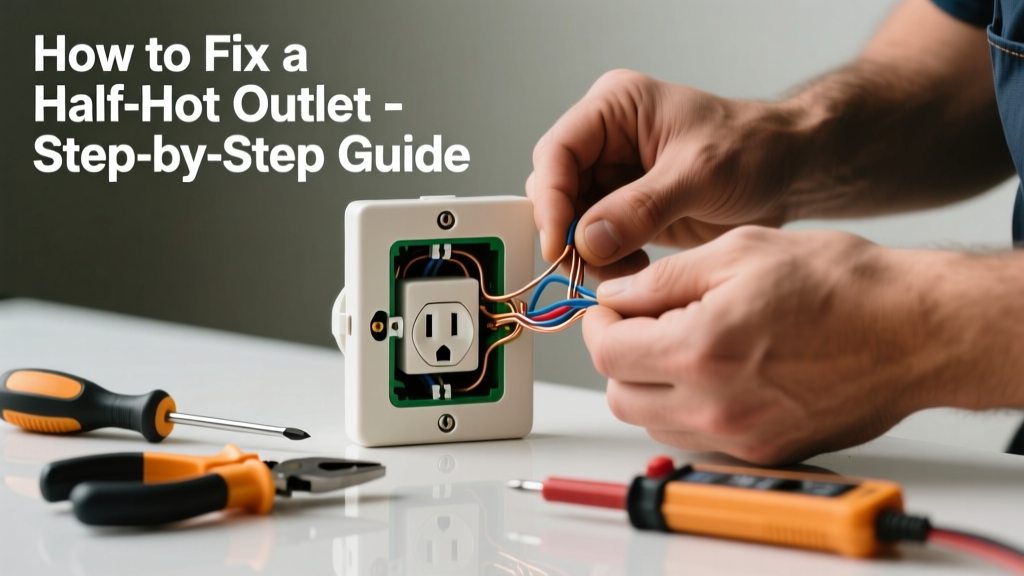
If your half-hot outlet—where one receptacle is always live and the other controlled by a wall switch—suddenly stops switching on or off, don’t assume it’s broken. This is usually a solvable wiring issue, but misdiagnosis can lead to shock risk or code violations. Most failures stem from simple mistakes made during prior installations or aging connections.
Quick Diagnosis
Before grabbing tools, eliminate obvious culprits:
- The wall switch controlling the switched half is turned off or faulty
- A tripped breaker or GFCI upstream has cut power to the circuit
- The brass tab between the two hot terminals on the outlet was accidentally broken (or left intact when it shouldn’t be)
- Loose or corroded wire connections at the outlet, switch, or junction box
- Backstabbed wires pulling loose over time—especially common in outlets installed before 2010
Tools & Materials Needed
| Item | Purpose | Estimated Cost |
|---|---|---|
| Voltage tester (non-contact or multimeter) | Confirms presence/absence of voltage at each terminal safely | $12–$45 |
| Insulated screwdrivers (flat & Phillips) | Tightens terminal screws without shorting conductors | $8–$22 |
| Wire strippers (with gauge markings) | Removes insulation cleanly without nicking copper | $10–$30 |
| New 15A or 20A duplex receptacle (specify decora or standard) | Replaces worn or damaged outlets; choose tamper-resistant if required by NEC 2020+ | $2–$8 |
| Needle-nose pliers | Bends and positions wires into side-wire terminals | $6–$15 |
Step-by-Step Fix
Work only after turning off the correct breaker and verifying no voltage at the outlet and switch with your tester. Tag the breaker to prevent accidental re-energizing.
- Check the switch first: Remove the wall switch cover plate and test for voltage across its terminals while toggling. If no voltage change occurs, the issue may be upstream—or the switch itself is failed. Replace if cracked, stiff, or shows burn marks.
- Inspect the outlet’s brass tab: For true half-hot operation, the brass (hot) tab connecting the two top/bottom brass screws must be fully removed. If intact, both outlets stay live. If broken but wires are reversed (switched hot on bottom, constant hot on top), the switched half won’t work. Use needle-nose pliers to verify clean breakage.
- Verify wire placement: Constant hot (usually black) goes to the bottom brass screw. Switched hot (often red or black with tape) goes to the top brass screw. Neutral (white) connects to silver screws—both tied together unless split-neutral wiring exists (rare in residential). Ground (bare or green) to green screw.
- Retighten all connections: Backstabbed wires should be moved to side-screw terminals. Loosen each screw, wrap wire clockwise ¾ turn, then tighten firmly. Check for nicks, corrosion, or aluminum wire (requires CO/ALR-rated device and antioxidant paste).
- Test before restoring power: With breaker still OFF, double-check that no bare copper touches adjacent terminals or box. Restore power and test both halves with a lamp or outlet tester.
When to Call a Pro
Stop immediately and contact a licensed electrician if you encounter any of these:
- Aluminum wiring anywhere in the circuit (common in homes built 1965–1973)—requires specialized connectors and torque specs
- Sparking, burning smell, or discolored outlet/switch faceplate
- Breaker trips repeatedly after repair—even with load disconnected
- No voltage at the switch box despite confirmed breaker power (suggests open neutral or hidden junction failure)
- Outlet shares a neutral with another circuit (multi-wire branch circuit), indicated by two hot wires (e.g., black + red) and one shared white—miswiring here risks 240V across devices
"Over 51% of electrical fires linked to outlets and switches stem from loose connections or improper tab removal," according to the National Fire Protection Association's Electrical Fire Trends Report, 2022.
Prevention Tips
Extend the life and safety of your half-hot setup with these habits:
- Always use side-screw terminals—not backstabs—on new outlets, especially on circuits feeding lamps or fans
- Label the controlling switch clearly (e.g., "Bedroom Outlet Top") with painter’s tape or an engraved plate
- Test outlets annually with a $5 plug-in tester like the Klein Tools RT210
- Replace outlets every 15 years—even if functional—as internal contacts fatigue and resistance rises
- Use only UL-listed tamper-resistant (TR) receptacles in bedrooms, living areas, and hallways per NEC 2020 requirements
Why does only one half of my outlet work after replacing it?
This almost always means the brass tab wasn’t fully removed—or was broken but the switched and constant hots were swapped on the terminals. Double-check tab integrity with a magnifier and confirm wire colors match your switch loop configuration. Refer to our guide on wiring a half-hot outlet correctly for color-coded diagrams.
Can I convert a half-hot outlet to always-hot?
Yes—but only if the switch loop includes a neutral (now required by NEC 2011+ for smart switches). Cap the switched hot wire with a wire nut in the outlet box and connect constant hot to both brass terminals (tab intact). However, this eliminates switch control, so consider whether a smart plug or remote-controlled lamp might better suit your need.
What if the switch controls multiple outlets but only one stopped working?
The failed outlet is likely daisy-chained downstream of a working one. Trace the cable path: power often enters the first outlet, then runs to the switch, then to additional outlets. Check connections at the last working outlet—it may have a loose pigtail or backstab failure feeding the rest.
Is it safe to use a GFCI as a half-hot outlet?
Not reliably. Standard GFCIs don’t support split-tab wiring—the test/reset buttons disable both outlets simultaneously. You’ll lose protection on the unswitched half or compromise functionality. Instead, install a GFCI breaker for the entire circuit or use a GFCI-protected always-hot outlet upstream, then wire the half-hot downstream normally.
How do I know if my outlet is wired as half-hot versus a switched outlet?
A true half-hot has one always-live receptacle and one switched one—both on the same yoke. A switched outlet means both top and bottom are controlled by the same switch. Test with a lamp: plug into each slot separately while flipping the switch. If only one works with the switch, it’s half-hot. If both go on/off together, it’s fully switched—and likely wired with the tab intact and switched hot on both brass screws.
Do LED bulbs affect half-hot outlet performance?
No—but low-wattage LEDs can make it harder to detect subtle issues. A failing switch or weak connection may cause flickering or delayed response with LEDs, while incandescents would simply go dark. Use a multimeter to verify consistent 115–125V at the switched terminal when the switch is on.
A properly functioning half-hot outlet balances convenience and control—until one half stops cooperating. Most fixes take under 30 minutes and cost less than $20 in parts, but rushing through verification steps risks bigger problems down the line. If your outlet feels warm, buzzes, or trips AFCI breakers intermittently, skip the DIY and call a licensed electrician. For related help, see our guides on troubleshooting flickering lights and replacing a GFCI outlet.