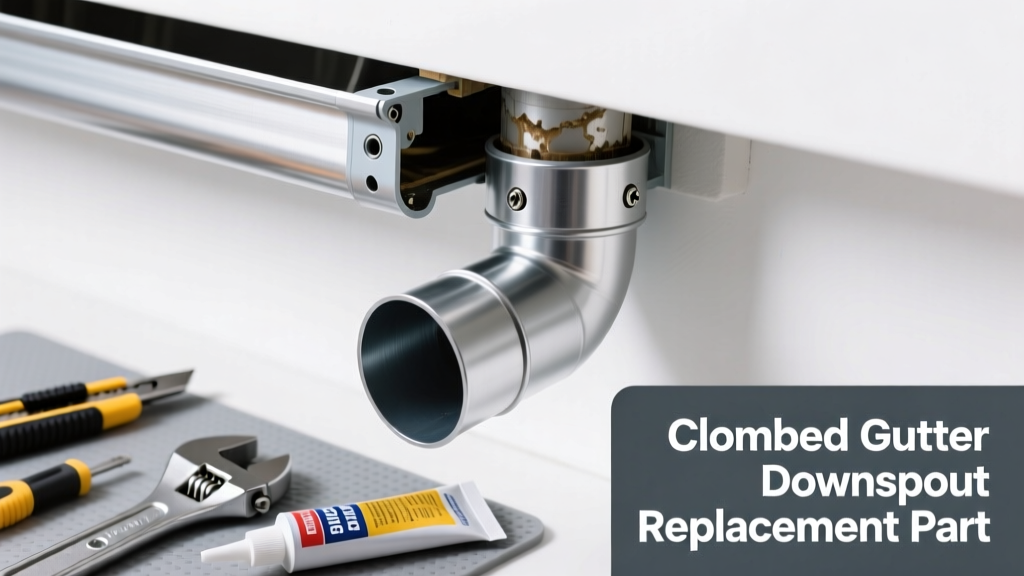
That gurgle-and-gush sound when it rains? That puddle pooling beside your foundation? Your downspout isn’t just clogged—it’s likely got a cracked, rusted, or detached section begging to be swapped out. Replacing just the damaged part—not the whole run—is faster, cheaper, and more sustainable than a full system overhaul.
Quick Diagnosis
Before grabbing tools, confirm the issue isn’t just debris. A clog that won’t clear with a plumber’s snake or garden hose often points to structural failure in the downspout itself. Here are the top culprits:
- Corrosion holes or splits in aluminum or galvanized steel downspouts (especially near elbows or seams)
- Cracked or brittle PVC sections—common in older installations exposed to UV or freeze-thaw cycles
- Loose or separated coupling joints where sections connect, allowing water to leak instead of flow
- Collapsed or dented sections from ladder impact or ice weight
- Improper slope causing chronic sediment buildup behind a warped segment
Tools & Materials Needed
| Item | Purpose | Estimated Cost |
|---|---|---|
| 10-ft extension ladder (Type IA, 300-lb rating) | Safe access to roofline and downspout height; non-conductive for overhead power line safety | $180–$250 |
| Downspout snips or aviation shears | Cut aluminum or steel downspout cleanly without burrs or distortion | $12–$22 |
| Replacement downspout section (4” round or 3”x4” rectangular) | Match existing material, size, and profile—verify length (typically 10 ft sold by the foot) | $8–$16/ft |
| Downspout connectors (male/female slip couplings or band clamps) | Secure new section to existing pipe; band clamps work best on corroded or uneven ends | $3–$9 each |
| Butyl rubber sealant (e.g., OSI Quad Max) | Waterproof joint sealant rated for exterior metal/PVC use; lasts 20+ years | $7–$11/tube |
Step-by-Step Fix
Work from the bottom up—start at the lowest point of failure. Always wear cut-resistant gloves and safety glasses.
- Shut off and inspect: Clear visible debris first. Then trace water backup upward until you spot dripping, bulging, or discoloration—mark both ends of the damaged zone with masking tape.
- Cut out the bad section: Use downspout snips to make two clean, perpendicular cuts—one inch beyond each tape mark. Remove the damaged piece and lightly file sharp edges.
- Measure and cut replacement: Hold the new section against the gap. Account for overlap: subtract 1.5” for slip couplings or add 0.5” for band clamp coverage. Cut precisely with snips.
- Install and seal: Slide couplings onto both ends of the new section. Insert into upper and lower pipes, hand-tighten couplings, then apply butyl sealant around all three joints. Tighten band clamps with a screwdriver until snug—not overtightened.
- Test thoroughly: Run a garden hose at the top of the downspout for 3 minutes. Watch for leaks at every joint and along the seam. Re-seal if needed.
When to Call a Pro
Some situations demand licensed expertise—not just for safety, but code compliance and long-term performance:
- You’re working on a multi-story home (>25 ft high) without fall arrest gear or OSHA-compliant anchorage
- The downspout connects directly to an underground drainage tile system—misalignment can flood basements
- Corrosion extends into the gutter outlet or roof flashing, indicating hidden roof deck rot
- Your home has historic or architecturally unique gutters (e.g., copper half-rounds with soldered seams)
- You’ve replaced the same section twice in under 18 months—signaling improper pitch or persistent debris source
Prevention Tips
Replacing one section is smart—but stopping repeat failures saves bigger headaches later. Focus on root causes, not just symptoms:
- Install leaf guards on gutters before next fall—they reduce debris volume by up to 85% (National Association of Home Builders, 2022)
- Check downspout pitch quarterly: it should drop ¼” per 10 ft of run. Use a laser level or string line to verify
- Clear splash blocks and extenders annually—clogged extensions force water back into the downspout base
- Replace galvanized steel downspouts with aluminum or vinyl after 15 years—corrosion accelerates past that point (U.S. Department of Housing and Urban Development, 2021)
Can I glue PVC downspout sections instead of using couplings?
No—standard PVC cement creates a permanent bond that prevents future disassembly for cleaning or repair. It also fails under thermal expansion stress in outdoor applications. Use solvent-weld primer and cement only if replacing the entire run with new PVC. For repairs, stick with slip couplings and butyl sealant.
How do I know if my downspout is aluminum or galvanized steel?
Scratch an inconspicuous area with a key: aluminum leaves a bright silver streak and feels softer; galvanized steel shows dull gray metal underneath and resists scratching more. Aluminum is non-magnetic; steel attracts a magnet. Most homes built after 1990 use aluminum.
Is it safe to use a pressure washer to clear a clog before replacement?
Only at low pressure (<1,200 PSI) and with a wide-angle tip—aiming upward from the bottom. High-pressure water can blow apart aged couplings or crack brittle PVC. According to the Insurance Institute for Business & Home Safety's 2023 report, 62% of DIY pressure-washer downspout attempts result in collateral damage to fascia or soffit.
"Most 'clogs' aren't blockages—they're failed joints. If water sprays sideways 3 feet up the pipe, you've got a separation, not a leaf jam." — Mike R., 28-year gutter installer, GutterPro Alliance
Do I need to paint the new downspout section to match?
Only if aesthetics matter and your original is painted. Bare aluminum naturally weathers to a uniform matte gray in 6–12 months. If matching is critical, use acrylic latex paint rated for metal—never oil-based, which peels in UV exposure.
What’s the average lifespan of a downspout section?
Aluminum lasts 20–30 years with basic maintenance; galvanized steel 15–20 years; PVC 25–40 years. But localized damage (impact, corrosion, poor pitch) often forces earlier replacement. The U.S. EPA estimates that 14% of household water usage is from leaks—including those originating in faulty downspouts.
A well-replaced downspout section shouldn’t need touching again for a decade—if you keep gutters clear and check connections twice yearly. And remember: that puddle by your foundation isn’t just unsightly—it’s the first sign of potential soil erosion or basement seepage. Fix it right, and you’ll protect more than just your gutters.