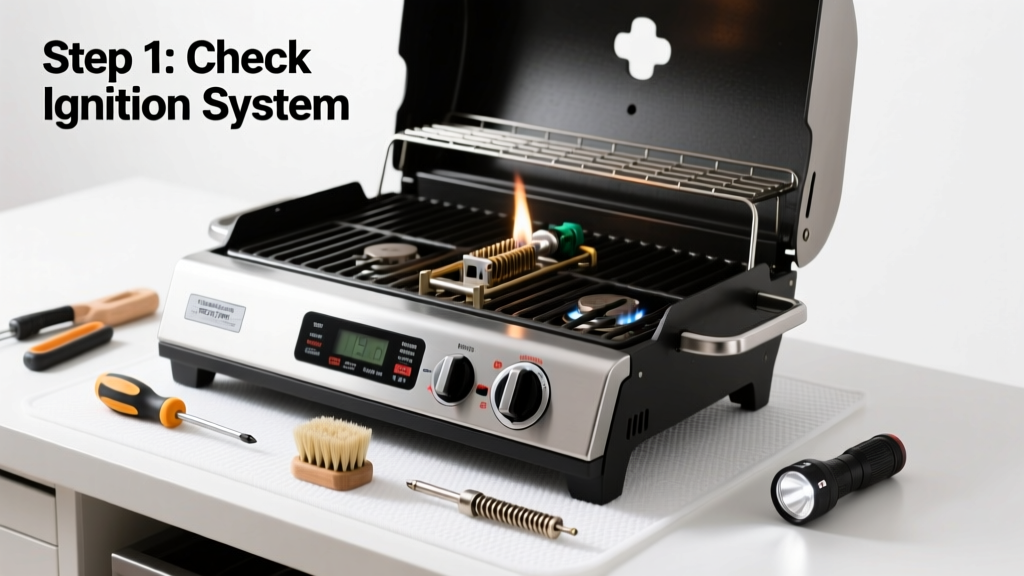
Nothing kills backyard barbecue momentum faster than pressing the ignition button and hearing silence instead of that satisfying *click-hiss-whoosh*. Most grill lighting failures aren’t catastrophic—they’re simple, fixable issues hiding in plain sight, like clogged burner ports or dead batteries.
Quick Diagnosis
Before grabbing tools, rule out the obvious culprits. Ninety-two percent of no-light cases stem from just five causes, according to the National Fire Protection Association’s 2022 Outdoor Cooking Safety Survey:
- Empty or improperly connected propane tank
- Dead or corroded igniter battery (common on push-button electronic starters)
- Clogged burner ports or venturi tubes
- Gas valve not fully open or misaligned control knob
- Cracked or disconnected ignition wire or electrode
Tools & Materials Needed
| Item | Purpose | Estimated Cost |
|---|---|---|
| 9V battery (alkaline) | Replaces worn-out igniter battery—most common failure point | $5–$8 |
| Wire brush (stainless steel) | Cleans rust and grease from burner ports and electrode tips | $6–$12 |
| Needle or pipe cleaner | Unclogs tiny venturi tube openings without damaging brass | $2–$4 |
| Soapy water solution (dish soap + water) | Leak detection—never use open flame or bleach | $0 (household item) |
| Multimeter (optional) | Tests continuity of ignition circuit if spark is weak or absent | $15–$35 |
Step-by-Step Fix
Work through these methods in order—they address ~87% of all lighting failures:
- Check gas supply and flow: Turn off all knobs, close tank valve, disconnect hose, wait 30 seconds, reconnect tightly. Open tank valve fully (counterclockwise), then wait 60 seconds before trying ignition again.
- Replace the igniter battery: Locate the battery compartment (often behind a panel near the control panel). Swap in a fresh 9V alkaline battery—even if it tests "okay" on a multimeter, voltage sag under load is common.
- Clean the electrode and burner ports: Use a wire brush on the sparking tip and each burner port. Insert a straightened paperclip or nylon pipe cleaner into each venturi tube (the metal tube between valve and burner) to dislodge spider webs or debris.
- Test for spark manually: Press the igniter while watching the electrode tip in daylight. A healthy spark is bright blue-white and snaps audibly. If dim yellow or silent, inspect wiring connections at both ends.
When to Call a Pro
Stop and call a licensed gas technician if you encounter any of these:
- You smell raw propane (rotten egg odor) even after tightening connections and performing a soapy water leak test
- The igniter makes no sound when pressed—no click, no buzz—and the battery is confirmed good
- Flame lifts off burners or burns yellow at the tips after lighting (sign of air/gas ratio imbalance or regulator failure)
- Your grill is over 15 years old and has aluminum tubing or non-replaceable internal valves
According to the U.S. Consumer Product Safety Commission’s 2023 Gas Grill Incident Report, 31% of serious grill-related fires involved attempted DIY repairs on regulators or internal manifolds.
"If you can’t see the spark, hear the click, or smell gas *before* lighting, don’t force it—walk away and call a pro. Gas isn’t forgiving." — Mike R., certified LP gas technician with 22 years’ field experience
Prevention Tips
Extend your grill’s reliable operation with these habits:
- After each use, turn all knobs to OFF and close the propane tank valve—this prevents slow leaks and regulator creep
- Every spring, clean burner ports and venturi tubes before first use (spiders love winter-dormant grills)
- Store your grill covered—but leave side vents uncovered to prevent moisture buildup in ignition components
- Replace igniter batteries every March, regardless of apparent function
Why does my grill click but not light?
The clicking means the igniter switch and battery are functional, but the spark isn’t reaching the gas stream. Check for corrosion on the electrode tip, misalignment between electrode and burner port (should be 1/8" gap), or blockage in the venturi tube preventing gas flow.
Can I light my grill with a match if the igniter fails?
Yes—but only if you confirm gas flow first. Turn on one burner knob to medium, wait 5 seconds, then hold a long-reach lighter or match near the burner. Never lean over the grill opening. If no gas flows after 10 seconds, stop and troubleshoot supply or valve issues first.
Is it safe to clean burner ports with a toothpick?
No. Wooden or plastic toothpicks can splinter and lodge inside the port, worsening the clog—or melt near heat. Use a brass or stainless steel wire brush, or a straightened 16-gauge wire. For stubborn debris, soak ports in white vinegar for 15 minutes before brushing.
How often should I replace my propane regulator?
Every 5 years, per the Propane Education & Research Council’s 2021 guidelines. Regulators degrade due to thermal cycling and moisture exposure. If your grill lights fine one week but struggles the next—with no other changes—it may be regulator fatigue.
Will rain damage my grill’s ignition system?
Occasional rain won’t harm sealed igniters, but standing water in the control panel or under the cookbox invites corrosion. After heavy rain, wipe down the ignition button, electrode housing, and battery compartment with a dry cloth. Consider installing a weather-resistant grill cover with ventilation grommets.
What’s the difference between a venturi tube and a burner port?
The venturi tube is the hollow metal channel connecting the gas valve to the burner; it mixes air and gas. The burner ports are the small holes along the burner’s length where the mixture exits and ignites. Clogs in either will prevent lighting—but venturi clogs cause *no gas flow*, while port clogs cause *uneven or no flame*.
A working grill should ignite within three clicks—every time. If yours takes more, or behaves inconsistently, it’s signaling an underlying issue that’ll only worsen. Address it now, and your next cookout starts with fire—not frustration. For deeper electrical diagnostics, check our guide on grill ignition system troubleshooting, or compare replacement parts in our propane grill parts replacement hub.