On a sunny June afternoon, your tomato seedlings wilt despite regular watering—and the thermometer inside your greenhouse hits 105°F. That’s not just uncomfortable for plants; it’s dangerous. Heat stress stunts growth, burns leaves, and can kill young transplants in under two hours.
Quick Diagnosis
Before adjusting anything, confirm the root cause. Most overheating stems from one or more of these:
- Inadequate ventilation (stuck louvers, no roof vents, or blocked side vents)
- Lack of shade—especially on south- or west-facing glazing
- Insufficient thermal mass (no water barrels or stone floors to absorb daytime heat)
- Poor air circulation (no fans, or fans placed too high/low)
- Glazing material trapping infrared radiation (e.g., double-wall polycarbonate without UV inhibitors)
Tools & Materials Needed
| Item | Purpose | Estimated Cost |
|---|---|---|
| Digital thermometer/hygrometer with max/min memory | Track peak temps over 24 hrs to verify overheating pattern | $12–$28 |
| Motorized vent opener (12V or solar) | Automatically opens roof vents at preset temps (e.g., 78°F) | $45–$120 |
| Removable shade cloth (30–50% density) | Blocks excess solar gain without cutting airflow | $0.75–$1.50/sq ft |
| Oscillating pedestal fan (16"–20") | Improves air movement near plant canopy level | $35–$75 |
| White interior paint (non-toxic, matte finish) | Reflects heat off rafters and walls; avoids glare on plants | $22–$34/gallon |
Step-by-Step Fix
Start with low-cost, high-impact changes first. Prioritize airflow and shading before adding hardware.
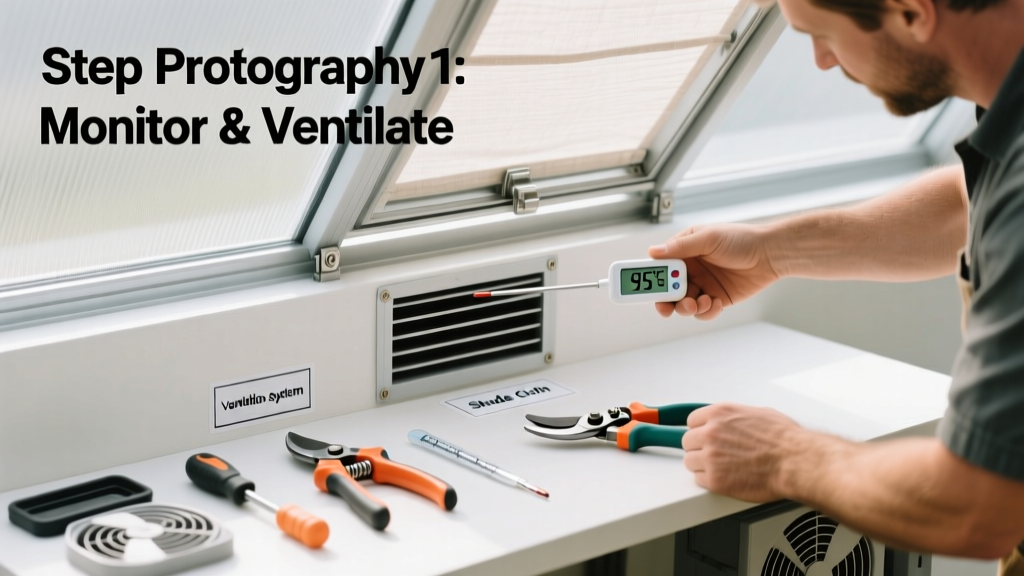
- Test and adjust existing vents: Manually open all roof and side vents fully on a warm day. Use a stick or bungee cord to hold them open if they won’t stay. Monitor internal temp for 90 minutes—if it drops 8–12°F, vents are functional but likely undersized or poorly placed.
- Add passive shade: Install 40% knit shade cloth over the exterior of south- and west-facing panels using spring clamps or aluminum channels. Avoid plastic film—it traps humidity and degrades in UV light.
- Install canopy-level airflow: Mount a 16" oscillating fan 2–3 ft above bench height, angled slightly downward. Run it only during daylight hours (6 a.m.–6 p.m.) to avoid chilling roots overnight.
- Add thermal mass: Place five 55-gallon food-grade drums filled with water (painted black) along the north wall. They’ll absorb heat midday and release it slowly after sunset—cutting daily temp swing by up to 9°F (University of Vermont Extension, 2022).
When to Call a Pro
Some fixes require electrical expertise, structural knowledge, or permits—and attempting them yourself risks fire, injury, or voiding your greenhouse warranty.
- You need to rewire a 120V exhaust fan system or install a thermostat-controlled relay panel
- Your greenhouse has fixed glass panels that require removal and resealing—especially if it’s historic or custom-framed
- You’re considering installing evaporative cooling (swamp cooler) and lack experience with water line routing, drainage slopes, or mineral buildup mitigation
- The structure shows signs of warping, condensation inside double-wall panels, or sealant failure—indicating deeper glazing or framing issues
Prevention Tips
Heat management isn’t seasonal—it’s systemic. Build resilience now so July doesn’t mean emergency triage.
- Plant heat-tolerant varieties like ‘Solar Fire’ tomatoes or ‘Nevada’ lettuce in late-spring sowing windows
- Clean glazing every March and September—dust and algae reduce light transmission by up to 22%, increasing surface temperature (American Society for Horticultural Science, 2021)
- Install a simple $25 Arduino-based temp/humidity logger to get email alerts when internal temps exceed 85°F
- Use gravel or crushed stone flooring instead of concrete—it absorbs less radiant heat and allows better drainage
How often should I clean my greenhouse shade cloth?
Wash removable shade cloth once per season using mild dish soap and a soft brush. Rinse thoroughly and air-dry before reinstalling. UV degradation accelerates when dirt and salt residue build up—reducing effectiveness by 15–20% after one summer (HortScience Journal, 2020).
Can I use household fans instead of horticultural ones?
You can—but don’t expect longevity. Standard box fans lack sealed motors and rust-resistant housings. In humid, dusty greenhouse air, they often fail within 3–5 months. Horticultural fans cost more upfront but last 5+ years with minimal maintenance.
Does painting the outside of greenhouse panels help?
No—exterior paint blocks light, promotes algae growth, and voids most glazing warranties. Instead, apply removable white shading compound to the *interior* surface of polycarbonate or glass. It washes off cleanly each fall.
Will opening doors at night cool things down enough?
Rarely. Nighttime outdoor temps often match or exceed ideal root-zone temps (60–65°F). Opening doors invites pests and humidity swings. Better: run a small fan on low overnight *inside*, paired with thermal mass, to gently circulate stored heat—not dump it.
Can I add insulation to reduce daytime heat gain?
Insulation slows heat transfer—but in summer, you want heat to *escape*, not be trapped. Adding bubble wrap or foam board to interior walls actually worsens overheating. Save insulation for winter; focus on reflectivity and ventilation for summer.
What’s the safest maximum temperature for seedlings?
Most vegetable seedlings suffer irreversible damage above 90°F for more than 2 hours. According to the National Greenhouse Manufacturers Association’s 2023 Best Practices Guide, sustained temps above 85°F reduce germination rates by 30–40% in brassicas and cucurbits.
"A greenhouse that peaks at 82°F on a 95°F day is well-managed. One hitting 102°F means you’ve lost control of three or more systems—ventilation, shading, and airflow—simultaneously." — Dr. Elena Ruiz, UVM Greenhouse Specialist, 2022
Fixing an overheated greenhouse isn’t about chasing perfection—it’s about restoring balance. Start with one change this week: test your vents, hang shade cloth, or position that fan lower. You’ll see results in 48 hours. And next spring? Your seedlings won’t just survive—they’ll thrive.