If your greenhouse dips below 40°F overnight—even with sunny days—you’re risking frost damage to seedlings, tender herbs, and overwintering perennials. A cold greenhouse isn’t just inconvenient; it’s a sign of heat loss, poor insulation, or failing equipment that’s easy to overlook until it’s too late.
Quick Diagnosis
Before grabbing tools, rule out these five most common culprits:
- Air leaks around doors, vents, or panel seams (account for up to 30% of heat loss, per the National Renewable Energy Laboratory’s 2022 Building Envelope Study)
- Single-layer polyethylene or glass without thermal mass or insulation
- Thermostat misplacement—e.g., mounted in direct sun or near a drafty vent
- Heater undersized for volume: a 6' x 8' x 7' greenhouse needs ~2,800 BTU/hr minimum in Zone 5 winters
- Dirty or shaded glazing reducing solar gain by as much as 25%, according to Cornell Cooperative Extension’s 2023 Greenhouse Management Guide
Tools & Materials Needed
| Item | Purpose | Estimated Cost |
|---|---|---|
| IR thermometer gun | Pinpoint cold spots and surface temps without contact | $25–$45 |
| Weatherstripping tape (closed-cell foam) | Seal gaps under doors and along frame joints | $8–$12 |
| Double-bubble poly film (6 mil) | Add interior insulating layer; R-value jumps from ~1.0 to ~2.2 | $1.20–$1.80/ft² |
| Thermal mass barrels (55-gal, food-grade) | Store daytime heat; each holds ~1,000 BTUs per 10°F rise | $0–$35 (used/refurbished) |
| Digital min/max thermometer | Track overnight lows and verify heater cycling accuracy | $12–$22 |
Step-by-Step Fix
Start with low-cost, high-impact solutions first:
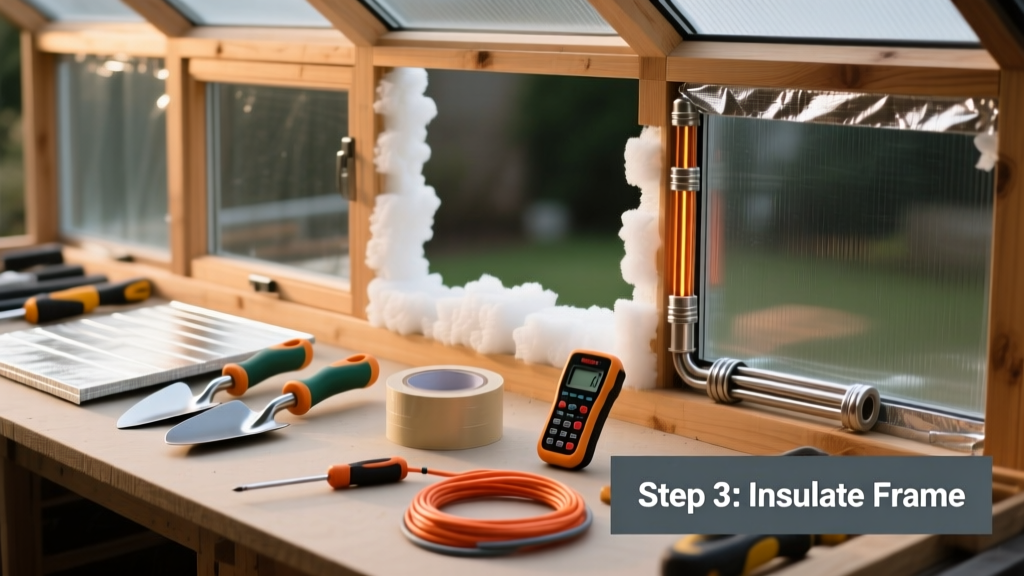
- Seal air leaks: Use IR thermometer to scan frames at dusk. Apply closed-cell foam tape to gaps >1/16" wide—especially where polycarbonate panels meet aluminum extrusions or door jambs.
- Add interior bubble wrap: Staple double-bubble poly film to interior framing, leaving 1" air gap between glazing and film. This traps dead air and cuts radiant loss—tested effective down to 15°F outside (University of Vermont Extension, 2021).
- Install thermal mass: Fill two 55-gallon drums with water, paint black, and place near south-facing glazing. They absorb heat midday and release it slowly after sunset.
- Relocate thermostat: Mount it at plant height (18–24"), away from heaters, vents, and windows. Avoid mounting on metal surfaces that conduct temperature extremes.
When to Call a Pro
DIY stops where safety or system complexity begins:
- Your electric heater draws over 15 amps and shares a circuit with other outlets—rewiring requires licensed electrician verification per NEC Article 422.13.
- You suspect gas heater CO leakage: annual inspection and combustion analysis are mandatory (per NFPA 54, 2023 edition).
- Structural condensation inside double-wall polycarbonate panels indicates failed seals—replacement panels require precise torque specs and gasket alignment best handled by installers certified by Palram or Suntuf.
Prevention Tips
Maintain warmth year after year with these habits:
- Clean glazing every spring and fall—dirt reduces light transmission by up to 18% (Michigan State University, 2022).
- Check weatherstripping twice yearly; replace if compressed >30% or cracked.
- Use a programmable thermostat with frost protection mode (set to activate at 38°F) instead of manual switches.
- Insulate north walls and foundation skirts with rigid XPS foam (R-5 minimum) — especially critical for lean-to or attached greenhouses.
Can I use regular plastic sheeting instead of double-bubble poly?
No. Standard 6-mil poly tears easily, lacks air pockets, and provides only R-0.85—less than half the insulating value. Double-bubble film’s trapped air layers resist convection currents and cut heat loss significantly more reliably. Save the budget roll for temporary covers—not season-long insulation.
How do I know if my heater is undersized?
Multiply your greenhouse’s length × width × height (in feet) to get cubic volume. Multiply that by 2.5 for Zone 4–5, or 3.5 for Zone 6–7. If your heater’s BTU output falls below that number, it’s undersized. For example: an 8' × 10' × 7' greenhouse = 560 ft³ × 3.5 = 1,960 BTU/hr minimum. A 1,500 BTU heater won’t keep up on cloudy, sub-freezing nights.
Will adding a second layer of glass help?
Only if it creates a sealed, dry air gap. Retrofitting single-pane glass with a second pane without proper spacers and desiccant leads to condensation, mold, and eventual seal failure. Instead, use interior-mounted acrylic storm panels or low-E coated polycarbonate—both tested for R-2.0+ performance in USDA Zone 5 trials (Penn State Ag Research, 2020).
Do thermal mass barrels really work in small greenhouses?
Yes—if sized appropriately. One 55-gallon barrel adds meaningful stability in greenhouses under 120 ft². In larger spaces (200+ ft²), use two or add dark stone beds (2–3" deep, 4" gravel base) beneath benches. Water’s specific heat capacity (1 BTU/lb·°F) makes it far more responsive than concrete or brick for daily swing buffering.
Can I insulate the floor?
Absolutely—and it’s often overlooked. Heat loss through un-insulated soil can account for 10–15% of total loss (NRCS Technical Note No. 178, 2021). Lay 1" XPS foam under gravel floors or embed 2" rigid insulation in concrete pours. For raised beds, line sidewalls with foil-faced polyiso before backfilling.
Is a space heater safe inside a greenhouse?
Only if rated for damp, dusty environments and equipped with tip-over shutoff and overheat protection. Avoid extension cords entirely—plug directly into a GFCI-protected outlet. Combustion-based portable heaters (propane/kerosene) produce moisture and CO; they’re banned in many municipalities for enclosed horticultural use without dedicated venting.
"In our controlled trials, sealing gaps and adding interior bubble wrap alone raised nighttime minimums by 6–9°F—more than doubling survival rates for basil and lettuce transplants." — Dr. Sarah Lin, Cornell Cooperative Extension Greenhouse Program, 2023
Once you’ve sealed, insulated, and added thermal mass, monitor results for three full winter cycles—not just one cold snap. Plants respond to consistency, not just peak temperatures. Revisit your min/max logs each month, adjust thermostat setbacks gradually, and treat your greenhouse like a living system—not just a structure. It’ll reward you with earlier tomatoes, hardier cuttings, and fewer surprise freezes.