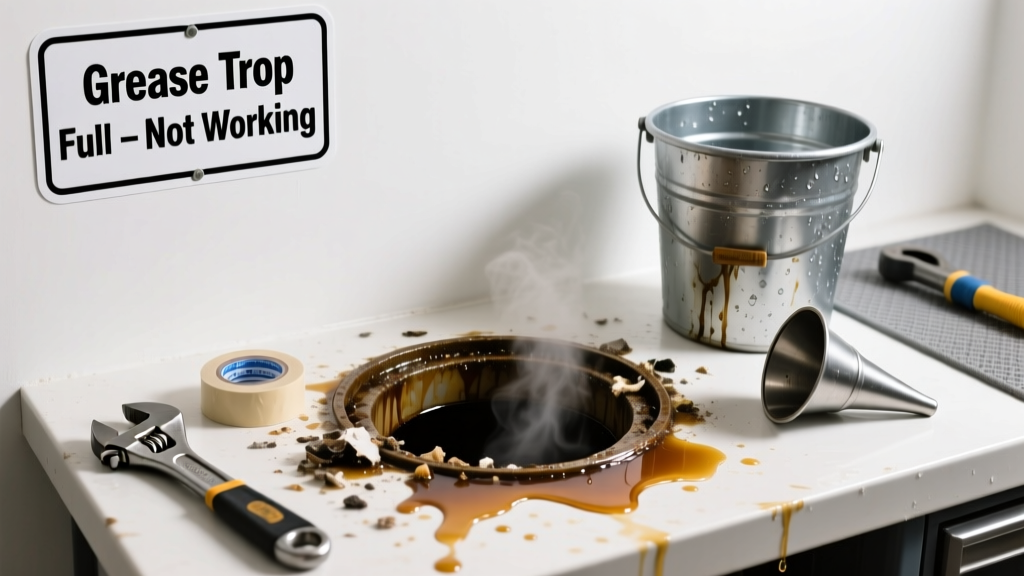
If your kitchen sink drains slowly, gurgles, or emits a sour odor — especially in a commercial kitchen or older home with a septic system — your grease trap is likely full and failing. Ignoring it risks sewer backups, health code violations, and costly damage. This guide walks you through real-world fixes that work, not just theory.
Quick Diagnosis
Before grabbing tools, confirm the issue isn’t misdiagnosed. A full grease trap often mimics other plumbing problems — but these signs point directly to grease trap failure:
- Slow or stopped drainage in sinks, dishwashers, or floor drains connected to the trap
- Foul, rancid odor near the trap access point or downstream pipes
- Oily sheen or visible grease in standing water around cleanout ports
- Overflow from the outlet pipe or manhole cover during or after heavy use
- Water backing up into secondary fixtures (e.g., mop sink when dishwasher runs)
Tools & Materials Needed
| Item | Purpose | Estimated Cost |
|---|---|---|
| Heavy-duty rubber gloves (nitrile + cut-resistant liner) | Protects hands from biohazards and sharp debris during manual cleaning | $12–$25 |
| Grease trap pump (portable diaphragm or vacuum type) | Removes liquefied FOG (fats, oils, grease) and sludge without breaking containment | $280–$650 (rental: $95/day) |
| Stainless steel scraper & stiff-bristled brush | Cleans hardened grease buildup on baffles and interior walls | $18–$42 |
| pH test strips (4.5–7.5 range) | Verifies if bacterial activity is low — indicating need for enzyme treatment | $8–$15 |
| Food-grade enzymatic grease trap treatment | Restores microbial balance to break down residual FOG between pump-outs | $22–$38 per 1-gallon container |
Step-by-Step Fix
Start with the least invasive method and escalate only if needed. Never use caustic drain cleaners — they damage traps and violate EPA regulations.
- Shut off all water sources feeding the trap (dishwasher, prep sinks, pot-wash stations) and post a "Out of Service" sign if commercial.
- Inspect inlet and outlet baffles for cracks, warping, or grease-clogged slots using a flashlight and mirror. Replace damaged baffles before pumping — a cracked baffle lets solids bypass separation.
- Pump the trap completely using a certified vacuum truck or portable pump. Remove both floating grease layer (FOG) and settled solids (sludge). The U.S. EPA estimates that 14% of household water usage is from leaks — but in kitchens, undetected grease trap overflow accounts for over 30% of preventable sewer line blockages (EPA Wastewater Management Report, 2022).
- Scrape and scrub interior surfaces, focusing on baffles, sidewalls, and the bottom slope. Use hot water (not boiling) and food-grade degreaser — never solvents or pressure washers inside the tank.
- Reintroduce beneficial bacteria with an enzymatic treatment dosed per manufacturer instructions. Wait 24 hours before resuming normal operation.
When to Call a Pro
Some situations require licensed expertise — not because you’re incapable, but because safety, code compliance, or liability is at stake:
- The trap is located under a concrete slab or beneath a walk-in cooler — excavation risk requires permits and structural assessment
- You detect hydrogen sulfide (rotten egg smell) above 10 ppm — this gas is toxic and flammable; OSHA mandates ventilation and air monitoring
- Local health department has flagged your establishment for repeated violations — fines start at $500 per incident in most municipalities
- Drain lines downstream show root intrusion or collapsed PVC — confirmed via camera inspection
"Over 68% of grease trap failures stem from inconsistent maintenance, not equipment age. A trap pumped every 90 days lasts 12–15 years. Pumped every 6 months? Average lifespan drops to 7 years." — National Restaurant Association Facility Maintenance Benchmark, 2023
Prevention Tips
Prevention isn’t about doing less — it’s about doing smarter. These habits reduce pump frequency by 40–60% according to Cornell Cooperative Extension’s 2021 Food Service Waste Study:
- Scrape all food waste into trash *before* rinsing dishes — even small amounts of rice or mashed potatoes solidify in traps
- Install pre-rinse spray valves with flow restrictors (max 1.6 GPM) to limit water temperature and volume entering the trap
- Keep a logbook: record dates of pump-outs, observed FOG depth, and any odors or backups — review quarterly
- Train staff to recognize early warning signs (e.g., slow drain = immediate scrape-and-wipe protocol)
Can I use bleach on this?
No. Bleach kills the beneficial bacteria essential for breaking down organic waste in the trap. It also reacts with grease to form soap scum that clogs baffles and reduces retention time. Instead, use a food-safe enzymatic cleaner like Bio-Clean Grease Trap Formula.
How often should I pump my grease trap?
Commercial kitchens: every 30–90 days, depending on volume. A 750-gallon trap serving 3 meals/day for 120 covers needs pumping every 45 days on average. Residential units (rare but found in rural homes with septic) typically need service every 6–12 months — but check your local code; some counties require quarterly inspections.
Why does my trap smell even after pumping?
Residual biofilm on baffles or stagnant water in the outlet pipe is the usual culprit. Flush the outlet line with 5 gallons of warm water mixed with 1 cup of baking soda and ½ cup white vinegar. Let sit 20 minutes, then flush with hot water. If odor persists, inspect for cross-connections with floor drains or vent stack obstructions — see our sewer gas troubleshooting guide.
Can I install a smaller trap to reduce maintenance?
No — undersizing violates plumbing codes (IPC 1002.3) and invites frequent overflow. Traps are sized by flow rate (gallons per minute), not convenience. A too-small unit fills in hours instead of days, causing immediate backups and potential fines.
Is there a DIY way to measure grease depth?
Yes. Use a clean 5-foot wooden dowel marked at 1-inch intervals. Insert vertically into the inlet side until it hits the bottom, then pull out and measure the grease-coated portion. If FOG layer exceeds 25% of total depth (e.g., >6 inches in a 24-inch-deep trap), pump immediately. Record measurements monthly.
What’s the difference between a grease interceptor and grease trap?
Grease traps are smaller (typically <50 gallons), installed indoors under sinks, and rely on gravity and cooling to separate FOG. Grease interceptors are larger (500–2000+ gallons), buried outdoors, and use longer retention times and baffling. Both fail similarly when overloaded — but interceptors require vacuum truck service, not portable pumps.
Fixing a full grease trap isn’t glamorous work — but it’s one of the highest-impact maintenance tasks for any food-service operation or older home. Done right, it prevents thousands in emergency plumbing calls and keeps your space compliant, odor-free, and functional. Pair these steps with consistent staff training and scheduled servicing, and you’ll rarely face this problem again. For ongoing support, refer to our commercial kitchen plumbing checklist or septic vs. grease trap comparison guide.