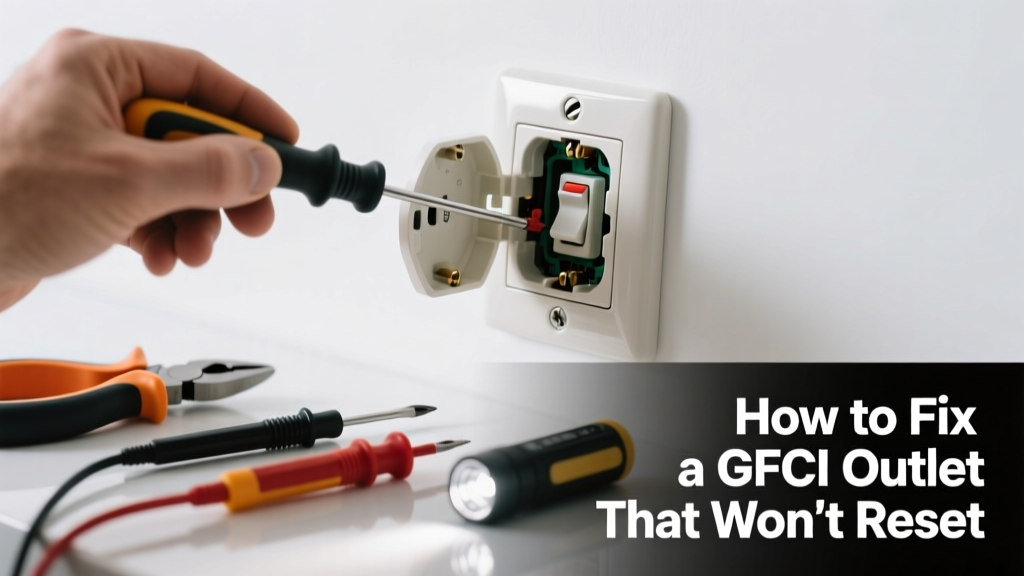
If your GFCI outlet refuses to reset—clicking but not staying on, or not clicking at all—it’s not just an inconvenience; it’s a warning sign. These devices protect against ground faults that can cause shock or fire, so ignoring the issue puts your home and family at risk. Most of the time, the fix is simple and takes under 15 minutes—but only if you know where to look.
Quick Diagnosis
Before grabbing tools, eliminate obvious causes. A GFCI won’t reset if:
- It’s tripped due to an actual ground fault downstream (e.g., a faulty appliance or wet wiring)
- There’s no power feeding the GFCI—check the circuit breaker and upstream GFCIs
- The outlet is damaged internally (common after repeated moisture exposure or age over 10 years)
- A neutral and hot wire are reversed or loose in the line-side terminals
- It’s installed on an ungrounded (two-wire) circuit without proper labeling
Tools & Materials Needed
| Item | Purpose | Estimated Cost |
|---|---|---|
| Voltage tester (non-contact) | Confirms power is present at the outlet and breaker | $12–$25 |
| Outlet tester (3-light) | Detects open ground, reverse polarity, or open neutral | $8–$15 |
| Small flathead screwdriver | Depressing test/reset buttons and securing terminal screws | $3–$7 |
| New GFCI outlet (15A or 20A) | Replacement if internal mechanism is failed | $14–$22 |
| Wire strippers | Cleaning and re-stripping wires for secure connections | $10–$18 |
Step-by-Step Fix
- Turn off power at the breaker—verify with a non-contact voltage tester at both the GFCI and the breaker panel. Never skip this step.
- Press the RESET button firmly while holding it for 3 seconds. If it clicks but pops back out immediately, there’s likely a persistent ground fault downstream—unplug everything on the same circuit and try again.
- Check for upstream GFCIs—kitchens, bathrooms, garages, and basements often share circuits. A tripped GFCI upstream will cut power to downstream outlets, making them appear dead and unresettable.
- Inspect wiring connections—remove the outlet, verify line vs. load wires are on correct terminals, and check for burnt insulation, corrosion, or loose neutrals (a leading cause of nuisance tripping).
- Replace the GFCI if it’s older than 10 years or shows discoloration, cracking, or fails continuity tests. According to the National Electrical Manufacturers Association (NEMA), 25% of GFCIs older than 12 years fail internal self-test functions without visible signs (NEMA WD 6-2022).
When to Call a Pro
Call a licensed electrician immediately if:
- You measure voltage at the line terminals but the GFCI still won’t hold reset—even after replacement
- You find aluminum wiring connected to the GFCI (requires special anti-oxidant paste and CO/ALR-rated devices)
- Multiple GFCIs on different circuits trip simultaneously—suggesting a main bonding or grounding issue
- You smell burning, see charring, or hear buzzing from the outlet box
"GFCIs should be tested monthly—and replaced every 10 years. We see nearly 40% of service calls for 'won’t reset' tied to units past their functional lifespan." — International Association of Certified Home Inspectors (InterNACHI), 2023 Electrical Standards Guide
Prevention Tips
Extend your GFCI’s life and reliability with these habits:
- Label outlets clearly: write "GFCI PROTECTED" on downstream receptacles using a permanent marker
- Test each GFCI monthly by pressing TEST then RESET—don’t wait for failure
- Use weather-resistant (WR) rated GFCIs outdoors or in damp locations like crawlspaces
- Avoid daisy-chaining GFCIs—only the first on a circuit needs GFCI protection unless required by code for specific locations
- Install AFCI/GFCI dual-function breakers in new construction or major panel upgrades for layered protection
Why does my GFCI trip when I plug something in?
This usually indicates a ground fault in the appliance or cord—not the GFCI itself. Unplug the device, reset the GFCI, then plug it back in slowly. If it trips again, test the appliance on a different GFCI-protected circuit. Persistent tripping points to internal insulation breakdown or moisture ingress in the device.
Can I replace a GFCI with a regular outlet?
No—doing so violates NEC Article 210.8 and removes critical shock protection in kitchens, bathrooms, garages, and outdoor areas. If the location requires GFCI protection (per current code), a standard outlet creates a safety hazard and fails inspection. Instead, consider upgrading to a GFCI breaker if wiring access is limited.
Does a GFCI need a ground wire to work?
No—it detects imbalances between hot and neutral currents, not ground presence. However, ungrounded GFCIs must be labeled "No Equipment Ground" per NEC 406.4(D)(2)(a). They’ll still trip on ground faults but won’t protect against some surge or lightning events the same way grounded systems do.
What if the reset button feels mushy or stuck?
A soft, spongy, or unresponsive reset button signals mechanical failure inside the device. Even if it occasionally holds, internal contacts may be arcing or corroded. Replace it immediately—do not rely on intermittent function. According to UL 943, GFCIs with compromised mechanical operation must be removed from service.
Can a bad light switch cause a GFCI to trip?
Rarely—but yes, if the switch shares a neutral with a GFCI-protected circuit and has a failing internal connection or moisture intrusion. This creates a shared-neutral imbalance that mimics a ground fault. Check for multi-wire branch circuits (MWBCs) where hots from different phases share one neutral—a known source of GFCI nuisance tripping.
How do I know if my GFCI is wired backwards?
Use a 3-light outlet tester: if it reads "Open Hot" or "Open Neutral" despite power being present, suspect miswired line/load terminals. More definitively, disconnect all load wires, cap them, and see if the GFCI resets with only line wires attached. If it does, the load side has a fault or miswire. Refer to the how to wire a GFCI outlet guide for terminal identification.
GFCIs are silent guardians—until they stop guarding. Most ‘won’t reset’ issues stem from simple oversights: forgotten upstream trips, aging units, or loose neutrals. Address them promptly, test regularly, and don’t hesitate to bring in a pro when voltage readings or physical signs point beyond basic troubleshooting. Your safety isn’t worth betting on a $15 outlet and a screwdriver.