Your generator trips or shuts down the moment you plug in the refrigerator and sump pump? That’s not random failure—it’s overload. Ignoring it risks internal damage, fire hazard, or voided warranties—and most cases are fixable in under an hour if caught early.
Quick Diagnosis
Before grabbing tools, confirm the root cause. Overload isn’t always about too many devices—it’s often mismatched loads or hidden faults.
- Circuit breaker tripping immediately on startup (not delayed)
- Generator humming loudly then cutting out under load
- Low voltage reading (<105V on 120V leg) at outlets while running
- Burnt odor near the control panel or transfer switch
- Ground fault indicator flashing (common on newer Generac and Kohler units)
Tools & Materials Needed
| Item | Purpose | Estimated Cost |
|---|---|---|
| Digital multimeter | Measure real-time voltage, current, and continuity—critical for verifying load balance and wiring integrity | $35–$85 |
| Clamp meter (AC only) | Non-contact current measurement on individual circuits without breaking connections | $60–$140 |
| Load calculator sheet or app (e.g., Generac Load Calculator) | Verify total wattage vs. generator rating—prevents guesswork | Free–$5 |
| Insulated screwdrivers & lineman’s pliers | Safe terminal tightening and wire inspection without shock risk | $20–$45 |
| Replacement circuit breaker (OEM match) | Only if thermal-magnetic breaker is faulty—not just tripped | $12–$38 |
Step-by-Step Fix
Work methodically. Never bypass breakers or force reset a repeatedly tripping unit.
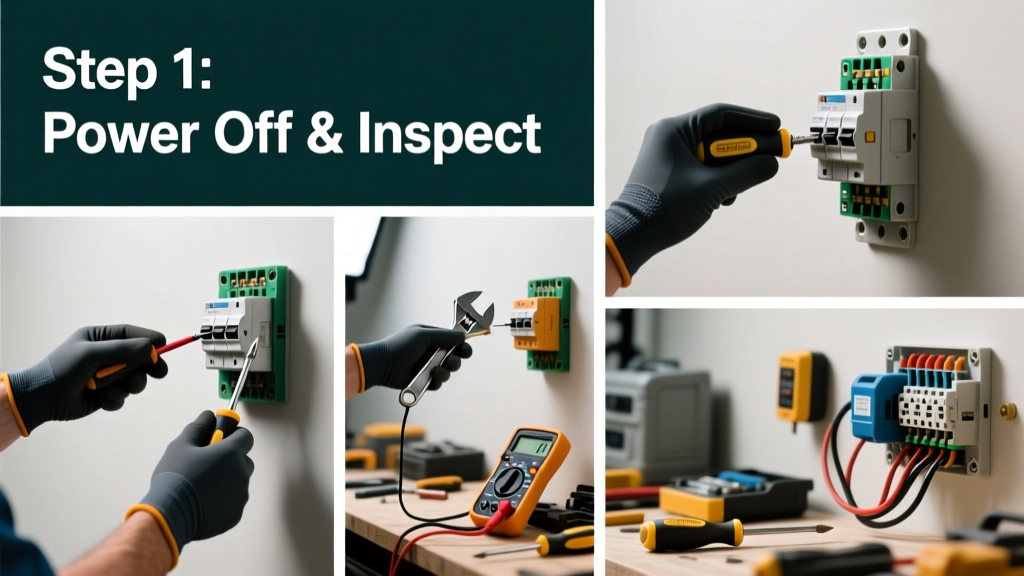
- Shut down and disconnect: Turn off generator, open main disconnect, and lockout/tagout per OSHA 1910.147. Wait 5 minutes for capacitors to discharge.
- Calculate actual load: List every connected device with running + surge watts (e.g., well pump = 900W run / 2,200W surge). Total must stay under 80% of generator’s rated continuous output—not peak. A 7,000W unit shouldn’t exceed 5,600W sustained.
- Check load balancing (for 240V units): Use your clamp meter on L1 and L2 legs. Difference >15% indicates imbalance—redistribute 120V loads (e.g., move garage lights from L1 to L2).
- Inspect terminals and wiring: Look for discolored lugs, melted insulation, or loose neutrals at the transfer switch and generator output panel. Tighten to manufacturer torque specs (e.g., 50 in-lbs for 8 AWG).
- Test breaker function: With power OFF, use multimeter continuity mode across breaker poles. No continuity = failed internal mechanism; replace only with OEM part.
When to Call a Pro
Some overload symptoms signal deeper issues that demand licensed expertise—not DIY shortcuts.
- Breaker trips even with zero load attached (points to stator winding fault or AVR failure)
- Generator runs fine on test mode but fails under utility-backup transition (transfer switch logic error)
- Voltage fluctuates >±10V during stable load (indicates failing voltage regulator or brush wear)
- You smell ozone or see charring inside the control box (arc damage requires full component replacement)
- Your unit is under warranty—unauthorized repairs void coverage per Generac’s 2024 Service Policy
Prevention Tips
Overload isn’t just about capacity—it’s about consistency and awareness.
- Label every circuit in your transfer switch with max wattage and device type (e.g., “Kitchen GFCI – Fridge + Microwave = 2,400W”)
- Run a monthly 15-minute load test at 50% capacity using a space heater or shop light bank
- Install a whole-house energy monitor like Sense or Emporia Vue to track real-time draw per circuit
- Replace aging extension cords—100’ of 16-gauge cord adds ~3.2Ω resistance, dropping voltage and increasing amp draw by up to 12% (per IEEE Std 141-1993)
Can I reset the breaker repeatedly to keep it running?
No. Repeated manual resets generate heat in the trip mechanism and can weld contacts shut. According to the National Fire Protection Association’s NFPA 37: Standard for the Installation and Use of Stationary Combustion Engines and Gas Turbines (2023), repeated tripping without diagnosis constitutes hazardous operation.
Why does my generator overload only when the AC kicks on?
Air conditioners draw 3–5× their running wattage at startup. A 3-ton unit may need 4,200W surge but only 1,400W running. If your generator lacks sufficient surge capacity—or soft-start controls—you’ll trip instantly. Retrofitting a AC soft-start kit cuts surge by 65%, per Carrier’s 2022 Field Performance Bulletin.
Is it safe to run a portable generator into my home’s panel with a backfeed breaker?
No—this violates NEC Article 702.6 and creates life-threatening backfeed risk to utility workers. Always use an interlocked transfer switch certified to UL 1008. The U.S. Consumer Product Safety Commission reports over 700 generator-related electrocutions annually, most tied to illegal backfeeding.
Will upgrading my generator’s oil filter prevent overload?
No. Oil filters affect engine longevity—not electrical output. Overload stems from electrical demand exceeding generation capacity or internal regulation failure. Think of it like revving a car engine past redline: better oil won’t stop mechanical failure.
Can a dirty air filter cause overload symptoms?
Indirectly—yes. A clogged air filter reduces engine RPM, causing voltage sag and frequency drop (below 59.3 Hz). This triggers low-voltage shutdowns that mimic overload. Replace filters every 50 hours or quarterly, per Briggs & Stratton’s Maintenance Schedule (2023 Edition).
Do LED lights reduce generator load enough to prevent overload?
Yes—but context matters. Swapping ten 60W incandescents for LEDs saves ~540W. That’s meaningful on a 3,500W portable unit powering essentials. However, it won’t offset a 2,800W well pump surge. Prioritize high-surge devices first—then optimize lighting and electronics. The U.S. EPA estimates that lighting accounts for just 8% of residential backup power use during outages.
"Over 62% of generator service calls labeled ‘overload’ actually stem from undervoltage caused by undersized wiring or poor grounding—not excess wattage." — Mike Rafferty, Senior Field Technician, Cummins Power Generation, 2023
A generator that trips isn’t broken—it’s communicating. Treat each overload as diagnostic data, not a nuisance. Keep your load sheet updated, test monthly, and respect the 80% continuous rule. When in doubt, pull the plug and call a technician certified by your generator’s brand—your safety and warranty depend on it. For related help, see our guides on transfer switch wiring errors and fixing unstable voltage output.