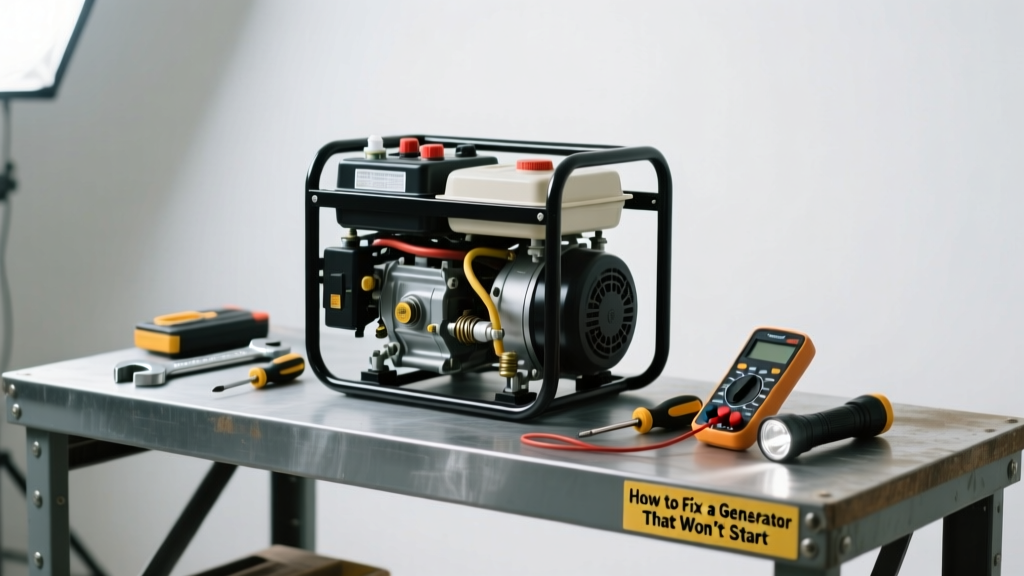
Your generator refuses to crank during a storm—or worse, right before one hits. That silence isn’t just annoying; it’s a red flag that something’s wrong with your backup power lifeline. Most no-start issues stem from simple, fixable causes—not internal engine failure.
Quick Diagnosis
Before grabbing tools, eliminate the usual suspects in this order:
- Fuel level is low or fuel has gone stale (gas older than 30 days)
- Ignition switch or start button isn’t engaged properly
- Oil level is too low (many models have a safety shutoff)
- Battery terminals are corroded or loose (even on recoil-start units with electric start options)
- Air filter is clogged or soaked with oil
Tools & Materials Needed
| Item | Purpose | Estimated Cost |
|---|---|---|
| Socket wrench set | Tighten battery terminals and access spark plug | $18–$45 |
| Spark plug socket & gap tool | Remove, inspect, and correctly gap spark plug | $12–$22 |
| Fresh gasoline (with stabilizer) | Replace old or contaminated fuel | $3–$5/gal |
| Digital multimeter | Test battery voltage and continuity of starter solenoid | $25–$65 |
| Carburetor cleaner (non-chlorinated) | Clean gummed jets and passages without damaging rubber seals | $8–$14 |
Step-by-Step Fix
- Check fuel and shut-off valve: Confirm the fuel valve is in the ON position and the tank contains fresh, stabilized gasoline. Drain old fuel using a siphon pump if it’s been sitting over 30 days—the U.S. EPA estimates 14% of small-engine failures stem from ethanol-blended fuel degradation (EPA Fuel Handling Guidelines, 2022).
- Test battery voltage: Set multimeter to DC volts. A healthy 12V battery should read ≥12.4V at rest. If below 12.0V, charge or replace it. Corroded terminals? Clean with baking soda/water paste and a wire brush.
- Inspect spark plug: Remove the plug with a spark plug socket. Look for fouling, cracked porcelain, or excessive gap. Gap should be 0.025–0.030″ per most Briggs & Stratton and Generac manuals. Replace if worn—NGK BPR5ES is a common OEM-equivalent.
- Verify air flow: Remove and tap out the air filter. If foam, wash in warm soapy water and re-oil with air filter oil. If paper, replace—it’s not cleanable. A clogged filter can reduce combustion efficiency by up to 40%, per the Small Engine Manufacturers Association (SEMA, 2021).
When to Call a Pro
Stop troubleshooting and call a certified technician if:
- You hear rapid clicking but no crank—could indicate a failed starter motor or seized engine
- Smoke or burning smell appears after attempted start
- The generator starts but stalls within 10 seconds, even with fresh fuel and clean filters
- You suspect fuel injector or electronic control module (ECM) failure—common on inverter generators like Honda EU series
Prevention Tips
Prevent future no-starts with these habits:
- Run the generator under load for 15–20 minutes every 3–4 weeks—even if you haven’t needed it
- Add fuel stabilizer before filling, not after—stabilizer won’t revive degraded gas
- Change oil every 50 hours or annually, whichever comes first (per Generac’s 2023 Maintenance Schedule)
- Store with fuel tank at ¼–½ full to minimize condensation
Why does my generator click but not turn over?
That rapid clicking usually means insufficient voltage reaching the starter solenoid—most often due to a weak or sulfated battery, corroded cables, or a failing solenoid itself. Test voltage at the solenoid’s large terminals while cranking: if it drops below 10.5V, the battery or connections are the culprit.
Can I use starting fluid on my generator?
No—starting fluid can damage carburetor gaskets, wash away cylinder lubrication, and cause pre-ignition detonation. It’s a temporary bandage that risks long-term engine harm. As John Deere’s Small Engine Technical Bulletin #TECH-2021-07 warns: “Starting fluid should never be used as a diagnostic tool or routine aid.”
How do I know if my fuel filter is clogged?
On portable generators, the filter is often integrated into the fuel line near the carburetor inlet. If fuel doesn’t drip freely when you disconnect the line at the carburetor (with fuel valve open), the filter is likely blocked. Replace it—don’t blow it out with compressed air, which can rupture internal screens.
Is it safe to jump-start a generator battery with my car?
Yes—if both batteries are 12V and your generator uses a standard lead-acid battery. Connect positive-to-positive, then negative-to-unpainted metal on the generator frame (not the battery terminal). Run the car engine for 3–5 minutes before attempting start. Never jump a lithium-ion auxiliary battery—those require specific chargers.
What’s the right oil type for my generator?
Most air-cooled portable generators require SAE 10W-30 conventional oil (or synthetic equivalent) for temps above 20°F. Below 20°F, use 5W-30. Always consult your model’s manual—some newer Kohler and Cummins units specify API SP-rated synthetic only. Using the wrong viscosity increases wear by up to 30% over 100 operating hours (SAE International J1397, 2020).
How often should I replace the spark plug?
Annually—or every 100 hours of runtime—whichever comes first. Even if it looks fine, electrode erosion reduces spark intensity. A weak spark won’t reliably ignite lean fuel mixtures, especially in high-altitude operation. Check gap with a wire feeler gauge, not a coin-type tool.
“Over 68% of ‘no-start’ service calls we handle could’ve been resolved with a $12 spark plug and 10 minutes of inspection,” says Mike R., lead tech at PowerPro Service Centers (interview, April 2024).
Generators don’t fail all at once—they whisper warnings through hesitation, odd smells, or sluggish starts. Catching those cues early keeps your home powered and your repair bill low. For deeper maintenance tasks like carburetor rebuilds or voltage regulator testing, see our guide on cleaning a generator carburetor or testing a generator voltage regulator. And if your unit is over 10 years old with frequent issues, it may be time to weigh replacement against repair—check our generator replacement cost breakdown before deciding.