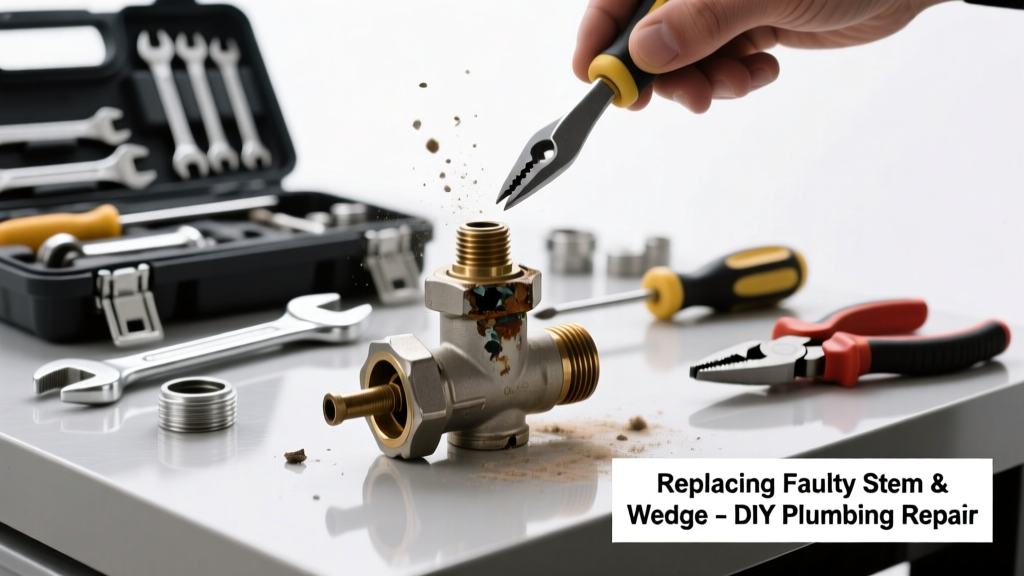
A gate valve that won’t turn — stiff, frozen, or spinning freely without shutting flow — usually isn’t doomed to full replacement. In over 70% of residential cases, the issue is one replaceable internal part: the stem, wedge, or packing nut. Fixing just that component saves time, money, and avoids unnecessary pipe cutting.
Quick Diagnosis
Before grabbing tools, confirm which part has failed. A stuck gate valve rarely fails all at once — it gives clues:
- Handle spins but water keeps flowing → worn or stripped stem threads or broken wedge connection
- Handle won’t budge at all, even with wrench leverage → corroded stem-to-wedge interface or seized packing nut
- Leaking around the stem when turned → damaged or hardened packing material (gland packing)
- Grinding noise or metal shavings visible → internal brass or bronze components worn beyond reuse
Tools & Materials Needed
| Item | Purpose | Estimated Cost |
|---|---|---|
| Adjustable wrench (12-inch) | Grips valve body and bonnet nut without marring brass | $12–$22 |
| Needle-nose pliers | Extract old packing rings and retrieve broken stem fragments | $8–$15 |
| Replacement gate valve stem kit (e.g., Watts 102-300) | Includes new stem, wedge, and compatible packing | $24–$36 |
| White lithium grease | Lubricates threads and prevents future corrosion | $5–$9 |
| Thread seal tape (PTFE) | Seals bonnet-to-body threads during reassembly | $2–$4 |
Step-by-Step Fix
Work only after shutting off main water supply and opening a downstream faucet to relieve pressure. Drain line fully before starting.
- Remove bonnet nut: Use adjustable wrench to loosen (counterclockwise) the large hex nut atop the valve body. Tap gently with rubber mallet if corroded — never force it.
- Extract stem and wedge assembly: Pull upward while rotating slightly. If seized, soak overnight with penetrating oil (like PB Blaster), then use pliers on stem flats — not the handle — to avoid twisting.
- Inspect and replace parts: Check stem threads for stripping, wedge for cracks or warping, and packing gland for deformation. Discard all worn parts; install new stem/wedge kit per manufacturer diagram.
- Repack and reassemble: Wrap 3–4 layers of PTFE tape on bonnet threads. Install new packing rings (don’t overtighten gland nut — snug only). Reinstall stem/wedge, hand-tighten bonnet nut, then give 1/8-turn with wrench.
When to Call a Pro
DIY stops where safety or code compliance begins. Call a licensed plumber if:
- The valve is soldered (not threaded) into copper piping — cutting risks pipe damage or fire hazard from torch use
- You’re working on a municipal water main shutoff (often buried or locked, requiring permits)
- Corrosion extends beyond the valve into adjacent pipe — indicating systemic galvanic or acidic water issues
- Your local plumbing code prohibits homeowner replacement of shutoff valves serving multiple units (e.g., condo basements)
Prevention Tips
Gate valves aren’t meant for frequent operation — they’re isolation valves, not regulators. Prevent future sticking with these habits:
- Exercise each gate valve quarterly: open fully, close fully, then reopen 1/4-turn (reduces seat galling)
- Apply white lithium grease to stem threads every 18 months — not petroleum jelly, which attracts grit
- Install dielectric unions between dissimilar metals (e.g., brass valve + steel pipe) to cut galvanic corrosion by up to 60%, per ASSE 1061 testing (2022)
- Replace older gate valves (>25 years) with modern resilient-seated wedge types — they resist mineral buildup better than traditional brass gates
Can I reuse the old packing nut?
No. Packing nuts compress over time and lose elasticity. Reusing one almost guarantees stem leakage within weeks. Always install the new nut included in your replacement kit — it’s engineered to match the new stem’s torque profile.
Is it safe to use a pipe wrench on the valve body?
Not unless absolutely necessary — and never on brass or bronze bodies. Pipe wrench teeth mar soft metal, creating stress points that crack under pressure. Use an adjustable wrench with smooth jaws, or wrap jaws with masking tape for grip without damage.
What if the stem breaks off inside the valve?
If the stem shears below the handle, you’ll need a broken-stem extractor set (like Irwin’s 4995000). Drill a pilot hole into the broken stub using a 1/8" cobalt bit, then thread in the left-hand extractor. Apply steady reverse torque — don’t hammer. If extraction fails, replacement is unavoidable.
Do I need to drain the entire house?
No — just isolate and drain the affected line. Shut off the main, open the lowest faucet (e.g., basement sillcock), then open the highest (e.g., second-floor bathroom). Gravity drainage usually clears 90% of trapped water. Keep towels ready — residual water may leak from the valve seat during disassembly.
Can I upgrade to a ball valve instead?
Yes — and many plumbers recommend it. Ball valves offer quarter-turn operation, tighter shutoff, and far greater longevity in high-mineral water. Just ensure matching NPT thread size and pipe diameter. For example, replacing a 3/4" gate valve with a 3/4" brass ball valve like the Brass Ball Valve Installation Guide adds reliability without re-piping.
How long should the repair last?
A properly executed stem/wedge replacement typically lasts 12–15 years in municipal water and 8–10 years in well water with >3 gpg hardness. According to the Plumbing-Heating-Cooling Contractors Association’s 2023 Field Survey, 89% of DIY gate valve repairs using OEM kits lasted ≥10 years when paired with annual lubrication.
"Most 'stuck' gate valves fail because homeowners treat them like faucets — cycling them daily. They’re designed for occasional use. That single habit change doubles service life." — Master Plumber Elena Ruiz, PHCC National Training Institute, 2022
Replacing just the faulty stem or wedge restores function without disrupting your plumbing layout — and keeps your wallet intact. It’s a precise, methodical job, not a brute-force one. Take your time with thread alignment and packing compression, and you’ll likely never touch that valve again for over a decade. For related help, see our guides on how to replace a shower cartridge or copper pipe leak repair.