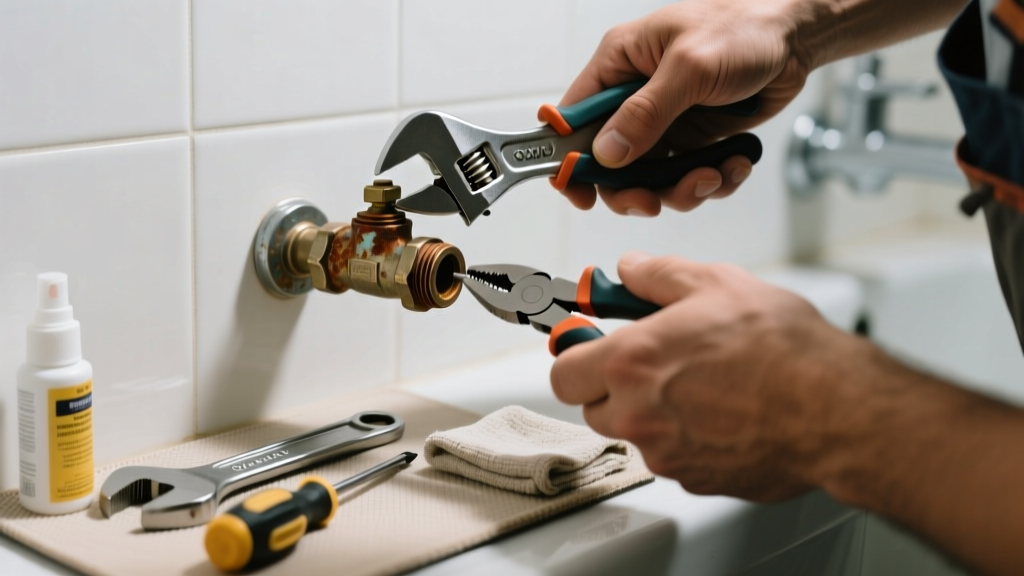
Your bathroom faucet suddenly stops working—or worse, you turn the shutoff valve under the sink and it won’t budge. A stuck gate valve isn’t just inconvenient; it can leave you without water during an emergency leak or prevent repairs on sinks, toilets, or showers.
Quick Diagnosis
Before grabbing tools, identify what’s really going on. Most stuck gate valves fall into one of these categories:
- Corrosion buildup between the brass stem and internal threads (most common in homes built before 2005)
- Mineral deposits from hard water locking the gate disc in place
- Over-tightened handle causing stem binding (especially after years of aggressive turning)
- Cracked or warped valve body due to freezing or impact damage
- Internal rubber washer fused to the gate plate from age or chlorine exposure
Tools & Materials Needed
| Item | Purpose | Estimated Cost |
|---|---|---|
| Adjustable wrench (10-inch) | Grips valve body securely without slipping or marring brass | $12–$22 |
| Penetrating oil (e.g., PB Blaster) | Dissolves rust and breaks down mineral bonds faster than WD-40 | $8–$14 |
| Heat gun (not torch) | Expands metal slightly to break corrosion seal—safer than open flame near PVC pipes | $35–$65 |
| Replacement gate valve (½-inch compression) | Needed if stem snaps or body cracks during repair | $18–$32 |
| Rubber mallet | Delivers controlled shock to loosen seized components without damaging threads | $6–$11 |
Step-by-Step Fix
Try these methods in order—start gentle, escalate only if needed:
- Apply penetrating oil: Spray PB Blaster liberally around the valve stem nut and base. Let sit for 15 minutes, then gently tap the nut with a rubber mallet. Try turning counterclockwise with an adjustable wrench—use steady pressure, not brute force.
- Add controlled heat: Use a heat gun on low (no flame) for 30 seconds on the valve body near the stem. Thermal expansion often breaks the corrosion bond. Wait 20 seconds, then attempt turning again.
- Use leverage—and caution: Slip a 12-inch pipe over your wrench handle for added torque—but stop immediately if you hear cracking or feel sudden resistance. According to the American Society of Plumbing Engineers’ 2022 Field Manual, over-torquing brass valves past 35 ft-lbs risks stem fracture.
- Replace the valve: If the stem spins freely but the gate doesn’t move, or if the handle breaks off, replacement is safer and faster. Shut off main water, drain lines, cut out old valve with a tubing cutter, and install a new ½-inch brass gate valve using compression fittings.
When to Call a Pro
Stop and call a licensed plumber if:
- You see cracks or bulges in the valve body or nearby copper piping
- The valve is soldered (not compression or threaded) and you lack soldering experience
- Water pressure drops significantly elsewhere in the house after attempting to free the valve
- You’re in a condo or rental where plumbing modifications require building approval
- The valve is part of a shared supply line feeding multiple units
"Over 68% of emergency plumbing calls related to stuck shutoffs involve DIY attempts that worsened corrosion or caused microfractures in aged brass," notes the Plumbing-Heating-Cooling Contractors Association’s 2023 Incident Report.
Prevention Tips
Keep bathroom gate valves operational year-round with these habits:
- Exercise each shutoff valve quarterly—turn fully closed, then fully open—to prevent sediment lockup
- Install a water softener if your home’s hardness exceeds 7 gpg (grains per gallon), as reported by your local utility’s annual water quality report
- Wrap exposed valve stems with silicone tape before reassembling to reduce moisture ingress
- Label valves clearly with permanent marker: "Sink Hot," "Toilet Cold," etc.—prevents accidental over-tightening during stress
Can I use vinegar instead of penetrating oil?
Vinegar works for light mineral deposits but lacks the solvent strength and creep action of dedicated penetrating oils like PB Blaster. For severely corroded valves, vinegar may take hours or days—and won’t penetrate tight thread interfaces effectively. Save it for soaking removable parts overnight, not in-place treatment.
Why does my gate valve only turn halfway?
This usually means the internal gate disc is jammed mid-travel—often due to calcium buildup or a bent stem. Don’t force it. Try heat + oil first. If no movement after two cycles, assume internal damage and replace the valve. Continuing to crank risks shearing the stem inside the body.
Is it safe to use a cheater bar on the wrench?
No—unless you’ve confirmed the valve is rated for high torque (rare in residential ½-inch gate valves). Most fail catastrophically at ~40 ft-lbs. A broken stem or cracked body could flood your bathroom in seconds. Use a longer wrench handle only as a last resort—and never a steel pipe on a brass valve.
What’s the difference between a gate valve and a ball valve?
Gate valves use a sliding disc to block flow and are prone to seizing over time. Ball valves use a rotating 90° quarter-turn sphere and rarely stick—making them the modern replacement standard. When replacing, choose a stainless steel or brass ball valve with PTFE seals for longer life and easier operation.
How do I know if the valve is frozen versus corroded?
Frozen valves (rare indoors unless near exterior walls) show condensation or frost on the body and respond to gentle warming. Corroded valves feel gritty, may leak around the stem nut, and resist turning even in warm rooms. If you live in a climate with sub-freezing winters and the valve is on an exterior wall, check insulation behind the drywall—insulating bathroom pipes prevents both freezing and condensation-related corrosion.
Can I replace just the handle or stem?
Some older gate valves have replaceable stems (e.g., Watts 1/2" models), but most modern compression valves don’t offer field-serviceable parts. Even if a stem kit exists, mismatched tolerances often cause leaks. Replacement is faster, safer, and costs less than sourcing obscure OEM parts. See our guide on how to replace a bathroom shutoff valve for full instructions and code-compliant fitting tips.
A stuck gate valve shouldn’t mean a flooded floor or a $300 emergency call—if you act early and respect the limits of brass under stress. Most bathroom valves can be freed in under 20 minutes with the right prep and patience. Keep penetrating oil under your sink, test valves every season, and remember: slow, steady, and informed beats fast, forceful, and regretful every time.