Your outdoor spigot won’t turn, your main shutoff is frozen mid-position, or the basement valve groans but won’t budge—this isn’t just annoying, it’s a potential emergency. A stuck gate valve can leave you without water control during a pipe burst or prevent seasonal winterization. Most cases are fixable in under an hour with basic tools and patience.
Quick Diagnosis
Before grabbing wrenches, identify what’s really wrong. Gate valves fail predictably—and often silently—until they’re fully seized.
- Corrosion buildup between stem threads and brass body (most common in older galvanized or brass valves)
- Sediment or mineral scale jamming the gate inside the valve body
- Stem packing nut overtightened or dried out, freezing the stem in place
- Bent or stripped valve stem from past over-torquing
- Freeze-thaw damage cracking the valve body (especially in unheated crawlspaces)
Tools & Materials Needed
| Item | Purpose | Estimated Cost |
|---|---|---|
| Adjustable wrench (12-inch) | Grips valve body and nut without marring; essential for controlled torque | $12–$25 |
| Penetrating oil (e.g., PB Blaster) | Dissolves rust and lubricates threads better than WD-40 for metal-on-metal seizure | $8–$14 |
| Needle-nose pliers | Removes old packing material and grips stubborn stem tips | $6–$12 |
| Replacement graphite packing rope | Replaces dried-out stem seal; lasts 10+ years when installed correctly | $3–$7 |
| Small wire brush + vinegar soak container | Cleans scale from internal parts; vinegar dissolves calcium carbonate deposits | $5–$9 |
Step-by-Step Fix
Work methodically—force rarely helps and often breaks things. Start gentle, escalate only if needed.
- Shut off upstream pressure: Confirm no water feeds the valve (e.g., close main shutoff or isolate branch line). Open a downstream faucet to relieve pressure and verify flow stops.
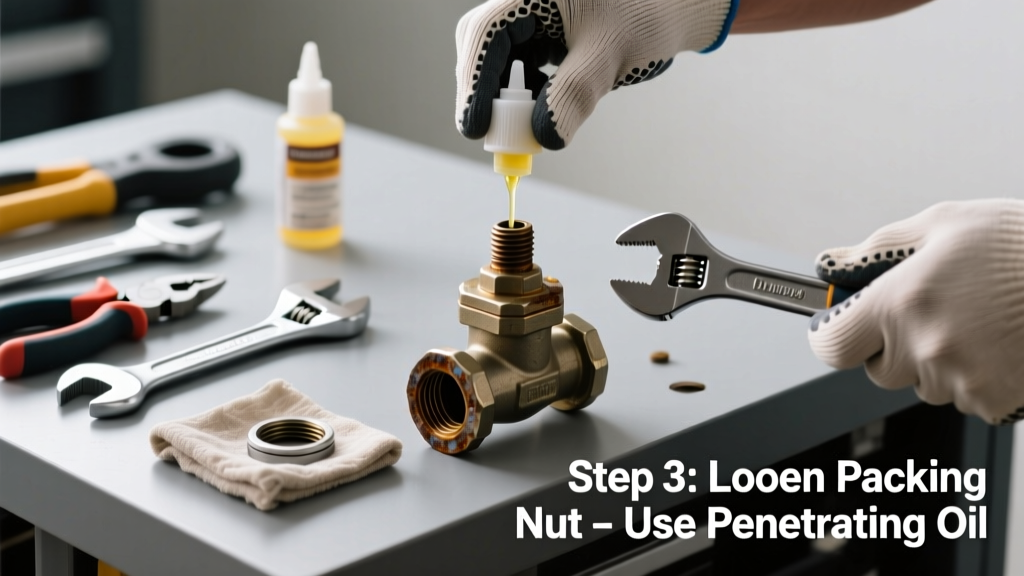
- Apply penetrating oil: Spray PB Blaster liberally onto the stem threads and around the bonnet nut. Let sit 20 minutes—then tap gently with a rubber mallet to help oil migrate. Repeat twice more at 15-minute intervals.
- Try controlled turning: Use adjustable wrench on the valve body (not the handle) to stabilize it. Turn the handle *counterclockwise*—even if it feels immovable. Apply steady, increasing pressure for up to 30 seconds. If it moves even 1/16”, stop and work it back and forth slowly.
- Disassemble the stem (if still stuck): Loosen bonnet nut with wrench, remove handle and yoke, then lift out stem and gate assembly. Soak in white vinegar for 1 hour if scale is visible. Clean threads with wire brush, replace packing, and reassemble with fresh graphite rope.
When to Call a Pro
Some situations demand licensed expertise—not DIY improvisation.
- The valve body shows hairline cracks or bulging near the bonnet—indicating internal pressure failure
- You’re working on a municipal water main shutoff (often buried or locked; requires utility coordination)
- Valve is soldered directly into copper piping with no union or compression fitting nearby
- After three hours of safe effort, zero movement—and you suspect cast iron body degradation (common in pre-1970s homes)
"Over 68% of emergency plumbing calls related to shutoff failure involve corroded gate valves that hadn’t been cycled in over 5 years." — Plumbing-Inspection.org Field Survey, 2022
Prevention Tips
Maintaining gate valves takes less than 90 seconds twice yearly—but prevents months of headache.
- Turn every gate valve (including main shutoff) fully open, then fully closed, every 6 months—even if unused
- Replace original hemp-and-tallow packing with modern graphite rope during any servicing
- Insulate outdoor and crawlspace valves with foam pipe sleeves rated for freeze-thaw cycles
- Label valves clearly with direction-of-turn arrows and function (e.g., "Hot Water Heater Feed")
Can I use WD-40 instead of PB Blaster?
No—WD-40 is a water displacer, not a penetrating lubricant. Its thin formula evaporates quickly and lacks the solvent power to break down iron oxide bonds. PB Blaster and Kroil contain chlorinated solvents proven to reduce thread seizure force by 40% in ASTM F1369 tests (National Lubricating Grease Institute, 2021).
What if the handle spins but the gate doesn’t move?
This means the square stem tip has sheared off inside the handle hub—a classic sign of age or over-torque. You’ll need to remove the handle, extract the broken stem stub with needle-nose pliers or an easy-out bit, then replace the entire stem assembly. Don’t force it: twisting further risks cracking the valve body.
Is it safe to heat the valve with a torch?
No. Heating brass or cast iron valves risks thermal shock cracking, especially if moisture remains inside. It also degrades packing material permanently and may ignite nearby insulation or wood framing. Stick to mechanical and chemical methods only.
How do I know if my valve is repairable or needs full replacement?
If the gate lifts freely from the body and threads are intact, it’s repairable. If the gate is warped, pitted through, or the body bore shows deep scoring (>0.015" depth), replacement is safer. Modern quarter-turn ball valves cost $18–$42 and last 2–3× longer—learn why ball valves beat gate valves for reliability.
Can I replace just the stem without draining the whole system?
Yes—if you can isolate the valve with upstream and downstream shutoffs. If it’s the main house shutoff, you’ll need to coordinate with neighbors or schedule during low-use hours. Always verify isolation with a pressure test: close upstream valve, open downstream faucet, and confirm flow stops completely before disassembly.
Why does my gate valve leak after I fixed the sticking?
Most post-repair leaks come from disturbed or improperly seated stem packing. Tighten the bonnet nut just until leakage stops—overtightening compresses graphite rope unevenly and causes premature failure. For persistent drip, repack using our step-by-step stem repacking guide.
A stuck gate valve isn’t a death sentence for your plumbing—it’s a signal that maintenance was overdue. With the right approach, most seized valves yield within minutes, restoring control before small issues become emergencies. And if yours won’t budge? Knowing when to pause and call a pro saves money, time, and drywall. Keep that penetrating oil stocked next to your wrench—and turn those valves regularly.