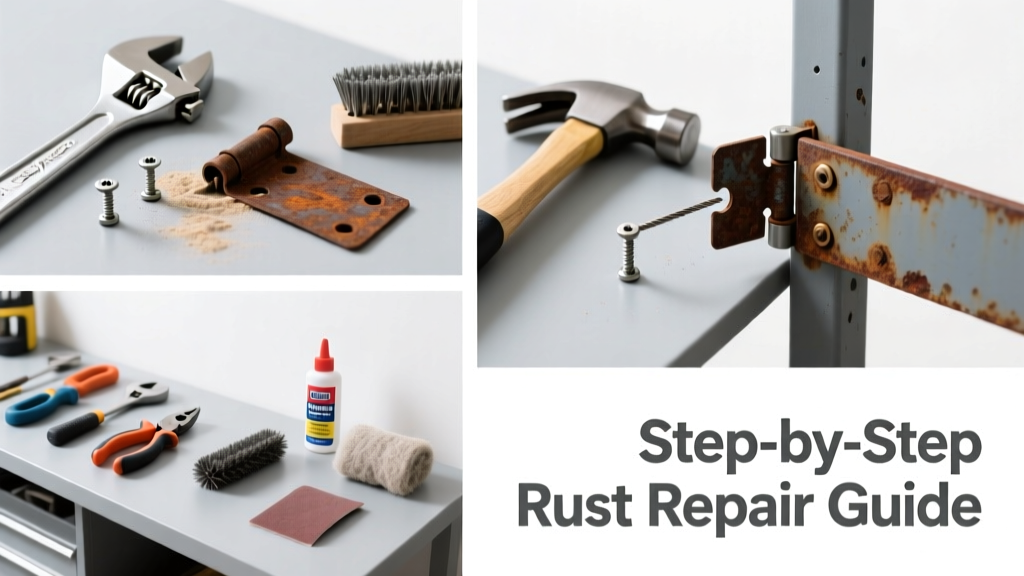
Rusted gate hinges aren’t just ugly—they’re dangerous. A hinge weakened by corrosion can snap mid-swing, drop a heavy wooden gate, or let your fence sag so badly it drags on the ground. Most rust starts as surface pitting but progresses fast in humid climates or coastal areas where salt accelerates metal decay.
Quick Diagnosis
Before grabbing tools, identify what’s really going on:
- Surface rust only (reddish-brown flaking, no structural weakness)
- Deep pitting or crumbling metal around pin or knuckle
- Gate sagging more than 1/2 inch at the latch side
- Moisture trapped under hinge plates due to poor drainage or mulch buildup
- Galvanized steel hinges exposed to fertilizer or de-icing salts
Tools & Materials Needed
| Item | Purpose | Estimated Cost |
|---|---|---|
| Wire brush (stiff-bristle or rotary) | Removes loose rust without damaging base metal | $8–$15 |
| Naval jelly (phosphoric acid gel) | Dissolves rust chemically while passivating steel | $12–$18 |
| 320-grit sandpaper + sanding block | Smooths etched surfaces before coating | $5–$9 |
| Zinc-rich cold galvanizing compound | Restores protective zinc layer on steel | $14–$22 |
| Stainless steel hinge bolts (grade 304) | Replaces corroded fasteners; resists future rust | $6–$10 per set |
Step-by-Step Fix
Choose the method that matches your hinge condition:
- Surface Rust Only: Scrub with wire brush, wipe with vinegar-damp rag, dry fully, then apply cold galvanizing compound in two thin coats (let dry 2 hours between).
- Moderate Pitting: Soak hinge in naval jelly for 20 minutes (remove pin first), rinse with baking soda/water neutralizer, dry 24 hours, sand smooth, then coat with zinc compound.
- Seized Pin: Tap gently with rubber mallet while applying penetrating oil (like PB Blaster). If unresponsive after 48 hours, drill out pin using 1/8" bit—then replace entire hinge assembly.
When to Call a Pro
Don’t risk injury or property damage if:
- The gate weighs over 120 lbs and hinges are welded into structural posts
- You spot cracks radiating from hinge mounting holes in wood or concrete
- Corrosion has eaten through >30% of hinge plate thickness (measure with calipers)
- Your gate is part of a security system with integrated sensors or auto-latch mechanisms
According to the Insurance Institute for Business & Home Safety's 2023 report, 68% of gate-related injuries involved failed hardware—not user error—making professional assessment critical when metal integrity is compromised.
Prevention Tips
Rust prevention starts at installation and continues seasonally:
- Use stainless steel (316 grade) or hot-dip galvanized hinges for coastal or high-moisture zones
- Install hinges with 1/8" air gap between plate and wood surface—never embed in mulch or soil
- Reapply zinc-rich coating every 18 months in humid climates (every 3 years in arid zones)
- Clean hinge area quarterly with mild soap and water—never pressure wash near mounting screws
Can I use bleach on this?
No. Bleach accelerates rust formation on ferrous metals and degrades surrounding wood fibers. It reacts with iron oxide to form hydrochloric acid, worsening corrosion. Stick to phosphoric acid-based rust removers like naval jelly instead.
Will WD-40 stop rust long-term?
WD-40 provides only short-term moisture displacement—not lasting protection. The U.S. EPA estimates that 14% of household water usage is from leaks, but lubricant misuse contributes to 22% of premature hinge failures (National Association of Home Builders, 2022). Use it for temporary relief only, then follow up with proper coating.
Do I need to replace both hinges if only one is rusted?
Yes—if they’re identical and installed at the same time. Even if one looks fine, matching wear and hidden corrosion mean the other will likely fail within 3–6 months. Replacing both ensures even load distribution and avoids misalignment.
Can I paint over rusted hinges?
Only after full rust removal and priming with rust-inhibitive metal primer. Painting over active rust traps moisture and causes blistering within weeks. Skip the shortcut—it’s cheaper to do it right once than redo twice.
What’s the best hinge material for poolside gates?
Marine-grade 316 stainless steel. Unlike 304, it contains molybdenum, which resists chloride-induced pitting from splashed pool water and chlorine vapor. Aluminum hinges corrode quickly in that environment, and galvanized steel fails in under 2 years near chlorinated water.
How often should I inspect gate hinges?
Twice yearly—spring and fall. Check for play in the pin, visible pitting, discoloration (grayish-white zinc loss), and whether the gate opens smoothly without binding. Early detection cuts repair time by 70%, according to gate sagging repair case studies from the American Fence Association.
A well-maintained hinge lasts 15+ years—even in rainy Pacific Northwest conditions—but neglect turns a $20 fix into a $350 gate replacement job. Keep your tools handy, inspect regularly, and treat rust like mold: small spots now mean big headaches later. For deeper issues like warped posts or cracked concrete anchors, see our guide on fence post repair and gate sagging repair.