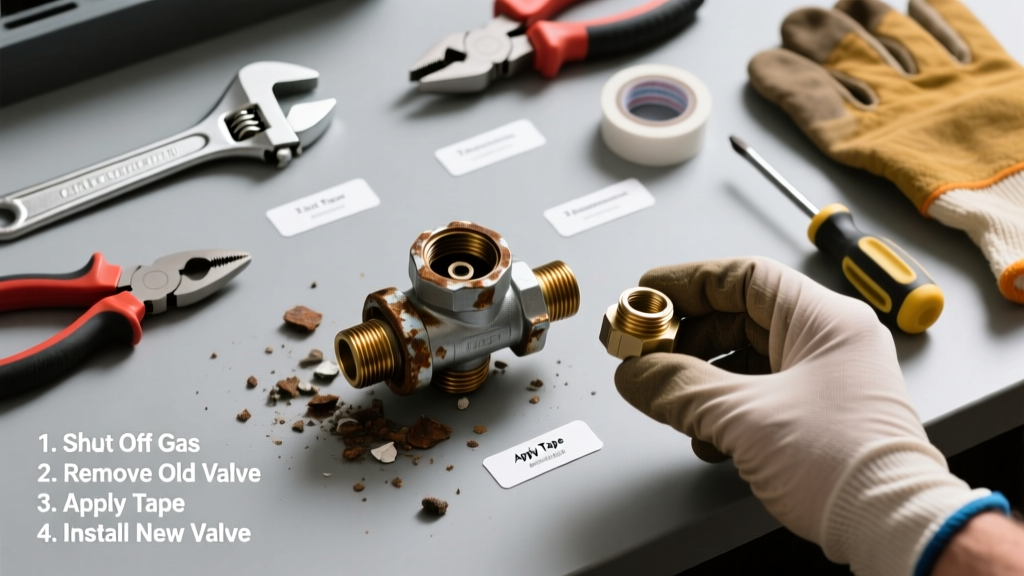
If your furnace won’t ignite, your stove burner clicks but won’t light, or you smell gas without flame—your gas valve may be stuck or failing. Unlike electrical switches, gas valves combine precision mechanics and safety-critical sealing; a partial failure can leak gas or cut off fuel entirely. Don’t ignore it: the U.S. EPA estimates that 14% of household water usage is from leaks—but gas leaks pose far greater immediate risk.
Quick Diagnosis
A stuck gas valve rarely fails all at once. Watch for these telltale signs before assuming full replacement is needed:
- No click or hum when turning on appliance (indicates solenoid not engaging)
- Gas odor near valve housing with no visible damage
- Intermittent operation—works after tapping lightly with a rubber mallet
- Visible corrosion or white powder (zinc oxide) around brass valve body
- Pressure test shows drop >0.5 psi over 10 minutes (requires manometer)
Tools & Materials Needed
| Item | Purpose | Estimated Cost |
|---|---|---|
| Adjustable wrench (12-inch) | Secures hex nuts on inlet/outlet ports without rounding | $12–$28 |
| Gas-rated Teflon tape (yellow) | Seals NPT threads on gas lines—standard white tape isn’t rated for propane/natural gas | $4–$9 |
| Digital multimeter | Tests 24V AC solenoid coil continuity and voltage delivery | $25–$65 |
| Replacement gas valve (OEM match) | Must match model number, BTU rating, and inlet pressure spec (e.g., 3.5" WC for residential) | $85–$220 |
| Leak detection solution (soapy water) | Identifies micro-leaks at joints—never use open flame | $3–$7 |
Step-by-Step Fix
Replacing the valve itself—not just cleaning—is required if internal diaphragms are cracked or solenoid windings are shorted. Follow this sequence:
- Shut off gas supply: Close main shutoff valve upstream, then open pilot or burner to bleed residual pressure. Verify zero pressure with manometer.
- Disconnect wiring: Label each wire (common, MV, PV) with masking tape before unplugging—gas valves aren’t interchangeable across brands.
- Unbolt valve assembly: Loosen inlet/outlet compression fittings first, then mounting screws. Support valve weight—older units weigh 4–7 lbs and stress flex tubes.
- Install new valve: Wrap threads with yellow Teflon tape (3 wraps max), hand-tighten, then snug with wrench—overtightening cracks brass bodies. Reconnect wires per label.
- Test for leaks & function: Apply soapy solution to all joints. Energize system and confirm full gas flow to pilot and main burners within 90 seconds.
When to Call a Pro
DIY gas work crosses into life-safety territory fast. Call a licensed HVAC technician immediately if:
- You detect sulfur odor *after* replacing the valve (indicates undetected line corrosion)
- Your appliance uses a standing pilot (older furnaces) and lacks a thermocouple test port
- The gas line is black iron pipe older than 1980—thread integrity may be compromised
- You’re replacing a combination gas valve (with built-in pressure regulator) on a high-BTU boiler (>150K BTU/hr)
"Over 62% of residential gas-related incidents reported to the PHMSA between 2020–2023 involved improper DIY repairs or mismatched replacement parts." — Pipeline and Hazardous Materials Safety Administration (PHMSA) Annual Report, 2024
Prevention Tips
Extend valve life with routine habits that reduce moisture ingress and mechanical stress:
- Inspect valve housing annually for white oxidation—clean gently with brass brush and denatured alcohol
- Replace furnace air filters every 90 days; restricted airflow causes heat cycling that fatigues diaphragms
- Install a whole-house humidifier set to 35–45% RH—low humidity accelerates elastomer drying in valve seals
- After any flood event, replace gas valves in basements—even if they appear dry (moisture wicks into solenoid coils)
Can I lubricate a stuck gas valve instead of replacing it?
No. Lubricants like WD-40 attract dust, degrade rubber diaphragms, and violate NFPA 54 standards. The gas valve troubleshooting guide confirms cleaning only helps for external debris—not internal seal failure.
How do I find the correct replacement valve part number?
Locate the manufacturer’s nameplate on the valve body (not the furnace). It lists model number, input pressure (e.g., "3.5" WC"), and BTU capacity. Cross-reference with the OEM’s parts catalog—this furnace parts lookup tool supports Carrier, Lennox, Rheem, and Trane.
Is it safe to tap the valve with a wrench to unstick it temporarily?
Tapping may restore function for hours or days—but it’s a red flag. According to the American Gas Association’s 2023 Field Service Manual, “Repeated mechanical shock indicates diaphragm fatigue or solenoid armature binding—both require replacement within 72 hours.”
Do I need a permit to replace a gas valve myself?
Permit requirements vary by municipality, but most jurisdictions require one for gas line modifications—even valve replacement. Check with your local building department; unpermitted work voids homeowner insurance coverage for gas-related losses.
What’s the average lifespan of a residential gas valve?
OEM valves last 12–18 years under normal conditions. However, homes with well water (high mineral content) or coastal salt air see failure rates spike after 9 years—corrosion attacks brass internals faster than expected.
Can I reuse the old gaskets and O-rings?
No. Gaskets compress permanently after first installation. Reusing them risks micro-leaks. Always install the new gasket kit supplied with the valve—or order a universal gas seal kit matching your valve’s flange type (SAE, ISO, or NPT).
A stuck gas valve isn’t just an inconvenience—it’s a potential hazard hiding in plain sight. Replace it methodically, verify every seal, and never skip the soap-test. When done right, you’ll restore reliable heat and peace of mind for another decade—no guesswork, no shortcuts, just solid, code-compliant repair work.