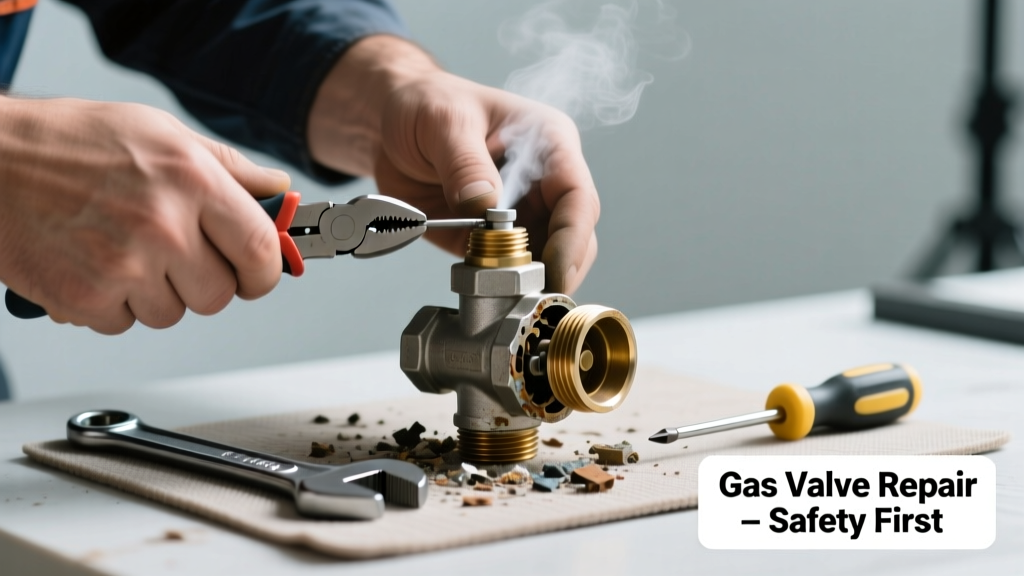
If your gas appliance—like a furnace, water heater, or stove—is making a persistent hiss, buzz, click, or grinding noise when it should be silent, the gas valve may be stuck or failing. This isn’t just annoying—it’s a potential safety hazard. Ignoring it could lead to incomplete combustion, carbon monoxide risk, or even gas leakage.
Quick Diagnosis
Before grabbing tools, confirm the issue isn’t misdiagnosed. Unusual gas valve noises often stem from:
- Debris or rust buildup inside the valve body (most common in units over 8 years old)
- Failing solenoid coil—causing rapid clicking or buzzing during ignition attempts
- Worn or warped internal diaphragm or spring assembly
- Low gas pressure upstream (e.g., regulator issues or kinked supply line)
- Electrical interference from nearby wiring or faulty control board signals
Tools & Materials Needed
| Item | Purpose | Estimated Cost |
|---|---|---|
| Combination wrench set (1/4"–7/8") | Tightening or loosening valve mounting and gas line fittings without rounding threads | $12–$28 |
| Digital multimeter | Testing solenoid coil resistance (should read 30–120 ohms; outside range = failure) | $25–$65 |
| Gas leak detector solution (soapy water) | Verifying no leaks after reassembly—never use open flame or electronic sniffers near suspected leaks | $4–$9 |
| Replacement OEM gas valve (if needed) | Exact match required—non-OEM valves void appliance warranties and violate NFPA 54 standards | $85–$220 |
Step-by-Step Fix
Always shut off gas and power before beginning. Locate the main shutoff valve (usually within 6 ft of the appliance) and turn it clockwise until snug. Then switch off electrical supply at the breaker.
- Clean the valve exterior and venturi tube: Use compressed air (not exceeding 30 psi) to blow out dust and cobwebs from the valve’s external ports and pilot orifice. Wipe down with lint-free cloth dampened with isopropyl alcohol—never lubricants or solvents like acetone.
- Test the solenoid coil: Set multimeter to ohms. Disconnect wires and measure resistance across terminals. According to the American Gas Association’s Gas Appliance Technician Manual (2022), readings under 25 Ω or over 130 Ω indicate coil failure.
- Tap gently to free internal components: With gas and power OFF, use a rubber mallet to tap the valve body—top, side, and base—three times each. A stuck plunger or diaphragm sometimes releases with vibration. Do not hammer or pry.
- Verify gas pressure: Attach a manometer to the test port (if equipped) or upstream T-fitting. Residential natural gas should read 3.5–7.0 inches water column (in. w.c.). Below 3.0 in. w.c. points to regulator or supply line issues—not the valve itself.
When to Call a Pro
Stop immediately and call a licensed gas fitter if you observe any of these:
- Gas odor (rotten egg smell) before, during, or after attempted repair
- Visible corrosion, pitting, or cracking on the valve body or gas lines
- Carbon tracking or melted insulation on valve wiring
- Ignition failure after three consecutive attempts—even with clean pilot and proper voltage
- Your state requires certified technicians for gas line work (e.g., Massachusetts, New York, and California mandate CSLB or equivalent licensing)
"Over 42% of residential gas-related incidents reported to the U.S. Consumer Product Safety Commission in 2023 involved DIY repairs on gas controls without proper certification." — CPSC Annual Report on Gas Appliance Incidents, 2023
Prevention Tips
Extend valve life and avoid repeat failures with these habits:
- Replace furnace and water heater air filters every 90 days—restricted airflow increases cycling stress on gas valves
- Have a licensed technician inspect and clean burners, orifices, and valves annually
- Install whole-house surge protection—voltage spikes damage solenoid coils more often than people realize
- Keep gas supply lines free of kinks, bends, or physical damage; replace corrugated stainless steel tubing (CSST) if older than 15 years
Can I spray WD-40 into the gas valve to loosen it?
No. WD-40 is petroleum-based and highly flammable. It can degrade rubber diaphragms and attract dust that clogs precision orifices. The National Fuel Gas Code (NFPA 54, 2023 edition) explicitly prohibits introducing foreign substances into gas control systems.
Why does my gas valve buzz only when the thermostat calls for heat?
A consistent 60 Hz hum during calls for heat usually indicates low voltage (under 24 VAC) reaching the solenoid—often due to a failing transformer, loose wire nut, or long low-gauge wiring run. Measure voltage at the valve terminals while the system is active.
Is it safe to replace just the solenoid coil instead of the whole valve?
OEM replacement coils are available for some models (e.g., Honeywell VR8300 series), but only if the valve body shows zero signs of wear or leakage. Most modern integrated valves—including those in Rheem, Carrier, and Lennox units—are sealed assemblies. Attempting coil-only replacement risks improper seating and gas leakage.
How long should a gas valve last under normal conditions?
Most OEM gas valves last 12–15 years with routine maintenance. However, the U.S. Department of Energy notes that units in high-humidity areas (e.g., coastal Florida or Pacific Northwest basements) average just 9.2 years before solenoid or diaphragm failure—due to accelerated internal corrosion.
What’s the difference between a gas valve making a ‘click’ vs. a ‘grind’ noise?
A single, sharp click at ignition is normal—it’s the solenoid engaging. Repeated rapid clicking means the coil isn’t holding; a grinding or scraping sound suggests metal-on-metal contact from a warped armature plate or worn internal bearing—both require full valve replacement.
Will tightening the gas valve mounting bolts stop the noise?
Loose mounting can cause vibration amplification, but overtightening cracks cast aluminum housings and warps sealing surfaces. Torque specs vary by model—e.g., White-Rodgers 36E22 requires 18–22 in-lbs. Always consult the manufacturer’s service manual before adjusting.
A stuck, noisy gas valve is rarely a 'wait-and-see' situation. Address it early with methodical diagnosis—not guesswork—and know your limits. When in doubt, prioritize safety over savings: a $150 service call beats a $15,000 home insurance claim. For related troubleshooting, see our guides on furnace not igniting and gas smell from water heater.