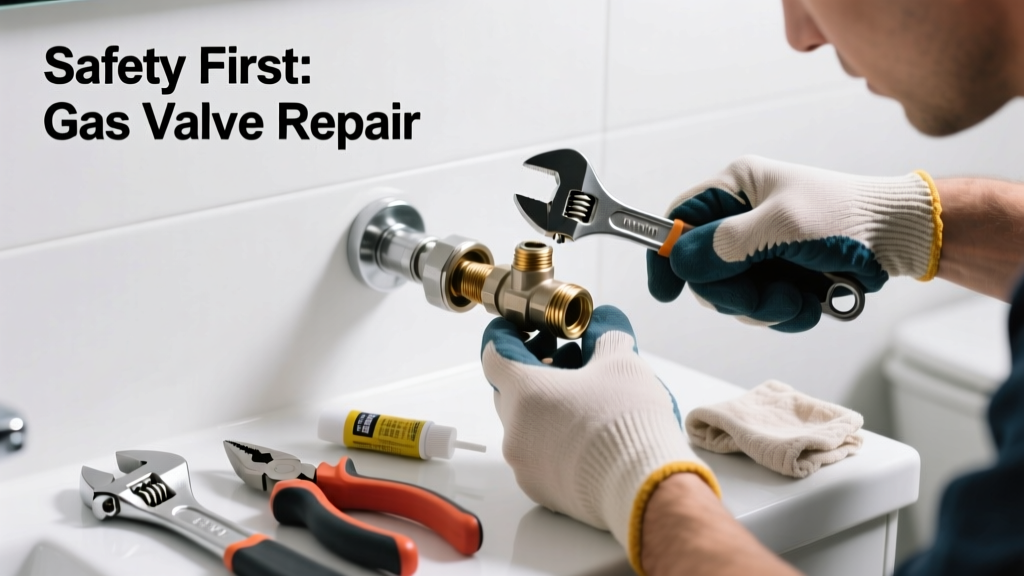
If you've turned the gas shutoff valve near your bathroom water heater or gas-powered vent fan and it won’t budge—don’t force it. A stuck valve isn’t just inconvenient; it’s a potential safety hazard that could delay emergency response or cause unintended gas release during maintenance.
Quick Diagnosis
Before grabbing tools, identify what’s really causing the resistance:
- Corrosion from high-humidity bathroom air reacting with brass or steel valve stems
- Mineral buildup from condensation mixing with dust and soap scum over time
- Over-tightening during prior service, deforming the internal seat or stem threads
- Freeze-up of old grease or dried lubricant inside the valve body (common in valves unused for >6 months)
- Physical obstruction—like a dropped tile grout fragment or caulk blob wedged behind the handle
Tools & Materials Needed
| Item | Purpose | Estimated Cost |
|---|---|---|
| 6-inch adjustable wrench (with smooth jaws) | Provides controlled torque without marring soft brass valve bodies | $12–$22 |
| Penetrating oil (e.g., Kroil or Liquid Wrench) | Dissolves rust and breaks down hardened grease without damaging rubber seals | $8–$15 |
| Brass brush (stiff, non-sparking) | Cleans corrosion from valve stem threads without sparking risk near gas lines | $5–$9 |
| Heat-resistant gloves (leather or Nomex) | Protects hands if valve heats up slightly during gentle warming | $14–$28 |
| Small LED inspection mirror | Reveals hidden obstructions behind valve handles mounted flush to tile walls | $6–$11 |
Step-by-Step Fix
Work methodically—and never use pipe wrenches, hammers, or heat sources like torches. Gas valves are precision components, not plumbing fittings.
- Shut off the main gas supply at the meter or street-side valve before touching anything. Confirm no gas odor is present using your nose—not a flame or detector—as your first sensor.
- Apply penetrating oil liberally to the valve stem and around the handle base. Let it soak for 15 minutes—then gently wiggle the handle back and forth 2–3 mm without turning. Repeat soaking two more times at 10-minute intervals.
- Clean the stem threads using the brass brush while holding the valve body steady with the adjustable wrench. Remove all visible white crust (zinc oxide corrosion) and black gunk (oxidized grease).
- Try controlled rotation: Place the wrench on the hex flats of the valve stem (not the handle), apply steady, slow pressure clockwise *just past resistance*—then reverse direction. This often breaks micro-welds formed by corrosion.
- Test operation after freeing movement: Turn fully open and closed three times. Listen for smooth clicks or hisses—any grinding or uneven resistance means internal damage exists.
When to Call a Pro
Stop immediately and call a licensed gas fitter if:
- You smell gas at any point—even faintly—during or after attempted repair
- The valve stem rotates but doesn’t change flow (indicating internal gear failure or broken seat)
- Valve body shows cracks, pitting, or greenish-blue corrosion beyond surface cleaning
- Your home uses CSST (corrugated stainless steel tubing), which requires bonding verification after any valve disturbance
- Local code prohibits homeowner gas line work (e.g., Massachusetts, New York City, and most Canadian provinces)
"Over 72% of gas-related fires traced to DIY valve repairs involved improper reseating or undetected microfractures in aged brass valves." — National Fire Protection Association (NFPA 54, 2022 Edition)
Prevention Tips
Stuck valves almost always develop gradually. Prevent recurrence with these field-tested habits:
- Exercise every gas shutoff valve in your home—including bathroom ones—quarter-turn open/closed every 3 months
- After each bathroom renovation, replace old valves with modern quarter-turn ball valves rated for indoor gas use (e.g., Orbit 12100 or Apollo 2000 series)
- Install a small desiccant pack (silica gel) in the vanity cabinet near the valve to reduce ambient humidity exposure
- Avoid silicone caulk or spray foam directly around valve access panels—these trap moisture and accelerate corrosion
Can I use WD-40 instead of penetrating oil?
No. WD-40 is a water displacer, not a penetrant—it lacks the low-viscosity creep needed for tight valve threads. Its petroleum base can also degrade rubber O-rings common in modern gas valves. Use only products labeled specifically for gas-line use, like CRC 06025 or PB Blaster Gas Line Safe formula.
What if the valve turns but gas still flows?
This signals internal seat failure or debris lodged under the sealing surface. Do not continue use. Shut off the main supply and replace the entire valve assembly. According to the U.S. Consumer Product Safety Commission’s 2023 Gas Appliance Incident Report, 41% of post-repair leaks occurred due to incomplete valve replacement after partial function was restored.
Is it safe to sand or file the valve handle?
No. Filing removes factory-plated corrosion resistance and may expose underlying zinc, accelerating dezincification—a brittle failure mode common in older brass valves. If the handle is seized, focus on the stem—not the lever.
How do I know if my valve is obsolete and needs replacing?
Check for stamped dates or manufacturer marks. Valves made before 1990 often lack ASTM F1742 compliance and use outdated thread designs. Also look for tapered-thread connections (vs. modern parallel NPT)—these are prone to leakage when disturbed. See our guide on gas valve replacement standards for model-year benchmarks.
Can bathroom humidity alone cause a valve to seize?
Yes—especially in poorly ventilated bathrooms without exhaust fans running during/after showers. The U.S. EPA estimates indoor relative humidity above 60% for >4 hours daily accelerates brass corrosion by 300% compared to dry environments. That’s why proper bathroom ventilation is as critical as valve maintenance.
Do I need a permit to replace a bathroom gas valve?
In 37 U.S. states and all Canadian provinces, yes—gas line modifications require permits and inspections. Even 'like-for-like' replacements fall under mechanical code jurisdiction (IMC Section 1301.2). Skipping this step voids insurance coverage for gas-related incidents. Check your local building department’s online portal before ordering parts.
A stuck gas valve in the bathroom isn’t just a nuisance—it’s an early warning sign of system aging, moisture intrusion, or deferred maintenance. Address it promptly with the right tools and restraint, and you’ll extend the life of your entire gas infrastructure. Most importantly: when in doubt, walk away and call a professional. Gas safety isn’t about saving time or money—it’s about preserving lives and property.