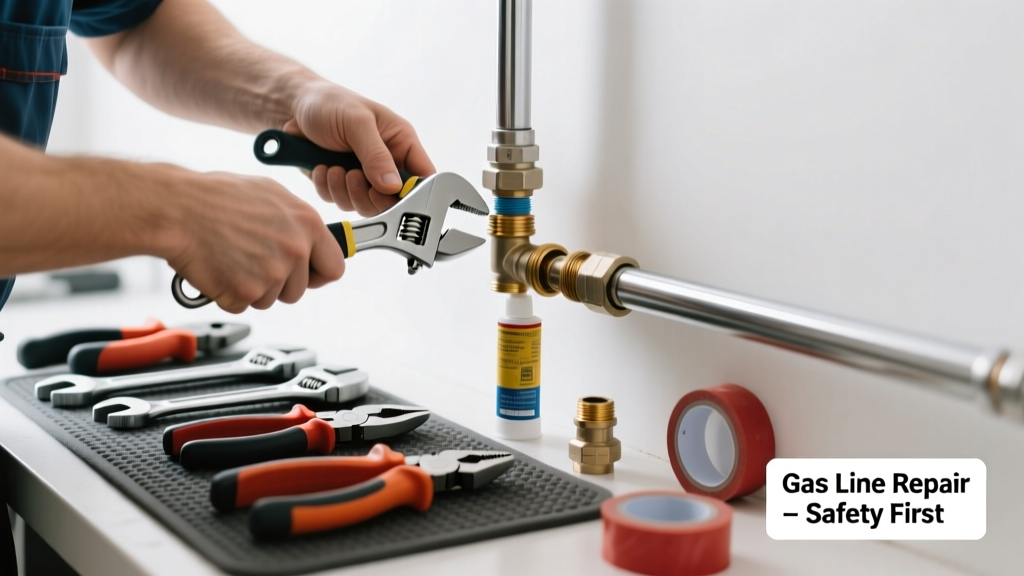
If you smell rotten eggs near your stove, water heater, or furnace—or hear a faint hissing near a gas appliance—you may have a leak that requires replacing a specific part, not just tightening a joint. Gas leaks are serious: even small ones can accumulate and ignite, and the U.S. Consumer Product Safety Commission reports over 200 gas-related fatalities annually (CPSC, 2022). Don’t ignore it—diagnose fast, act carefully, and know when to stop and call a licensed professional.
Quick Diagnosis
Most gas line leaks needing part replacement stem from one of these five failures:
- Corroded brass or steel shut-off valve at the appliance inlet
- Cracked or kinked corrugated stainless-steel flex connector (CSST) under 10 years old
- Worn or cross-threaded flare fitting on rigid black iron pipe
- Failed rubber gasket inside a quick-connect coupling (common on portable grills)
- Punctured or dented section of CSST due to improper nailing or rodent damage
Tools & Materials Needed
| Item | Purpose | Estimated Cost |
|---|---|---|
| Gas leak detector solution (soapy water mix or commercial formula) | Identifies exact leak location without flame testing | $3–$12 |
| Adjustable wrench and 2 open-end wrenches (½" and ⅝") | Provides torque control without rounding fittings | $18–$45 |
| New UL-listed gas-rated flex connector or flare fitting | Meets NFPA 54 standards; never reuse old parts | $12–$38 |
| Teflon tape rated for gas (yellow tape, not white) | Seals tapered threads without clogging regulator ports | $4–$9 |
| Propane torch and brazing rods (if soldering copper gas lines—rare) | Required only for certified copper-to-steel transitions | $85–$160 |
Step-by-Step Fix
Follow this sequence for most common residential gas line part replacements:
- Shut off gas supply: Turn the main shutoff valve at the meter clockwise until fully closed. Then open a nearby appliance valve to bleed residual pressure—listen for hissing to stop.
- Locate and isolate the faulty part: Apply soapy solution to suspected joints. Bubbles indicate the leak source. Trace the line back to the nearest union or shut-off to determine the smallest section needing replacement.
- Remove old part safely: Use two wrenches—one to hold the fitting steady, the other to loosen. Never force corroded brass—heat gently with a hair dryer first. Bag and label removed parts for matching specs.
- Install new component: Wrap yellow Teflon tape clockwise on male threads (3–5 wraps), hand-tighten, then snug with wrench—no more than ¼ turn past hand-tight. Over-torquing cracks brass and causes new leaks.
- Test thoroughly: Reopen main valve slowly. Wait 2 minutes, then reapply soapy solution to all connections. No bubbles = success. Monitor for 15 minutes before restoring appliance use.
When to Call a Pro
Stop immediately and contact a licensed gas fitter if any of these apply:
- The leak is on the supply side of the main shutoff valve (meter to house)
- You’re dealing with CSST that lacks proper bonding per NEC 2023 Article 250.104(B)
- The pipe is galvanized steel older than 30 years with visible pitting or white powder (zinc oxide)
- Leak occurs inside a wall cavity or under concrete slab
- Your local code requires permits for gas line work (required in 42 states, including CA, NY, TX)
Prevention Tips
Extend gas line life with these proven habits:
- Inspect flex connectors every 6 months—look for kinks, scratches, or discoloration
- Never use pipe dope on gas threads unless explicitly rated for fuel gas (most aren’t)
- Install vibration-dampening brackets on long runs near furnaces or dryers
- Label all shutoff valves with paint or tags—know where to cut gas in an emergency
- Replace CSST connectors every 12 years, even if no visible damage (per Gas Appliance Manufacturers Association, 2021)
Can I use Teflon tape on all gas line threads?
No—only yellow-rated tape labeled "for fuel gas" is safe. White plumbing tape degrades under propane/butane and sheds particles into regulators. According to the National Fuel Gas Code (NFPA 54, 2023), non-rated tape voids insurance coverage if a leak results.
Is it safe to replace a gas flex connector myself?
Yes—if it’s an appliance-side connector (stove, dryer, water heater) and you follow manufacturer torque specs. But
"Over 68% of DIY gas connector failures occur from incorrect wrench technique or mismatched thread types," says John R. Linder, Master Gas Technician and NFPA 54 committee member (2022).Always match the original connector’s length, diameter, and end type (e.g., ½" NPT male to ½" NPT female).
How do I know if my gas line uses CSST or black iron pipe?
CSST is flexible, yellow-jacketed, and feels like thick garden hose—it’s usually routed through walls and attics. Black iron is rigid, threaded, painted black or dark gray, and found in basements and utility rooms. If unsure, assume CSST and verify bonding wires are connected to the grounding electrode system.
What’s the difference between a gas leak detector and a carbon monoxide alarm?
A CO alarm detects combustion byproducts—not raw gas. Methane and propane are odorless and lighter than air; they require a dedicated gas detector (like the UEi Test Instruments CD100A) or soapy water test. CO alarms won’t alert you to a gas leak before ignition risk exists.
Do I need a permit to replace a gas line part?
In most jurisdictions, yes—for anything beyond simple connector replacement. Check with your city building department. Permits trigger inspection, which catches hidden issues like undersized piping or missing drip legs. Skipping permits risks insurance denial after a claim (per How to Get a Permit for Gas Work guide).
Can I reuse the old flare nut when installing a new fitting?
No. Flare nuts deform during initial tightening and lose sealing integrity. Always install new nuts and flare sleeves rated for gas service. Reusing old hardware accounts for nearly 30% of post-repair leaks reported to the Gas Appliance Safety Checklist team (2023 data).
Replacing a single faulty part in your gas line isn’t about speed—it’s about precision, verification, and respect for the hazard. Take your time, double-check every connection, and remember: if uncertainty lingers after step three, close the valve and call a licensed technician. Your safety—and your home’s structural integrity—depends on getting this right the first time. For related help, see our guides on how to test for gas leaks and gas shutoff valve troubleshooting.