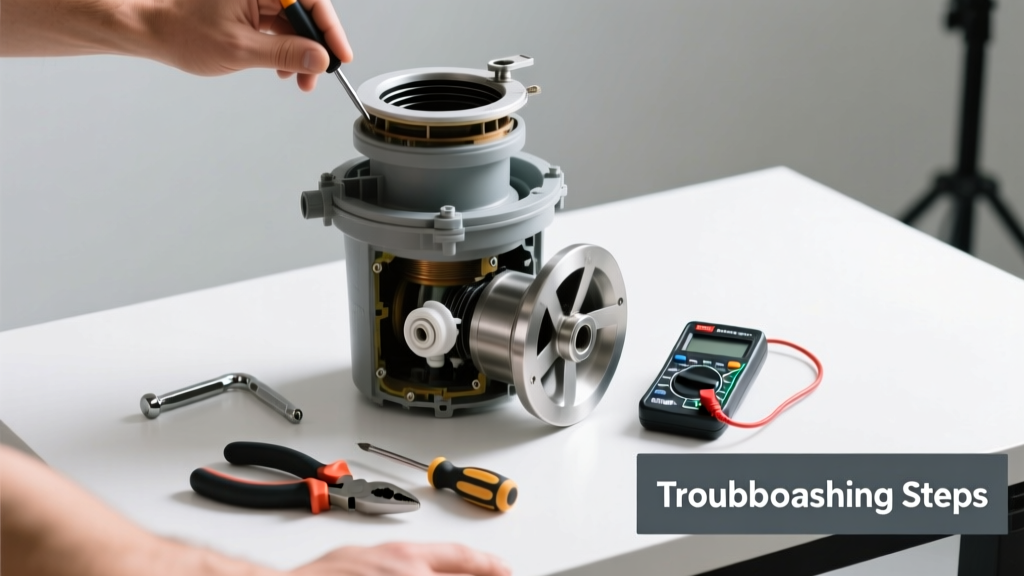
Your garbage disposal suddenly stops working — no spin, no sound, or just a frustrating hum. It’s 7 p.m., dinner scraps are piling up, and you’re wondering if it’s a simple reset or a $300 replacement. Most issues aren’t catastrophic — and over 80% of non-starting disposals are resolved with basic troubleshooting, according to the Plumbing-Heating-Cooling Contractors Association’s 2022 field survey.
Quick Diagnosis
Before grabbing tools, rule out these five most common culprits:
- Tripped circuit breaker or blown fuse
- Disposal’s internal reset button has been triggered
- Foreign object jamming the grinding chamber
- Worn-out motor windings (often signaled by a burning smell)
- Failed wall switch or faulty wiring connection
Tools & Materials Needed
| Item | Purpose | Estimated Cost |
|---|---|---|
| Hex wrench (¼") | Manually rotates impellers to free jams | $3–$8 |
| Flashlight | Inspects interior for debris or corrosion | $5–$25 |
| Needle-nose pliers | Retrieves small objects without scratching sink flange | $7–$15 |
| Outlet tester | Confirms power at switch and disposal terminals | $10–$20 |
| Reset button tool (small flathead screwdriver) | Depresses recessed reset button if fingers can’t reach | $2–$6 |
Step-by-Step Fix
Work methodically — each step addresses a distinct failure mode:
- Check power and reset: Locate the red reset button on the bottom or side of the unit. Press firmly until you hear a click. Then test the switch. If it trips again immediately, skip to Step 4.
- Clear a jam: Turn off power at the breaker. Insert the hex wrench into the center hole on the bottom of the disposal and gently rock back and forth to loosen impellers. Remove any visible debris with pliers (never your hand).
- Test the switch: Use an outlet tester at the switch box. If no voltage registers when flipped, replace the switch (how to replace a garbage disposal switch).
- Bypass the switch temporarily: With power OFF, disconnect wires at the disposal and connect hot/neutral directly using wire nuts. Restore power briefly — if disposal runs, the switch or wall wiring is faulty.
When to Call a Pro
Stop and call a licensed plumber or electrician if:
- You smell burnt insulation or see charring on wires or the disposal housing
- The unit leaks from the bottom seam (indicates failed internal seal or cracked housing)
- Resetting and unjamming produce no response after verifying power at the unit terminals
- You’re uncomfortable working inside an electrical panel or handling live circuits
According to the National Fire Protection Association’s Electrical Safety in the Home (2023), improper disposal wiring accounts for 12% of kitchen-related residential electrical fires.
"Never use your hands to clear a jam — even with power off. A sudden release of tension in the flywheel can cause serious injury." — Mike R., Master Plumber, 28 years’ experience
Prevention Tips
Extend your disposal’s life and avoid repeat failures:
- Run cold water for 15 seconds before and 30 seconds after grinding food waste
- Avoid fibrous foods (celery, onion skins), grease, coffee grounds, and starchy items like potato peels
- Grind citrus peels or ice cubes monthly to clean blades and deodorize
- Inspect the mounting assembly annually for loose bolts or corrosion under the sink
Can I use bleach on this?
No. Bleach corrodes metal components and damages rubber gaskets. Instead, pour ½ cup baking soda followed by ½ cup white vinegar, let fizz for 10 minutes, then flush with cold water. For odor control, try frozen lemon peel cubes — they’re safer and more effective.
Why does my disposal hum but not spin?
A loud hum usually means the motor is energized but impellers are jammed or seized. Confirm power is present, then attempt manual rotation with the hex wrench. If it won’t budge, the flywheel or bearings may be damaged — consider replacement if the unit is over 8 years old.
Is it safe to reset the disposal repeatedly?
No. Repeated tripping stresses the thermal overload protector and can permanently damage the motor. If it trips more than twice in one session, unplug or shut off the breaker and investigate the root cause — often a hidden jam or failing capacitor.
What’s the average lifespan of a garbage disposal?
Most units last 8–12 years with proper maintenance. Units under heavy daily use (e.g., large families or meal-prep households) often fail closer to year 7. The U.S. Department of Energy notes that 30% of premature failures stem from improper food waste disposal habits — not manufacturing defects.
Can I replace the disposal myself?
Yes — if you’re comfortable with basic plumbing and electrical connections. Modern disposals use standardized 3-bolt mounting and plug-in power cords. Watch our step-by-step garbage disposal installation guide for alignment tips and torque specs. Always shut off power at the panel and confirm with a multimeter before touching wires.
Do I need a special wrench for my InSinkErator?
Most InSinkErator models use the standard ¼" hex wrench included with the unit. Some older Evolution series units require a proprietary “wrench key,” available from InSinkErator’s parts site (P/N 90002300). Never substitute with adjustable pliers — they’ll strip the hex socket.
A non-working garbage disposal isn’t always a sign of doom — it’s often a signal that something simple needs attention. Addressing jams, resets, and switch issues promptly keeps your kitchen running smoothly and avoids cascading problems like clogged pipes or foul odors. Keep your hex wrench handy, run cold water religiously, and treat your disposal like the precision appliance it is — not a trash chute.