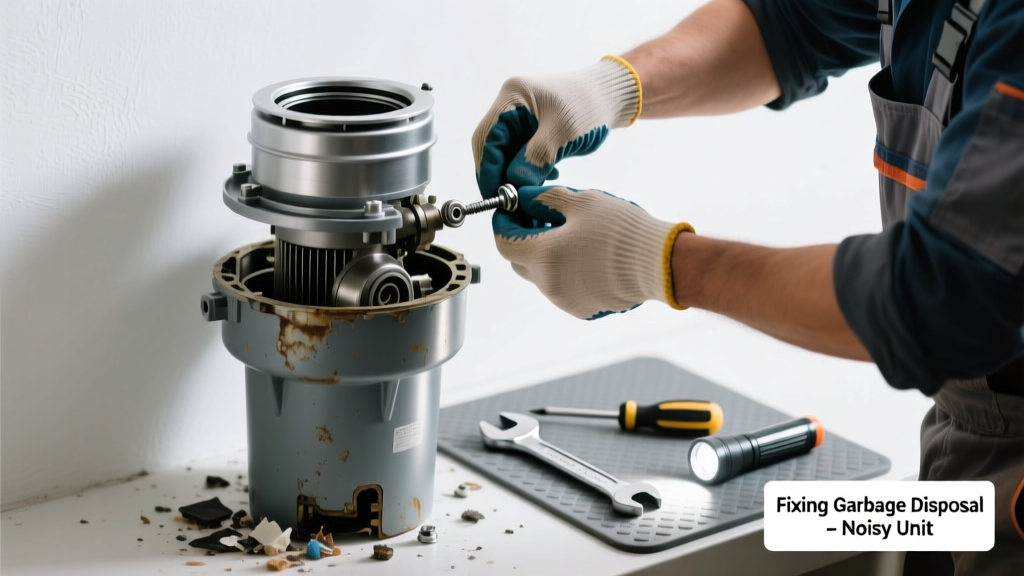
Your garbage disposal suddenly groans, buzzes without spinning, or clanks like metal in a blender — and dinner scraps are backing up. This isn’t just annoying; it’s a sign something’s jammed, worn, or misaligned. Most of these issues can be resolved in under 30 minutes with basic tools and caution.
Quick Diagnosis
Before grabbing tools, identify the noise type and behavior:
- Humming but no rotation → Likely a jammed impeller or failed motor capacitor
- Grinding or scraping → Foreign object (utensil, bone fragment) or worn grinding ring
- Rattling or clunking → Loose mounting assembly or damaged flywheel
- Clicking on startup → Tripped reset button or faulty switch wiring
- Burning smell + silence → Overheated or burnt-out motor (do not restart)
Tools & Materials Needed
| Item | Purpose | Estimated Cost |
|---|---|---|
| Allen wrench (1/4") | Manually rotate the grinding plate to clear jams | $2–$5 |
| Disposal wrench (or hex key) | Designed for turning the flywheel from the bottom access hole | $4–$8 |
| Flashlight | Inspect interior for debris or damage without disassembly | $5–$15 |
| Needle-nose pliers | Safely extract small metal or plastic objects | $6–$12 |
| Reset button tool (small screwdriver) | Press the red reset button if motor overheats | $0 (use existing) |
Step-by-Step Fix
Work safely: Always shut off power at the circuit breaker — not just the wall switch — before touching any part. Verify with a non-contact voltage tester.
- Reset the unit: Locate the red reset button on the bottom or lower rear of the disposal. Press firmly. If it pops back out immediately, skip to step 3 — the motor is likely seized or shorted.
- Clear the jam: Insert the Allen wrench into the center bottom hex socket. Rotate clockwise and counterclockwise to free stuck debris. You’ll feel resistance ease when the flywheel turns freely. Test with power restored — if it hums again, repeat.
- Check for foreign objects: Shine a flashlight inside. Use needle-nose pliers (power OFF!) to remove visible items — never your fingers. Look especially near the grinding ring and drain opening.
- Test the switch and wiring: If no sound at all when switched on, check the wall switch with a multimeter. A reading of 0 volts across terminals indicates a dead switch or broken wire — see garbage disposal switch replacement.
When to Call a Pro
Don’t risk shock, flooding, or further damage in these cases:
- You smell burning insulation or see charring on wires or the motor housing
- The disposal leaks water from the bottom seal or mounting flange
- It trips the GFCI repeatedly after resetting and clearing jams
- There’s visible corrosion on internal components or cracked housing
- You’ve replaced the reset button and capacitor but still get no response
According to the National Association of Home Builders’ 2022 Remodeling Impact Report, 68% of homeowners who delayed professional help after motor failure ended up paying 2.3× more due to secondary water damage and cabinet rot.
Prevention Tips
Extend your disposal’s life and avoid noise issues with consistent habits:
- Run cold water for 15 seconds before and 30 seconds after grinding — it solidifies grease so it flushes cleanly
- Avoid fibrous foods (celery, onion skins), coffee grounds, and starchy items (potato peels) that clog or dull blades
- Grind ice cubes monthly to sharpen impellers and clean residue — add 1/2 cup vinegar for deodorizing
- Tighten mounting bolts annually — vibration loosens them over time, causing rattles
- Replace rubber splash guard every 2–3 years; cracks let debris slip behind the flange and jam the flywheel
Can I use bleach to clean my noisy disposal?
No. Bleach corrodes metal components and degrades rubber seals, accelerating wear and increasing future noise. Instead, use baking soda and vinegar followed by cold water flushes — it’s safer and equally effective for odor and buildup. For persistent gunk, try garbage disposal deep clean methods.
Why does my disposal make a loud grinding noise only when I run it?
This usually means a hard object — like a fruit pit, small utensil, or bone shard — is wedged between the impeller and grinding ring. It may not block rotation entirely but creates friction on each spin. Turn off power, inspect with a flashlight, and remove the object with pliers before restarting.
Is it safe to reach inside the disposal with my hand?
Never. Even with the switch off, the unit could activate unexpectedly if someone flips the breaker or switch. Always use long-handled tongs or needle-nose pliers — and verify power is cut at the panel with a voltage tester first.
What does a failing disposal capacitor sound like?
A weak or failed start capacitor causes a loud, sustained 60Hz hum with zero blade movement — the motor tries to spin but lacks torque. It won’t reset, won’t respond to manual turning, and often overheats within seconds. Capacitors cost $8–$15, but replacement requires electrical knowledge — consider hiring a pro unless you’re experienced with appliance motors.
How long should a garbage disposal last before making noise regularly?
Most units last 8–12 years with proper care, per the U.S. Department of Energy’s 2023 Appliance Lifespan Guide. If yours is older than 10 years and now grinding loudly or cycling on/off, internal wear is likely — replacement may be more economical than repeated repairs.
Can a loose sink flange cause rattling noises?
Yes. A loose flange lets the entire disposal shift slightly during operation, creating rhythmic clunks or vibrations transmitted through pipes and cabinets. Tighten the three mounting bolts evenly with a wrench — don’t overtighten, or you’ll crack the sink flange. Check this before assuming internal failure.
A noisy disposal doesn’t always mean it’s time for a new unit — but ignoring the sound can turn a $5 fix into a $300 plumbing emergency. Take 20 minutes today to inspect, reset, and clear. Keep a disposal wrench taped under your sink — it’s saved more than one dinner party from disaster. And if the hum returns next week? Now you know exactly what to listen for and where to look.