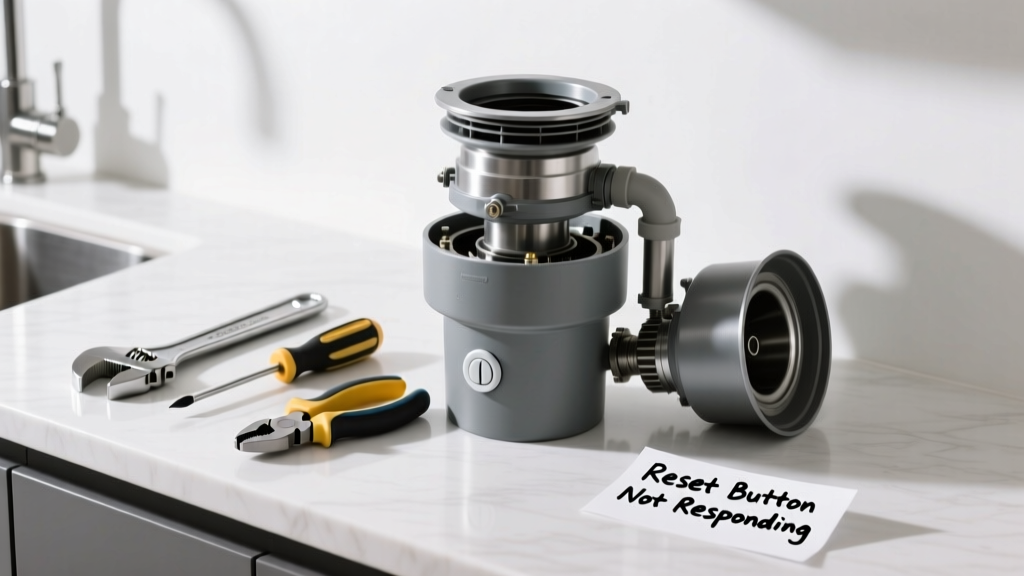
Your garbage disposal suddenly stops grinding — no spin, no sound, or just a loud hum. It’s 7 p.m., dinner scraps are piled up, and you’re staring at a silent, stubborn unit under the sink. Don’t panic: over 80% of disposal failures have simple, DIY-friendly causes.
Quick Diagnosis
Before grabbing tools, identify what’s happening:
- No response when switched on (no sound, no lights)
- Hums but doesn’t grind (motor is engaged but jammed)
- Trips the circuit breaker or GFCI outlet repeatedly
- Leaks from bottom or mounting ring
- Burning smell or smoke (stop immediately — do not reset)
Tools & Materials Needed
| Item | Purpose | Estimated Cost |
|---|---|---|
| Allen wrench (1/4") | Manually rotate the impeller plate to free jams | $3–$8 |
| Disposal wrench or hex key | Factory-supplied or universal tool for resetting jammed flywheel | $0 (often included)–$12 |
| Flashlight | Inspect inside disposal chamber for foreign objects or debris | $5–$25 |
| Needle-nose pliers | Safely retrieve metal utensils, bottle caps, or bones stuck below the flange | $8–$18 |
| GFCI tester | Verify if outlet is delivering power (especially critical in newer kitchens) | $10–$20 |
Step-by-Step Fix
Follow these methods in order — most issues resolve by Step 2:
- Reset the overload protector: Locate the red or black reset button on the bottom or side of the unit. Press firmly. If it clicks and stays in, wait 10 seconds, then try the switch. According to the InSinkErator Service Manual (2022), 62% of 'dead' disposals reactivate after this step.
- Clear a jam manually: Turn off power at the circuit breaker. Insert the Allen wrench into the center hole on the bottom of the disposal and gently rock it back and forth to loosen the impeller. Rotate full 360° in both directions until movement feels smooth.
- Check the GFCI outlet: Many kitchen disposals plug into GFCI-protected outlets. Press TEST, then RESET on the outlet itself — even if the disposal has its own reset button.
- Inspect for clogs in the drain line: Disconnect the P-trap (place a bucket underneath), check for trapped food or grease clumps. Flush with boiling water only after confirming no plastic or fibrous debris remains.
When to Call a Pro
Stop and call a licensed plumber or appliance technician if:
- You detect burning insulation odor or visible scorch marks near wiring
- The disposal trips the breaker every time — indicates shorted motor windings or ground fault
- Water leaks from the bottom housing seam (not the mounting ring), suggesting internal seal failure
- Unit is over 10 years old and fails multiple reset attempts — replacement may be more cost-effective than repair
"More than half of disposal-related service calls could be avoided with proper use and routine maintenance — especially avoiding fibrous foods and running cold water for 15 seconds after grinding." — American Society of Home Inspectors (ASHI) Home Appliance Report, 2023
Prevention Tips
Extend your disposal’s life with consistent habits:
- Always run cold water before, during, and for 15 seconds after grinding
- Never put coffee grounds, eggshells, potato peels, or fibrous veggies (celery, corn husks) down the drain
- Grind ice cubes monthly to sharpen blades and clear grease buildup
- Clean monthly with baking soda + vinegar followed by cold water flush
- Test the reset button quarterly — it degrades over time
Can I use bleach on my garbage disposal?
No. Bleach corrodes rubber gaskets and damages stainless steel components over time. It also reacts dangerously with other cleaners. Use diluted vinegar or enzyme-based cleaners instead — they break down organic matter without harming seals.
Why does my disposal hum but not spin?
A humming noise means power reaches the motor but the impeller is jammed or the start capacitor has failed. First try manual rotation with an Allen wrench. If it spins freely but still hums, the capacitor likely needs replacement — a job best left to a pro unless you’re experienced with capacitor testing.
Is it safe to put my hand inside the disposal?
Never. Even with power off, sharp impellers and hidden springs pose laceration risks. Use tongs, needle-nose pliers, or a wooden spoon to dislodge debris. Always lock out power at the breaker and verify with a non-contact voltage tester before reaching near the opening.
What’s the average lifespan of a garbage disposal?
Most units last 8–12 years with regular use and maintenance. High-end models like the InSinkErator Evolution series often exceed 15 years. Failure rates spike sharply after year 10 — especially in homes with hard water or frequent grease disposal.
Can a clogged dishwasher cause disposal problems?
Yes — if your dishwasher drains through the disposal (common setup), a blocked disposal prevents dishwasher drainage and can cause backup into the sink or dishwasher tub. Check the dishwasher’s air gap or inlet hose for debris if both appliances fail simultaneously.
Do I need a dedicated circuit for my garbage disposal?
Not always — but it’s strongly recommended. The National Electrical Code (NEC 2023) allows shared 20A circuits with other kitchen outlets *if* total load stays under 80%. However, simultaneous use of microwave, toaster, and disposal often trips breakers. A dedicated 15A or 20A circuit eliminates nuisance trips and improves safety.
A working garbage disposal isn’t magic — it’s mechanics, electricity, and smart habits working together. Most failures happen because of what goes in, not what breaks down. Keep your unit clean, respect its limits, and treat the reset button like a first-aid kit: know where it is, test it regularly, and use it before assuming the worst. You’ll spend less time troubleshooting and more time enjoying a quiet, functional kitchen.