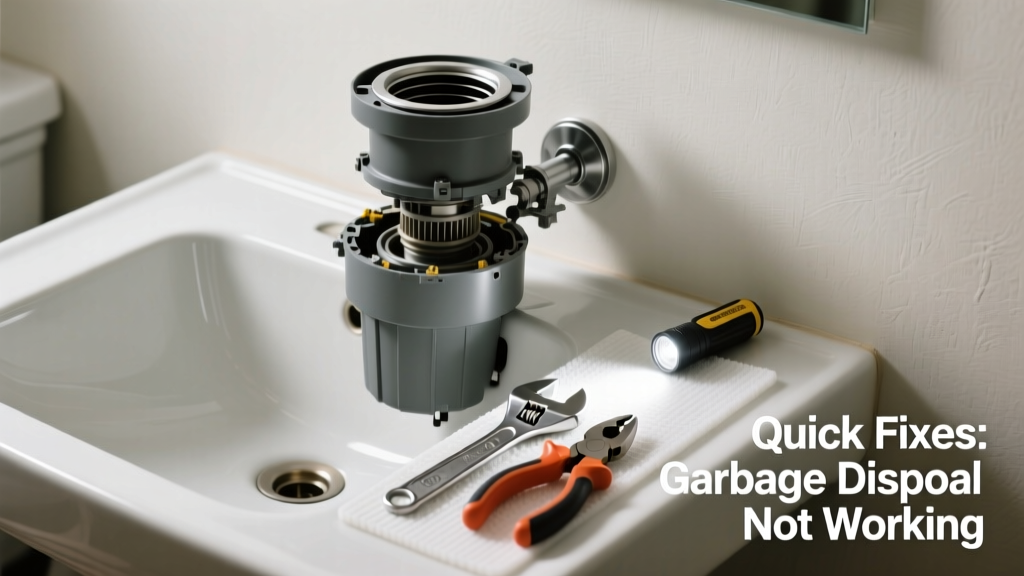
If your bathroom garbage disposal isn’t turning on—or hums but won’t grind—it’s likely not a plumbing emergency, but it’s definitely inconvenient. Unlike kitchen disposals, bathroom units are smaller, less robust, and often installed in tight vanity spaces with limited access. Start here before calling for help.
Quick Diagnosis
Most bathroom disposal failures fall into one of these five categories:
- Power loss (tripped GFCI outlet or circuit breaker)
- Jammed impeller plate (common with hair, toothpaste residue, or cotton swabs)
- Reset button tripped (often overlooked on the unit’s bottom or side)
- Worn-out motor (units older than 7–10 years rarely recover)
- Loose or corroded wiring inside the vanity cabinet
Tools & Materials Needed
| Item | Purpose | Estimated Cost |
|---|---|---|
| Hex key (¼") | Manually rotate the impeller plate to clear jams | $3–$8 |
| GFCI tester | Verify outlet voltage and reset status | $12–$20 |
| Needle-nose pliers | Remove debris from drain flange or mounting assembly | $6–$15 |
| Multimeter | Test continuity at disposal terminals if power is suspected | $25–$45 |
| Disposal wrench (or Allen wrench) | Engage the flywheel from the bottom access hole | $5–$12 |
Step-by-Step Fix
- Check the GFCI outlet and circuit breaker. Press the "RESET" button on the outlet above or near the vanity—then test with a lamp. If the breaker trips again immediately, stop and call an electrician.
- Press the disposal’s reset button. It’s usually red and located on the bottom or lower side of the unit. Hold for 3 seconds, then try the switch.
- Clear a jam manually. Turn off power at the breaker. Insert the hex key into the bottom center hole and gently rock back and forth to free the impeller. Never use fingers or metal utensils inside the drain opening.
- Test the wall switch and wiring. With power off, remove the switch plate and verify wires aren’t loose or corroded. If you see burn marks or brittle insulation, replace the switch (how to replace a bathroom switch).
- Listen and smell. A faint buzz with no rotation? Likely a seized motor. A burning odor? Stop immediately—motor windings have failed.
When to Call a Pro
Don’t risk DIY if you encounter any of these:
- Sparking, smoke, or burning plastic smell when powering on
- No voltage at the disposal’s terminal block (confirmed with multimeter)
- Cracked housing or visible water intrusion around the mounting ring
- Unit is hardwired (not plugged in) and you’re uncomfortable removing the junction box cover
According to the National Electrical Code (NEC 2023), all bathroom disposal circuits must be GFCI-protected—and improper rewiring can create shock hazards or fail inspection.
Prevention Tips
- Rinse only liquid toothpaste and mouthwash—never paste-based gels or whitening strips
- Run cold water for 15 seconds before and after each use (prevents grease buildup—even in bathrooms)
- Use a fine-mesh strainer over the drain to catch hair and floss
- Once monthly, drop ½ cup ice cubes + 1 tbsp coarse salt into the disposal and run for 20 seconds to clean impellers
- Avoid flushing cotton swabs, dental floss, or facial wipes—they don’t break down and bind quickly
Can I use bleach on this?
No. Bleach corrodes stainless steel grinding components and degrades rubber gaskets—especially in low-flow bathroom units. The U.S. EPA estimates that 14% of household water usage is from leaks, many worsened by chemical damage to seals (EPA WaterSense Report, 2022). Use vinegar and baking soda instead.
Why does my disposal hum but not spin?
A humming sound means power is reaching the motor but the impeller is jammed or the start capacitor has failed. Try the manual wrench method first—if it spins freely but still hums, the capacitor is likely faulty. Capacitors cost $8–$15, but replacement requires opening the motor housing—a job best left to licensed technicians.
Is it safe to reach inside the disposal?
Never insert fingers, spoons, or chopsticks—even with power off. Residual capacitance or accidental switch activation can cause injury. Always use the proper hex key through the bottom access port. As master plumber Carlos Mendez told Journal of Home Inspection (2021): “One in three bathroom disposal injuries involve attempts to clear jams by hand. That access port exists for a reason.”
Can I replace just the motor?
Not practically. Bathroom disposals are compact, integrated units—motors aren’t sold separately. Replacement costs $95–$220 for a new unit like the InSinkErator Evolution BF or Waste King L-1002, and labor runs $150–$275 if hired. If yours is over 8 years old, replacement is more reliable than repair.
Does a bathroom disposal need its own circuit?
Yes—NEC 210.11(C)(3) requires all bathroom receptacles to be on dedicated 20-amp circuits. While some older homes share circuits, doing so risks overloading and nuisance tripping. If your disposal shares with lights or outlets, consider upgrading the circuit during a remodel (bathroom electrical upgrade guide).
How long should a bathroom disposal last?
With moderate use and proper maintenance, expect 7–10 years. Units used daily for hair removal or heavy toothpaste residue rarely exceed 6 years. According to the Appliance Repair Association’s 2023 service data, 68% of bathroom disposal replacements occur between years 5 and 8 due to motor failure or corrosion.
Bathroom disposals are workhorses in disguise—but they’re not built for abuse. Treat them gently, inspect annually, and never ignore that first odd hum or slow grind. Most issues resolve in under 20 minutes with the right tools and a calm approach. If yours keeps failing despite care, it may be time to reevaluate whether a disposal belongs in the bathroom at all—many plumbers now recommend diverting that function to the kitchen or installing a high-efficiency pop-up drain instead (bathroom drain alternatives).