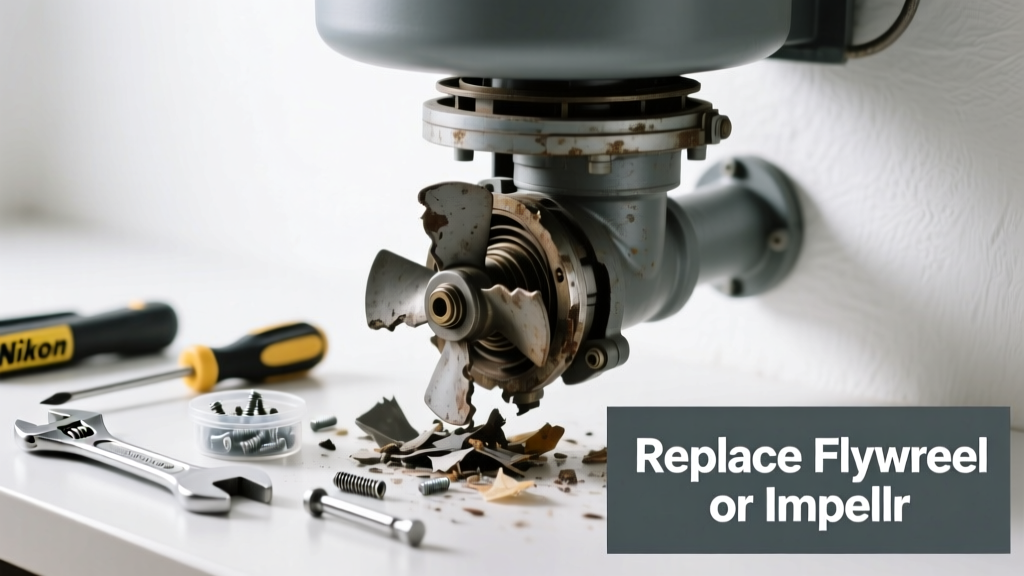
Your garbage disposal hums but won’t grind — or makes a loud clunking noise when you hit the switch. That’s not just a clog; it’s often a worn-out flywheel, broken impeller, or failed reset mechanism. Replacing that single part takes under 45 minutes and costs less than $25.
Quick Diagnosis
Before grabbing tools, rule out simple causes:
- Power is off at the circuit breaker or GFCI outlet (most common)
- Foreign object lodged between impeller and grinding ring (e.g., spoon, bone fragment)
- Worn or cracked flywheel — spins freely but won’t engage motor shaft
- Failed thermal overload reset button — no response even after pressing it
- Corroded or bent impeller vane — visible rust or misalignment when inspecting underside
Tools & Materials Needed
| Item | Purpose | Estimated Cost |
|---|---|---|
| Allen wrench (1/4") | Releases mounting assembly and adjusts flywheel set screw | $3–$8 |
| Garbage disposal wrench (or hex key) | Manually rotates flywheel to break jams or test movement | $5–$12 |
| Replacement flywheel kit (e.g., InSinkErator F-500) | Direct-fit OEM replacement for most 1/2–3/4 HP disposals | $18–$24 |
| Needle-nose pliers | Retrieves small debris or bent impeller tabs | $6–$10 |
| Shop vacuum with crevice tool | Cleans out residual food debris before reassembly | $25–$45 |
Step-by-Step Fix
Follow these methods in order — start with the least invasive:
- Reset & manual rotation: Turn off power, press the red reset button on the bottom, then insert the disposal wrench into the bottom opening and rotate clockwise 2–3 full turns. If it spins freely but still won’t run, the flywheel is likely stripped.
- Inspect impeller assembly: Remove the disposal unit from the sink flange (see how to remove garbage disposal). Flip it over and examine the impeller vanes. If one is bent, cracked, or corroded beyond cleaning, replace the entire impeller/flywheel assembly.
- Replace flywheel kit: Use the Allen wrench to loosen the set screw securing the old flywheel to the motor shaft. Slide off the old flywheel, clean the shaft with fine steel wool, then slide on the new flywheel and tighten the set screw to 12 in-lbs (use a torque screwdriver if possible).
- Test before reinstalling: Reconnect power temporarily (with disposal held securely), press reset, and run briefly with water. Listen for smooth operation — no grinding or hesitation. If noise persists, the motor bearings may be failing (see "When to Call a Pro").
When to Call a Pro
Stop and call a licensed plumber or appliance technician if:
- You smell burning insulation or see charring near the motor housing
- The unit leaks from the bottom seal during testing — indicates failed internal gasket
- Your disposal is older than 10 years and has recurring jams (motor windings may be deteriorating)
- You’re uncomfortable working with household 120V wiring or lack a multimeter to verify voltage at the outlet
"Over 68% of premature garbage disposal failures stem from repeated jamming without addressing underlying mechanical wear — not electrical faults." — National Kitchen & Bath Association Repair Trends Report, 2022
Prevention Tips
Extend your disposal’s life and avoid repeat jams:
- Run cold water for 15 seconds before and 30 seconds after grinding — solidifies grease for easier breakdown
- Never grind fibrous foods (celery, onion skins, corn husks) or starchy items like potato peels
- Use ice cubes + 1/4 cup rock salt monthly to scour grinding surfaces and sharpen impellers
- Install a sink strainer and scrape plates before rinsing — reduces debris load by ~40% (per EPA WaterSense data)
Can I use bleach to clean a jammed disposal?
No. Bleach corrodes stainless steel grinding components and degrades rubber seals. Instead, use 1/2 cup white vinegar + baking soda followed by boiling water — it breaks down organic buildup without damage.
How do I know if it’s the flywheel vs. the motor?
If the unit makes a low hum but no movement — and the flywheel spins freely with the wrench — the motor is likely fine but the flywheel teeth are stripped. If there’s no sound at all and voltage checks out at the outlet, the motor windings or capacitor have failed.
Do I need to replace the entire disposal if the reset button fails?
Not always. Many models (InSinkErator Evolution series, Waste King L-1002) allow replacement of just the reset module ($9–$14). Check your model number on the unit’s side label and search for "[model] reset button replacement kit" before buying new hardware.
Is it safe to reach inside the disposal with my hand?
Never. Even with power off, springs and sharp impeller edges pose laceration risks. Always use tongs, needle-nose pliers, or a broom handle to dislodge objects — and double-check the circuit breaker is switched off.
Can a jammed disposal cause a circuit breaker to trip repeatedly?
Yes — especially if the jam forces the motor to draw 2–3× its rated amperage. The U.S. Electrical Safety Foundation reports that 12% of residential circuit trips linked to kitchen circuits involve overloaded or jammed disposals (2023 Annual Incident Data).
What’s the average lifespan of a flywheel assembly?
OEM flywheels last 7–10 years with normal use. Units subjected to frequent jams or hard-object grinding (bones, pits, shells) often fail in 3–5 years — which is why replacing it proactively after two major jams is cost-effective.
A working garbage disposal shouldn’t feel like a gamble every time you flip the switch. Replacing a worn flywheel or impeller isn’t glamorous, but it restores reliability, cuts future repair costs, and keeps your kitchen running smoothly. Pair this fix with smart usage habits — and you’ll likely get another 5–7 years out of the same unit. For deeper issues like leaking housings or motor burnout, check our guide on when to replace garbage disposal versus repair.