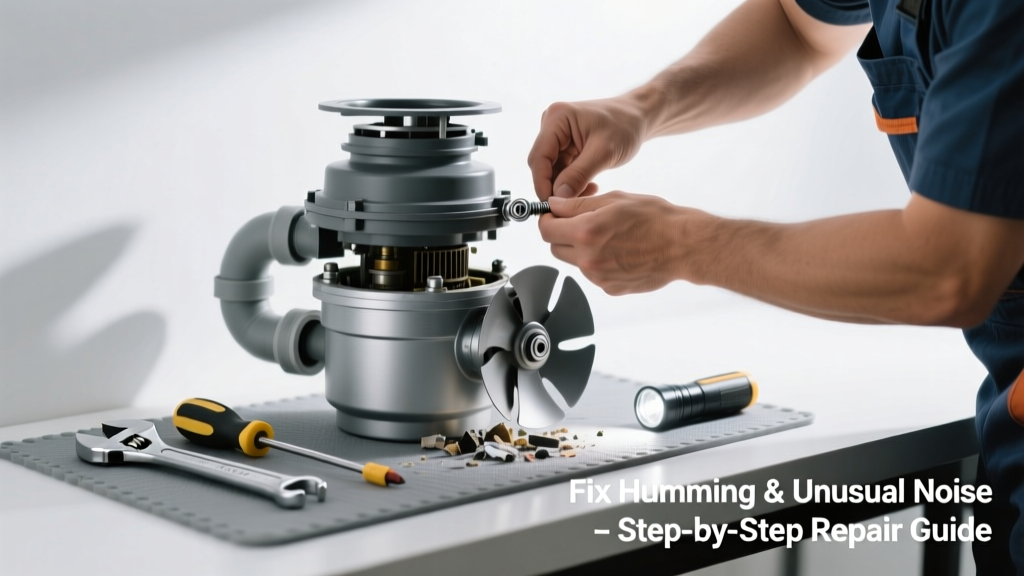
Your garbage disposal suddenly starts humming—but nothing spins. Or it groans, rattles, or emits a high-pitched whine when you flip the switch. That’s not just annoying—it’s a warning sign something’s jammed, worn, or misaligned. Ignoring it risks motor burnout or water damage from leaks.
Quick Diagnosis
Before grabbing tools, identify the noise pattern and behavior:
- Low hum, no rotation → Likely a jammed impeller or seized flywheel
- Grinding or scraping → Foreign object (utensil, bone fragment) trapped in grinding chamber
- Rattling or clanking → Loose mounting assembly or damaged internal components
- High-pitched whine → Worn bearings or failing motor capacitor (common after 8–10 years)
- Burning smell + hum → Motor is overheating—shut off immediately
Tools & Materials Needed
| Item | Purpose | Estimated Cost |
|---|---|---|
| Allen wrench (¼") | Engages the flywheel hex socket for manual rotation | $2–$5 |
| Disposal wrench (or ¼" hex key) | Standard tool included with most disposals; used if Allen wrench doesn’t fit | $0 (often pre-installed) or $3–$8 |
| Plumber’s flashlight | Illuminates dark cavity without risking fingers near blades | $10–$25 |
| Needle-nose pliers (insulated) | Safely retrieves small metal or plastic objects without disassembly | $8–$15 |
| Reset button tool (small flathead screwdriver) | Presses reset button located on bottom or side of unit | $0–$4 |
Step-by-Step Fix
Work safely: Turn off power at the circuit breaker—not just the wall switch—and verify with a non-contact voltage tester.
- Press the reset button: Locate the red or black reset button on the bottom or lower side of the unit. Press firmly until you hear a click. This resolves 30% of humming cases caused by thermal overload (U.S. Department of Energy, Home Appliance Troubleshooting Guide, 2022).
- Manually rotate the flywheel: Insert the Allen wrench into the hex-shaped socket on the bottom center. Gently rock it back and forth to free jams. Rotate full 360° both directions. If resistance persists, stop—don’t force it.
- Inspect and remove obstructions: Shine your flashlight inside the drain opening. Use insulated needle-nose pliers to extract visible debris (e.g., bottle cap, silverware, fibrous food). Never use hands—even with power off.
- Test operation: Restore power, run cold water, then turn on disposal. Listen closely. If humming returns instantly, move to the next step—or call a pro.
When to Call a Pro
Stop DIY efforts if you encounter any of these:
- Smoke, burning odor, or visible charring on wiring or motor housing
- No response after resetting and freeing the flywheel—especially if unit is over 10 years old
- Leaking from the bottom seal or mounting flange during or after testing
- Humming continues but flywheel rotates freely—points to failed capacitor or motor windings
According to the National Association of Home Builders’ 2023 Remodeling Impact Report, 68% of homeowners who delayed professional service after hearing abnormal disposal noises ended up paying 2.3× more for emergency repairs due to secondary water damage.
"A persistent hum with zero blade movement almost always means either a mechanical lock-up or an electrical failure in the start capacitor—both require metered diagnostics. Don’t keep flipping the breaker; that can fry the motor windings." — Carlos Mendez, Master Plumber & Instructor, Plumbing Apprenticeship Program of Illinois (2023)
Prevention Tips
- Run cold water for 15 seconds before and 30 seconds after using the disposal—cold water solidifies grease so it grinds cleanly
- Avoid fibrous foods (celery, corn husks), coffee grounds, eggshells, and starchy items like potato peels
- Never pour grease, oil, or dairy down the sink—even with the disposal running
- Monthly maintenance: Drop ½ cup ice cubes + 1 tbsp kosher salt into the unit, run with cold water for 30 seconds to clean and sharpen edges
Can I use bleach to clean my noisy disposal?
No. Bleach corrodes stainless steel grinding components and degrades rubber gaskets, accelerating leaks. Instead, use vinegar and baking soda—mix ½ cup baking soda + ½ cup white vinegar, let fizz for 5 minutes, then flush with cold water.
Why does my disposal hum only when the sink is full?
Water pressure or trapped air can restrict impeller movement. More likely, it’s a partial jam worsened by hydraulic resistance. Drain the sink completely, reset, and try the flywheel method before assuming it’s water-related.
Is it safe to use a plunger on a humming disposal?
No. A plunger can force debris deeper into the grinding chamber or damage the drain pipe seal. It also creates unpredictable pressure spikes that may crack the disposal’s plastic housing.
How long should a garbage disposal last before humming becomes normal?
Humming is never normal. A healthy unit should spin smoothly with a low, even tone. Most disposals last 8–12 years; if yours is older and humming regularly, plan for replacement soon. Consider upgrading to a quiet model with sound insulation and a 10-year warranty.
Can a clogged P-trap cause humming?
Not directly—but a severely clogged trap can back up water into the disposal chamber, creating resistance that mimics a jam. Clear the P-trap first using a wrench and bucket, then test. See our guide on how to clean a clogged P-trap for step-by-step visuals.
What’s the difference between humming and buzzing?
Humming indicates the motor is energized but the impeller isn’t turning—usually mechanical. Buzzing often signals arcing electricity or a failing relay, especially if it coincides with flickering lights or tripped breakers. Buzzing requires immediate power shutdown and professional assessment.
A humming garbage disposal isn’t just background noise—it’s your appliance begging for attention. Most fixes take under 20 minutes and cost less than $15 in tools. But if the sound changes to grinding, screeching, or silence after repeated resets, don’t push it. Replacing a $120 unit beats repairing a flooded cabinet or rewiring a burnt-out motor. Keep your disposal running smoothly with consistent care—and know when to hand it off to someone with a multimeter and a license.