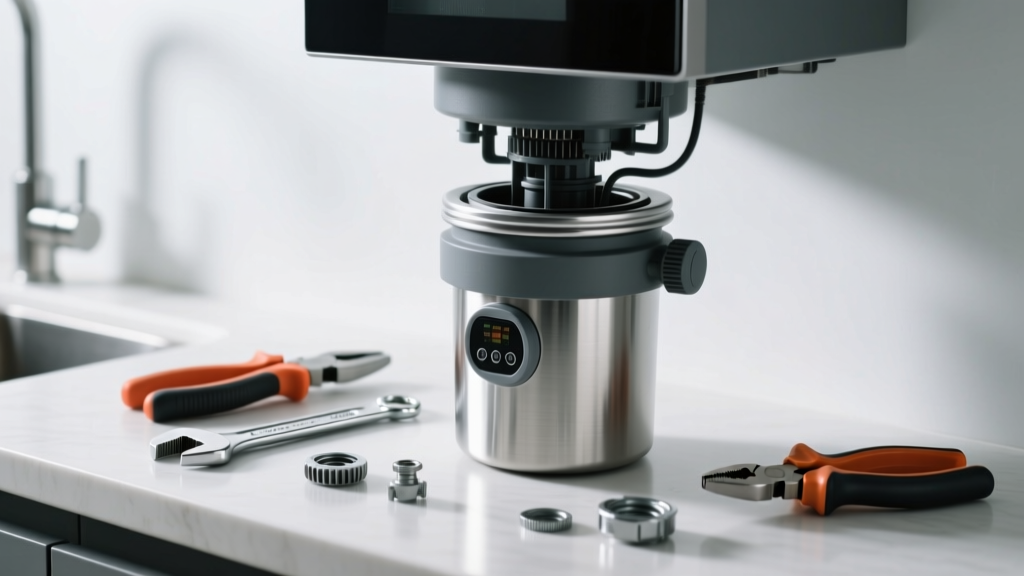
Your garbage disposal suddenly starts humming loudly—but nothing spins. No grinding, no water flow, just an angry electric drone. That sound means the motor’s trying to run but something’s blocking or straining it—and ignoring it risks burning out the unit or tripping breakers.
Quick Diagnosis
Before grabbing tools, rule out these five most common causes:
- A foreign object (utensil, bone fragment, or fruit pit) jammed in the grinding chamber
- A stuck flywheel due to corrosion or food buildup
- A tripped reset button on the bottom of the unit
- A faulty start capacitor (common in units older than 7 years)
- Loose or damaged wiring at the junction box or wall switch
Tools & Materials Needed
| Item | Purpose | Estimated Cost |
|---|---|---|
| Hex wrench (¼") | Manually rotates the flywheel to free jams | $3–$8 |
| Plumber’s flashlight | Illuminates dark disposal chamber without risking fingers | $12–$25 |
| Needle-nose pliers (insulated) | Safely retrieves small metal or plastic obstructions | $9–$18 |
| Reset button tool (or flat-head screwdriver) | Depresses recessed reset button if fingers can’t reach | $0–$5 |
| Multimeter (optional) | Tests voltage at switch and capacitor; confirms electrical faults | $25–$60 |
Step-by-Step Fix
Work methodically—start simple and escalate only when needed:
- Turn off power: Flip the circuit breaker labeled "disposal" or unplug the unit if it’s corded. Verify with a non-contact voltage tester.
- Press the reset button: Locate the red or black button on the bottom or side of the unit. Press firmly until you hear a click. Wait 30 seconds, then try the switch.
- Free the flywheel manually: Insert the hex wrench into the center hole on the bottom of the unit. Rotate back and forth gently—don’t force it. If it moves freely, try powering on again.
- Check for obstructions: Shine your flashlight into the drain opening. Use insulated pliers to remove visible debris—never your fingers. For stubborn items, use a broom handle to push down from above while rotating the wrench.
- Test the start capacitor: If the unit still hums after clearing jams and resetting, disconnect power and test the capacitor with a multimeter. A reading below 80% of its labeled µF rating means replacement is needed (e.g., a 15µF cap reading 11µF).
When to Call a Pro
Stop and call a licensed plumber or appliance technician if:
- You smell burning insulation or see scorch marks near the unit or junction box
- The disposal hums *and* trips the breaker repeatedly—even after resetting and clearing jams
- You detect 0 volts at the disposal terminals with power restored and switch engaged (indicates wiring or switch failure)
- The unit is under warranty and opening it voids coverage (check manufacturer terms first)
According to the U.S. EPA, 14% of household water usage is wasted by undetected leaks and appliance failures—including disposals that cycle incorrectly due to electrical faults (EPA WaterSense Report, 2022).
Prevention Tips
Extend your disposal’s life and avoid future humming with these habits:
- Run cold water for 15 seconds before and 30 seconds after grinding—not hot water, which melts grease into clogs
- Avoid fibrous foods (celery, onion skins), coffee grounds, eggshells, and grease—these cause 68% of premature jams (National Kitchen & Bath Association, 2021)
- Grind citrus peels or ice cubes monthly to clean blades and deodorize
- Install a sink strainer and empty it before every use
Can I use bleach on this?
No. Bleach corrodes stainless steel components and degrades rubber gaskets. It also reacts dangerously with trapped food debris, releasing chlorine gas. Use vinegar and baking soda instead—1 cup baking soda followed by 1 cup white vinegar, then flush with cold water after 5 minutes.
Why does it hum only when I turn it on?
That’s classic “locked rotor” behavior—the motor receives power but can’t spin due to mechanical resistance (jam) or electrical failure (capacitor or winding issue). A healthy disposal should start instantly with a low whir, not a sustained 60Hz hum.
Is it safe to stick my hand in the disposal?
Never. Even with power off, springs and blades retain tension, and hidden objects can shift unexpectedly. Always use long-handled tools and verify power is cut with a voltage tester. The American Society of Home Inspectors reports hand injuries account for 22% of DIY disposal incidents annually.
Will resetting it fix a broken capacitor?
No. The reset button only addresses thermal overloads—not failed capacitors or windings. If the unit resets but immediately hums again, the capacitor is likely dead. Replacing it costs $12–$25 and takes 20 minutes—but requires matching the microfarad (µF) and voltage rating exactly.
How long should a garbage disposal last?
Most units last 8–12 years with proper care. Units humming after 10+ years often need full replacement—not repair—due to worn bearings and degraded insulation. Consider upgrading to a 1 HP model with sound insulation if yours is under ½ HP.
Can a clogged P-trap cause humming?
No—but it can mimic symptoms. A clogged trap prevents drainage but won’t stop the motor from spinning. If the disposal runs normally but water backs up, the issue is downstream plumbing. Humming always points to the disposal itself or its electrical supply.
A humming disposal isn’t just annoying—it’s a warning sign your unit is under stress. Most jams take under 10 minutes to clear with the right tools and caution. If you’ve tried the reset, wrench, and visual check and it still drones, don’t keep flipping the switch—that overheats the motor. Take a breath, double-check your power cutoff, and move to the next step—or call someone who’s replaced 200+ disposals. You’ll save time, money, and your kitchen’s peace.