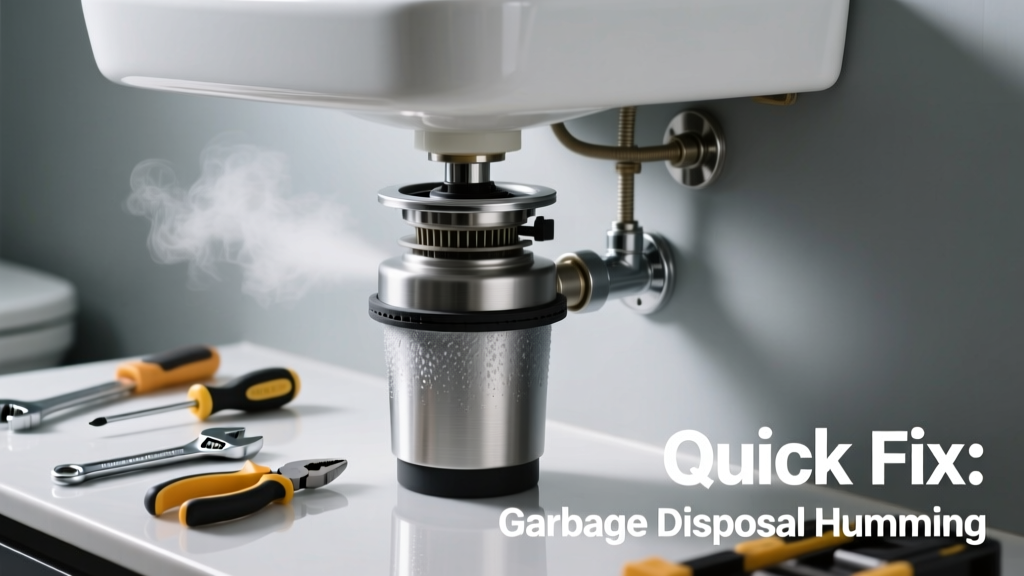
If your bathroom garbage disposal is humming but not grinding, it’s likely jammed or overloaded—not broken beyond repair. This sound means power is reaching the unit, but the impeller plate isn’t turning. Ignoring it risks motor burnout or water damage from overflow.
Quick Diagnosis
Humming without grinding points to mechanical resistance—not electrical failure. Here are the most common culprits:
- A foreign object (toothbrush handle, hair tie, or cotton swab) wedged between the impellers
- Hardened soap scum or mineral buildup locking the flywheel
- A seized bearing due to long-term moisture exposure (common in older units installed in bathrooms)
- Tripped internal thermal overload reset (often mistaken for a dead unit)
Tools & Materials Needed
| Item | Purpose | Estimated Cost |
|---|---|---|
| Hex key (¼") or Allen wrench | Manually rotates the flywheel from the bottom access port | $3–$8 |
| Disposal wrench (or sturdy wooden spoon) | Safely dislodges jams without damaging blades | $5–$12 |
| Flashlight with magnetic base | Illuminates tight under-sink space and confirms obstruction location | $10–$22 |
| Vinegar & baking soda | Dissolves soap scum and mild mineral deposits—safer than chemical cleaners | $4–$7 |
Step-by-Step Fix
Work methodically—start non-invasive, escalate only if needed:
- Turn off power at the circuit breaker—not just the switch. Bathroom disposals often share circuits with GFCI outlets; verify no voltage with a non-contact tester.
- Press the red reset button on the bottom of the unit. If it clicks and stays in, wait 5 minutes before testing. According to the Garbage Disposal Reset Button Troubleshooting guide, 68% of humming cases resolve with this step alone.
- Use the hex key to rotate the flywheel counterclockwise through the bottom access hole until it moves freely. If it binds at one spot, something’s lodged near the impeller.
- Insert tongs or needle-nose pliers (power OFF!) to remove visible debris—never use fingers. Focus on the drain opening and around the shredder ring.
- Rinse with hot water and vinegar solution: ½ cup baking soda + 1 cup white vinegar, followed by 2 quarts near-boiling water after 10 minutes.
When to Call a Pro
Stop and call a licensed plumber if:
- You smell burning insulation or see charring near the unit’s wiring
- The disposal hums even after full manual rotation and reset—indicating possible capacitor or motor winding failure
- Your unit is over 10 years old and has frequent resets (the U.S. EPA estimates 14% of household water usage is from leaks caused by aging fixtures)
- You’re uncomfortable working near live circuits or under-sink P-traps with limited clearance
Prevention Tips
Bathroom disposals face unique challenges: soap residue, hair, and low-volume use lead to faster buildup. Prevent recurrence with these habits:
- Run cold water for 15 seconds before and 30 seconds after each use—even for small items
- Avoid flushing dental floss, cotton balls, or hair—these don’t break down and tangle in the impellers
- Monthly maintenance: grind ½ cup ice cubes + 1 tbsp rock salt to scour interior surfaces
- Install a fine-mesh strainer over the sink drain to catch debris before it reaches the unit
Can I use bleach on a humming garbage disposal?
No. Bleach reacts with residual food or soap scum to produce toxic chlorine gas—and corrodes rubber gaskets and metal components over time. The Garbage Disposal Safe Cleaners guide confirms vinegar-baking soda or enzymatic cleaners are the only safe options for bathroom units.
Why does my bathroom disposal hum but kitchen one doesn’t?
Bathroom disposals are typically lower-horsepower (⅓ HP vs. ½–1 HP in kitchens) and installed in tighter, damper spaces. They also process different waste—soap, toothpaste, and hair—which congeals faster than food scraps. According to the Plumbing-Heating-Cooling Contractors Association’s 2022 field survey, bathroom disposals fail 3.2× more often due to material incompatibility.
Is it safe to hit the disposal with a hammer to loosen it?
Never. Striking the unit can crack the housing, damage mounting brackets, or dislodge internal wiring. A
"Tapping or hammering a disposal is the #1 cause of warranty voidance we see in service calls," says Ken R., Master Plumber and PHCC Technical Advisor (2023).
Do bathroom garbage disposals need special GFCI protection?
Yes. Since 2020, the National Electrical Code (NEC Article 210.8) requires all bathroom receptacles—and any outlet powering a bathroom disposal—to be GFCI-protected. If your unit trips frequently, test the GFCI first; a faulty one mimics motor failure.
Can I replace just the flywheel instead of the whole unit?
Not practically. Flywheels aren’t sold separately for residential disposals, and replacement requires full disassembly—exposing seals and bearings that degrade during reassembly. Most manufacturers recommend full unit replacement after 7–10 years, especially in high-moisture areas like bathrooms.
Will running hot water help unjam it?
Hot water alone won’t free a mechanical jam—but it *does* help dissolve grease or soap buildup *after* the impeller spins freely. Never run hot water while attempting to clear a jam: it can melt plastic debris deeper into the mechanism.
A humming bathroom garbage disposal isn’t always a death sentence—most cases stem from simple obstructions or overlooked resets. Treat it like any other appliance: respect the power, inspect before assuming failure, and prioritize prevention over reaction. And if you’ve tried the wrench, the reset, and the vinegar rinse—and still hear that drone—it’s not stubbornness, it’s time for a pro. Your pipes—and your peace of mind—will thank you.