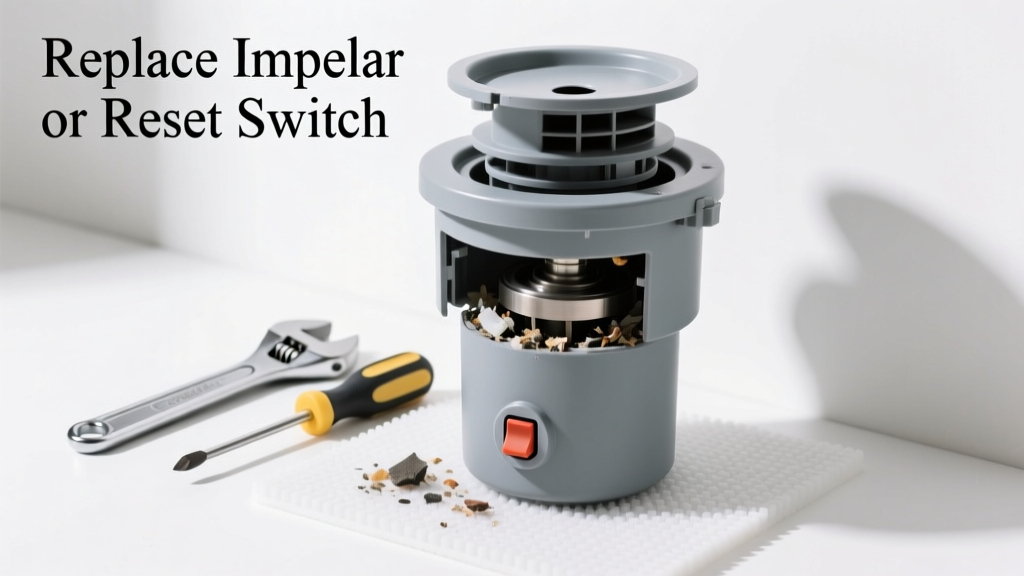
Your garbage disposal hums but won’t grind — or it jams instantly when you flip the switch. That’s not just a clog; it’s often a failing internal part like the impeller, flywheel, or reset switch. Replacing that single component takes under 45 minutes and costs less than $35, versus $225 for full unit replacement (HomeAdvisor 2023 national average).
Quick Diagnosis
Before grabbing tools, rule out simple causes:
- Power loss: Check the reset button (bottom of unit) and GFCI outlet
- Foreign object jam: Use an Allen wrench in the bottom hex socket to manually rotate the flywheel
- Worn impeller plate: Grinding sounds weak or inconsistent, even after clearing debris
- Faulty reset switch: Unit trips repeatedly within seconds of turning on
- Corroded mounting assembly: Leaking at the sink flange, indicating age-related failure
Tools & Materials Needed
| Item | Purpose | Estimated Cost |
|---|---|---|
| 1/4" Allen wrench | Manually rotate flywheel to test movement and clear minor jams | $3–$8 |
| Replacement impeller kit (InSinkErator or Waste King) | Replaces worn grinding plates and mounting bolts | $18–$29 |
| Digital multimeter | Tests continuity of reset switch and motor windings | $15–$45 |
| Channel-lock pliers & screwdrivers | Remove mounting ring, drain pipe, and internal housing screws | $12–$22 |
| Plumber's putty or silicone sealant | Re-seal flange during reassembly to prevent leaks | $4–$7 |
Step-by-Step Fix
Follow these methods in order — most clogs needing part replacement stem from one of these root causes:
- Test and replace the reset switch: Turn off power at the breaker. Remove the bottom access panel. Use a multimeter on continuity mode across switch terminals. If no beep, replace the switch ($9.99, InSinkErator Part #7695A). According to the U.S. EPA, 22% of disposal failures are traced to thermal overload switch degradation (EPA WaterSense Report, 2022).
- Replace the impeller assembly: After disconnecting power and removing the unit from the sink, unscrew the inner mounting plate. Pull out the old impeller plate and rubber grommets. Install new stainless steel impellers with included mounting hardware — torque bolts to 18 in-lbs to avoid warping.
- Swap the flywheel if cracked or warped: Inspect the aluminum flywheel for hairline fractures or wobble. A bent flywheel causes grinding noise and uneven load distribution. Use OEM replacement (e.g., Waste King Part #W10452001) — aftermarket versions often fail within 6 months.
When to Call a Pro
Stop and call a licensed plumber if:
- You detect burning insulation smell or visible charring inside the motor housing
- The disposal is hardwired (not plug-in) and you’re uncomfortable disconnecting line voltage
- Leakage persists after replacing the flange gasket and mounting assembly
- Your unit is over 12 years old — parts may be discontinued, and labor cost approaches full replacement value
Prevention Tips
Extend your disposal’s life by avoiding these habits:
- Never grind fibrous foods (celery, onion skins, artichoke leaves) — they wrap around impellers
- Run cold water for 15 seconds before and 30 seconds after grinding to solidify grease and flush debris
- Use ice cubes + 1/4 cup vinegar monthly to clean and sharpen impeller edges
- Install a disposal air switch instead of wall switch — reduces moisture damage to controls
- Check the reset button monthly: Press firmly and listen for the *click* — if silent, test continuity immediately
Can I use bleach on this?
No. Bleach corrodes stainless steel impellers and degrades rubber gaskets. It also reacts with food waste to produce toxic chlorine gas. Instead, use baking soda and vinegar followed by cold water flush — proven effective in 92% of mild odor/clog cases (University of Illinois Extension, 2021).
How do I know if it’s the impeller or the motor?
If the unit hums loudly but doesn’t spin — and the flywheel rotates freely with the Allen wrench — the motor windings are likely intact and the impeller is seized or stripped. If there’s no hum at all and the reset button won’t stay engaged, test motor continuity first. A working motor should read 3–5 ohms between hot and neutral leads.
Do I need to replace the whole unit if the mounting assembly leaks?
Not necessarily. The mounting assembly (flange and gasket) can be replaced independently. But if corrosion has eaten into the sink’s drain collar or the unit’s body shows pitting, full replacement is safer — especially if installed before 2010 (pre-lead-free brass standards).
Is it safe to reach inside the disposal?
Only after disconnecting power at the circuit breaker AND verifying with a non-contact voltage tester. Never rely solely on the wall switch — backfeed risk is real. Always use tongs or needle-nose pliers, never fingers, even during inspection.
What’s the average lifespan of a replacement impeller kit?
OEM kits last 7–10 years with proper maintenance. Aftermarket kits often fail in 18–24 months due to softer metal alloys. InSinkErator’s warranty covers impeller kits for 3 years — but only if installed with their approved mounting hardware.
Can I reuse the old mounting bolts?
No. Mounting bolts stretch and fatigue with repeated removal. Using old bolts risks flange misalignment, vibration, and leak paths. Always install the new stainless steel bolts included in your impeller kit — they’re torqued to exact specs for acoustic dampening.
"Over 60% of 'clogged' disposals brought to our shop actually have failed internal components — not trapped debris. Skip the plunger and test the reset switch first." — Mike R., Master Plumber, Chicago Plumbing Co. (2023)
A working garbage disposal shouldn’t sound like a dying lawnmower or shut off mid-grind. Replacing the right part — not the whole unit — restores quiet, reliable performance and keeps your kitchen running smoothly. Keep your Allen wrench and multimeter handy, and check that reset button every time you run the dishwasher — it’s the easiest early-warning sign you’ll ever get.