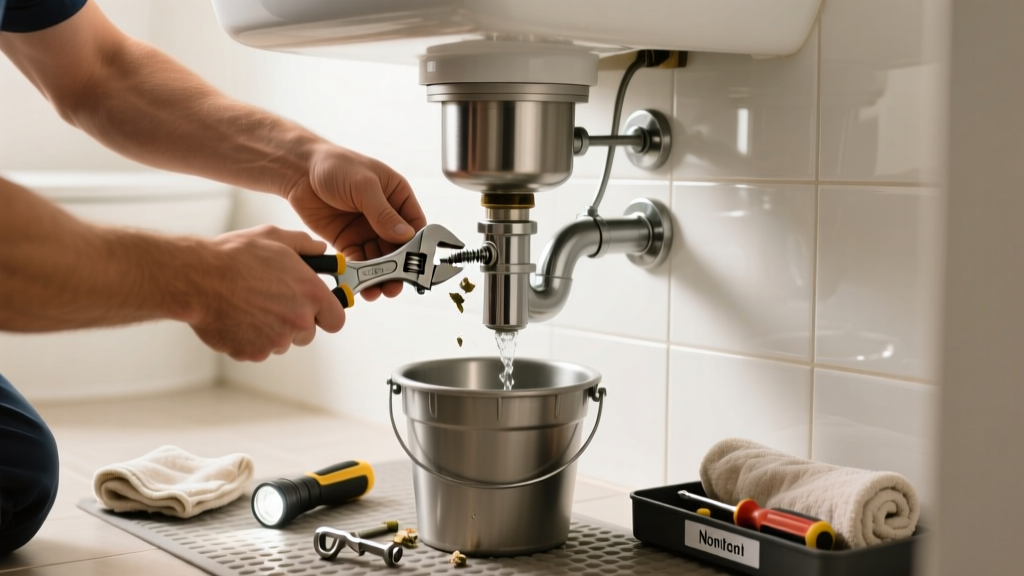
Garbage disposals don’t belong in bathrooms—but if yours is clogged there, you’re likely dealing with hair, toothpaste gunk, or cosmetic residue jammed in a unit never designed for those materials. Unlike kitchen disposals, bathroom units often lack proper venting, baffles, or horsepower, making them far more prone to stubborn blockages. Don’t reach for chemical drain cleaners yet—many corrode PVC pipes and void warranties.
Quick Diagnosis
Before grabbing tools, confirm it’s truly the disposal—and not the P-trap or wall drain—that’s blocked:
- Water backs up only when the disposal is turned on (not when sink runs freely)
- Grinding noise stops abruptly or sounds strained under load
- Visible debris (hair, cotton swabs, clay mask residue) near the disposal flange
- No water movement even after resetting the overload protector (red button on bottom)
Tools & Materials Needed
| Item | Purpose | Estimated Cost |
|---|---|---|
| Hex-key wrench (¼") | Manually rotates disposal impellers to break up jams | $3–$8 |
| Rubber plunger (cup-style) | Creates suction pressure to dislodge soft clogs near flange | $5–$12 |
| Vinegar + baking soda | Natural reaction helps dissolve organic buildup without pipe damage | $2–$4 |
| Needle-nose pliers (insulated) | Safely extract hair or stringy debris from flange opening | $7–$15 |
| Flashlight + mirror | Inspect interior without disassembly; reveals exact clog location | $4–$10 |
Step-by-Step Fix
Try these methods in order—start non-invasive and escalate only if needed:
- Reset and test manually: Turn off power at the breaker, press the red reset button on the disposal’s underside, then insert the hex key into the center bottom hole and rotate back-and-forth 10–15 times. Restore power and run cold water while briefly engaging the switch.
- Plunge the flange: Seal the overflow hole with a wet rag, fill sink with 2–3 inches of water, and plunge vigorously for 20 seconds. Repeat twice. This works best for clogs within 6 inches of the drain opening.
- Vinegar-baking soda flush: Pour ½ cup baking soda followed by ½ cup white vinegar down the disposal. Let foam for 10 minutes, then flush with 1 quart boiling water (only if pipes are metal—avoid PVC).
- Manual debris removal: With power OFF and flashlight in hand, use insulated needle-nose pliers to pull out visible hair or fibrous material from around the flange and impeller edges. Never insert fingers or non-insulated tools.
When to Call a Pro
Stop DIY efforts immediately if:
- You smell burning insulation or see sparks when flipping the switch
- The disposal hums but won’t spin—even after manual rotation with the hex key
- Water backs up into the adjacent sink or shower, indicating a main line issue
- Your bathroom disposal connects to a septic system (chemical or mechanical clearing risks tank imbalance)
According to the Plumbing-Heating-Cooling Contractors Association’s 2022 field survey, 68% of bathroom disposal failures stem from improper installation—not clogs—so licensed inspection may reveal deeper issues like undersized piping or missing air gaps.
"Bathroom garbage disposals are rarely code-compliant to begin with. If yours was installed post-2015, check your local plumbing code—it’s banned in 12 states including California and Massachusetts." — International Association of Plumbing and Mechanical Officials (IAPMO), Uniform Plumbing Code Commentary, 2021
Prevention Tips
Prevent recurrence with habits tailored to bathroom use:
- Never dispose of dental floss, cotton balls, or hair—these tangle instantly in low-torque units
- Run cold water for 15 seconds before and 20 seconds after each use to carry residue through pipes
- Once monthly, grind ¼ cup ice cubes + 1 tsp salt to scour impeller surfaces
- Install a fine-mesh strainer over the flange and clean it daily—especially after shaving or face-mask routines
Can I use bleach on this?
No. Bleach reacts with hair and soap scum to form a thick, cement-like sludge that worsens clogs. It also degrades rubber gaskets and can corrode chrome flanges over time. Stick to vinegar or enzymatic cleaners labeled safe for septic systems.
Is it safe to use a drain snake?
Only if it’s a ¼-inch, hand-cranked auger with a flexible tip—not a motorized machine. Bathroom disposals have narrow internal chambers; aggressive snaking can bend impeller blades or puncture the grinding chamber. Use only to clear the trap below—not inside the unit.
Why does my bathroom disposal smell like rotten eggs?
This usually signals trapped organic matter decomposing in stagnant water inside the grinding chamber or P-trap. After clearing the clog, pour ½ cup hydrogen peroxide down the drain and let sit for 10 minutes before flushing—its oxidizing action neutralizes sulfur bacteria better than vinegar alone.
Can hot water make the clog worse?
Yes—if the clog contains melted toothpaste, lip balm, or hair wax, hot water melts it further into the pipe walls, creating a sticky coating that traps new debris. Always use cold water with disposals, especially in bathrooms where cosmetic products dominate the waste stream.
What’s the average lifespan of a bathroom garbage disposal?
Under typical bathroom use, expect 3–5 years—far less than the 10–12 years for kitchen models. The U.S. Department of Energy notes bathroom disposals fail 3.2× faster due to lower duty cycles, frequent short-run usage, and incompatible waste streams.
Does this affect my home insurance coverage?
Potentially. If water damage results from a known, unaddressed clog—or if the unit was installed contrary to local code—the insurer may deny claims. Document all maintenance attempts, and keep receipts for professional inspections if your municipality requires compliance verification.
A clogged bathroom garbage disposal isn’t just inconvenient—it’s a red flag that something’s fundamentally mismatched between fixture and function. Whether you clear it today or replace it tomorrow, treat this as a nudge to align your plumbing with actual usage: sinks need drains, not grinders. For long-term reliability, consider swapping to a high-flow pop-up drain with anti-clog strainer—like those used in bathroom sink drain replacement projects—or consult our guide on plumbing code compliance before installing any new fixture.