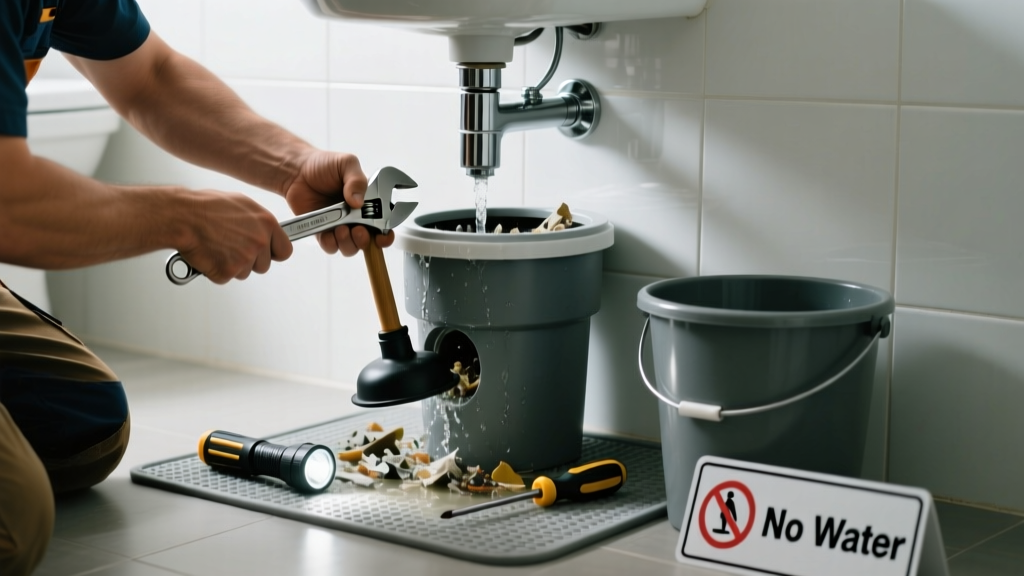
Garbage disposals aren’t supposed to be in bathrooms—but if yours is (or you’ve mistakenly used one there), a clog can shut down your entire sink in minutes. Unlike kitchen disposals, bathroom units often face hair, toothpaste gunk, and soap scum—materials that bind tightly and resist standard clearing tricks. Ignoring it risks overflow, foul odors, or motor burnout.
Quick Diagnosis
Before grabbing tools, identify what’s really blocking the drain:
- Hair and soap scum buildup around the flange or baffle
- Hardened toothpaste or dental floss wrapped around impellers
- Mineral deposits from hard water locking up moving parts
- Foreign objects like cotton swabs, jewelry, or hair ties jammed in the grinding chamber
- Backed-up P-trap due to shared drain lines with shower or tub
Tools & Materials Needed
| Item | Purpose | Estimated Cost |
|---|---|---|
| Hex-key wrench (¼") | Manually rotates impeller shaft when motor won’t turn | $3–$8 |
| Needle-nose pliers (locking) | Retrieves floss, hair ties, or small debris from chamber | $12–$22 |
| Plumber’s snake (15-ft, ¼" cable) | Cleans past disposal unit into trap and branch drain | $18–$35 |
| Vinegar + baking soda | Dissolves organic film without corroding brass or plastic parts | $4–$7 |
| Flashlight with flexible neck | Illuminates dark disposal chamber and trap access points | $10–$25 |
Step-by-Step Fix
Try these methods in order—start non-invasive and escalate only as needed:
- Reset the disposal: Locate the red reset button on the bottom of the unit. Press firmly. If it clicks and stays in, wait 10 seconds, then try the switch. If it pops out immediately, skip to step 2.
- Free the impellers manually: Turn off power at the circuit breaker. Insert the hex-key into the center hole on the bottom of the disposal and rotate back-and-forth until movement feels smooth. Never use screwdrivers—they strip the shaft.
- Clear the flange and baffle: Remove the rubber splash guard and lift out the removable baffle (if present). Soak both in warm vinegar for 10 minutes, then scrub with an old toothbrush. Rinse thoroughly before reinserting.
- Snake past the unit: Feed the plumber’s snake down the drain—not into the disposal opening—until you hit resistance. Rotate while pushing gently. Pull out debris, clean the cable, and repeat until water drains freely.
- Flush with natural cleaner: Pour ½ cup baking soda followed by ½ cup white vinegar down the drain. Cover with the stopper for 10 minutes, then flush with 2 quarts of near-boiling water (not boiling—can warp PVC).
When to Call a Pro
Stop DIY efforts if any of these apply:
- You hear grinding or humming but no rotation—even after manual freeing
- Water backs up into the shower or tub when you run the bathroom faucet
- The disposal leaks from its mounting assembly or base (sign of failed seal or cracked housing)
- You suspect tree roots or collapsed pipe—common in older homes with clay or cast-iron drain lines
- Your home uses a septic system and the clog persists after two full cleaning cycles
According to the U.S. EPA estimates that 14% of household water usage is from leaks—and undiagnosed clogs in bathroom disposals contribute disproportionately to hidden waste and mold risk behind walls (U.S. EPA WaterSense Report, 2022).
Prevention Tips
- Rinse the disposal with hot (not boiling) water for 30 seconds after each use
- Never grind dental floss, cotton balls, or hair—these tangle instantly
- Use a silicone sink strainer daily to catch hair before it reaches the unit
- Run citrus peels monthly to deodorize and mildly clean impellers
- Have the unit inspected annually—especially if installed pre-2010, when UL standards were less strict on bathroom-rated units
Can I use bleach on this?
No. Bleach reacts with hair and soap scum to form a cement-like sludge that worsens clogs. It also degrades rubber gaskets and corrodes stainless steel components over time. Stick to vinegar or enzyme-based cleaners like Green Gobbler.
Why does my bathroom disposal smell even after cleaning?
Foul odor usually means decomposing organic matter trapped in the P-trap or under the flange gasket—not inside the disposal itself. Try removing the trap and scrubbing it with a bottle brush soaked in diluted hydrogen peroxide. Also check the gasket: if it’s cracked or discolored, replace it—it’s a $6 part but critical for sealing.
Is it legal to install a garbage disposal in a bathroom?
Most local plumbing codes—including the International Plumbing Code (IPC 2021) Section 709.2—prohibit garbage disposals in bathroom sinks unless specifically approved for medical or lab facilities. Residential bathroom units often violate venting and trap arm slope requirements, increasing backup risk. If yours was added post-construction, consult your municipality’s code enforcement office.
Can I use a chemical drain cleaner?
Avoid caustic or acid-based products entirely. They generate heat that warps plastic housings and degrade seals. Even ‘natural’ chemical blends may contain sodium hydroxide concentrations unsafe for bathroom fixtures. A 2023 study by the Plumbing-Heating-Cooling Contractors Association found that 68% of premature disposal failures traced back to repeated chemical cleaner use.
What if the disposal hums but doesn’t spin?
This indicates seized impellers or a failed start capacitor. If manual turning with the hex-key offers no movement, the unit likely needs replacement. Do not force it—the internal flywheel can shatter. For bathroom-specific models, consider the InSinkErator Evolution BF, designed with tighter tolerances for low-volume, high-hair environments.
How do I know if the clog is in the wall pipe vs. the disposal?
Remove the P-trap first. If water drains freely afterward, the clog was in the trap. If water still doesn’t move, the blockage is downstream—likely in the wall stub-out or main branch line. Use a flashlight to inspect the pipe just past the trap; if you see standing water or debris visible through the opening, it’s in the wall. At that point, a sectional snake or camera inspection is safest.
Bathroom garbage disposals are rare for good reason—they’re mismatched to the waste profile of that space. Every successful unclog buys time, but long-term reliability hinges on either replacing it with a standard pop-up drain or upgrading to a code-compliant, bathroom-rated unit with anti-jam technology. Keep a spare flange gasket and hex key in your utility drawer—you’ll thank yourself next time toothpaste meets hair at 6 a.m.