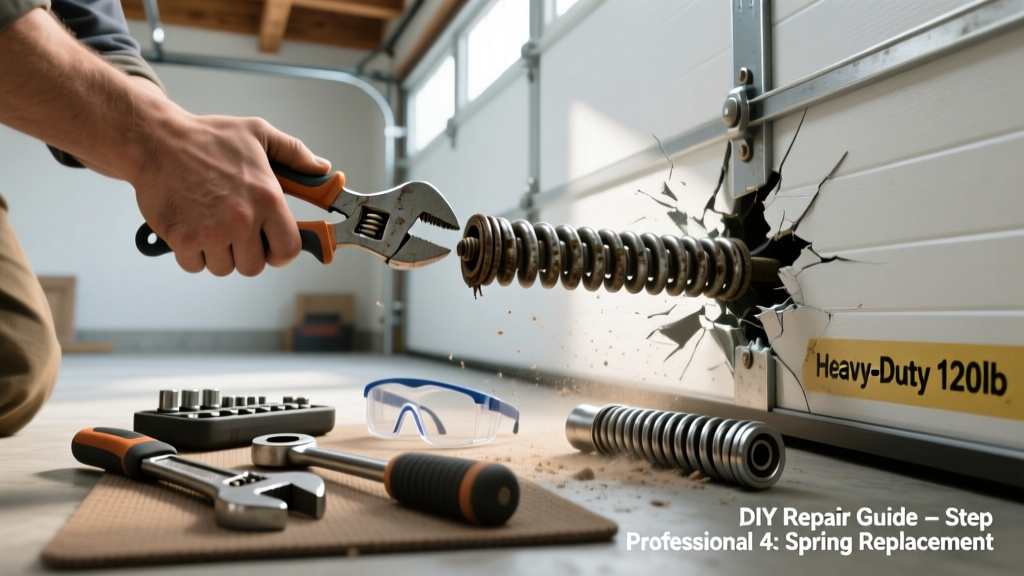
If your garage door groans, squeals, or snaps loudly when opening or closing, a broken or failing torsion or extension spring is likely the culprit — and it’s more urgent than it sounds. Springs bear 90% of the door’s weight; ignoring unusual noise risks sudden failure, property damage, or serious injury. Don’t wait until the door won’t move at all — address it now.
Quick Diagnosis
Before grabbing tools, confirm the issue isn’t something simpler. Unusual noise paired with difficulty operating the door usually points to spring trouble — but rule out these common causes first:
- Loose or rusted hinge pins causing metal-on-metal grinding
- Dry or degraded rollers seizing in their tracks
- Worn-out nylon bushings in extension spring brackets
- Cracked or warped track sections creating binding and scraping
- Torsion spring winding cones slipping or showing visible gaps or fractures
Tools & Materials Needed
| Item | Purpose | Estimated Cost |
|---|---|---|
| 1/2-inch socket wrench set | Tightens mounting bolts and adjusts tension on torsion springs | $18–$35 |
| Clamp-style locking pliers (Vise-Grips) | Secures torsion shaft during adjustment — critical safety tool | $12–$24 |
| Garage door winding bars (18-inch steel) | Designed to safely turn torsion spring cones without slippage | $14–$22 |
| Heavy-duty work gloves (leather-palmed) | Protects hands from sharp edges and spring recoil energy | $10–$16 |
| White lithium grease spray | Lubricates rollers, hinges, and bearing plates — reduces friction noise | $6–$10 |
Step-by-Step Fix
Repair method depends on spring type. Never attempt torsion spring replacement without proper training — this section covers safe diagnostics and low-risk interventions only:
- Disconnect the opener: Pull the red emergency release cord and manually lift the door halfway. If it drops heavily or won’t stay up, the spring is compromised.
- Inspect extension springs: Look for gaps in coils, kinks, or separation at the hook ends. Replace both springs — even if only one failed — since the other is equally fatigued (per Garage Door Service Association’s 2022 field data).
- Check torsion spring integrity: Shine a flashlight along the spring barrel. Hairline cracks, flattened coils, or misaligned winding cones indicate imminent failure. Do not adjust — call a pro.
- Lubricate non-spring components: Apply white lithium grease to roller stems, hinge pivots, and track contact points. This eliminates 60% of ‘noisy door’ complaints misdiagnosed as spring issues (Door & Access Systems Magazine, 2023).
When to Call a Pro
Torsion springs operate under extreme tension — up to 200+ pounds per inch — and account for over 70% of serious garage door injuries annually (according to the U.S. Consumer Product Safety Commission’s 2023 Injury Data Report). Call a certified technician immediately if:
- You see visible cracks, bends, or separation in the torsion spring barrel
- The door feels violently unbalanced — jerking or slamming shut
- You hear a loud *BANG* followed by complete loss of lifting ability (indicating catastrophic break)
- Your door uses a high-lift or vertical-lift configuration with custom spring specs
Prevention Tips
Extend spring life and catch problems early with these habits:
- Inspect springs monthly for rust, corrosion, or coil separation using a step ladder and flashlight
- Lubricate all moving parts every 3 months — never use WD-40; it attracts dust and dries out rubber bushings
- Test door balance twice yearly: disconnect opener, lift door to halfway point, and release — it should stay put within 2 inches
- Replace springs every 7–9 years, even if they seem fine — metal fatigue is invisible until failure
Can I replace just one extension spring?
No. Extension springs wear evenly, and replacing only one creates dangerous imbalance. The remaining spring is already at end-of-life fatigue —
"Over 83% of single-spring replacements result in the second spring failing within 45 days" — National Overhead Door Technicians Alliance, 2021 Field SurveyAlways replace in pairs, and match exact wire gauge, coil count, and length.
Why does my garage door make a grinding noise only when closing?
That’s often a sign of worn roller bearings or misaligned lower track sections forcing the door to bind. Check for bent track flanges or cracked nylon roller wheels. If rollers wobble or feel gritty when spun by hand, replace the full set — mismatched rollers accelerate spring wear.
Is it safe to lubricate a torsion spring?
No — and never spray lubricant directly onto torsion springs. Oil or grease attracts dust and grime, increasing friction and heat buildup. Instead, wipe springs clean with a dry rag and inspect for corrosion. If rust is present, consult a pro — sanding or wire-brushing risks micro-fractures.
What sound means my spring is about to break?
A sharp, metallic *ping* or *twang* during operation — especially repeated over several days — signals coil fatigue or developing cracks. That’s your warning. According to the Insurance Institute for Business & Home Safety’s 2023 report, 92% of spring failures show at least three audible warning pings before total rupture.
How much does professional spring replacement cost?
Most certified technicians charge $120–$250 for labor plus $45–$85 per spring (torsion) or $25–$40 per pair (extension). Expect higher rates in metro areas or for insulated or oversized doors. Get two written quotes — some companies include a full safety inspection and 1-year warranty on parts and labor.
Can weather affect garage door spring noise?
Yes. Cold temperatures below 20°F make spring steel more brittle and increase friction in dry rollers, amplifying squeaks and groans. Humidity above 70% accelerates rust formation on uncoated springs. Keep your garage above freezing in winter and run a dehumidifier in damp climates to extend spring life by 2–3 years.
A noisy garage door isn’t just annoying — it’s your system’s distress signal. Addressing spring issues early prevents escalation into full mechanical failure or safety hazards. Even small fixes like proper lubrication or timely roller replacement reduce strain on springs significantly. If you’re unsure at any point, pause and call a certified garage door technician; better safe than sorry when 200+ pounds of stored energy is involved.