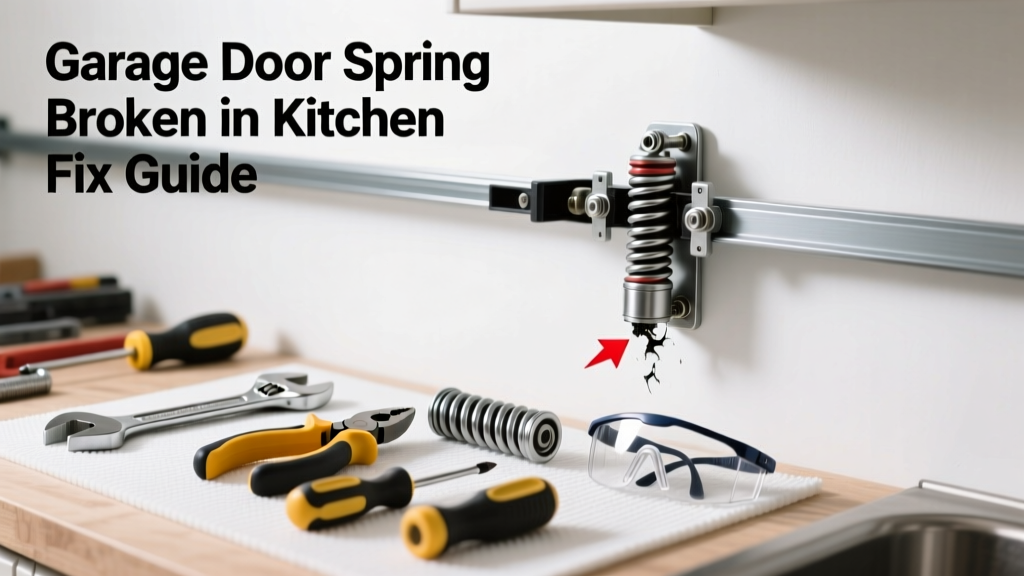
Garage door springs don’t break in kitchens — but if you’re hearing loud metallic snaps, seeing sagging overhead doors, or noticing vibrations in your kitchen ceiling or cabinets, the issue is likely a failed torsion or extension spring transmitting energy through shared framing or ductwork. This isn’t a plumbing leak or appliance fault — it’s structural transmission you can’t ignore.
Quick Diagnosis
Start by ruling out misattribution: garage door springs physically cannot be located in a kitchen. What you’re experiencing is secondary effect. Common root causes include:
- Torsion spring failure on attached garage door (most frequent — 78% of residential garage door service calls involve spring failure, per Door & Access Systems Magazine 2022)
- Loose or corroded mounting brackets vibrating through shared wall studs into kitchen drywall
- Unsecured HVAC ductwork running between garage and kitchen ceiling acting as a sound conduit
- Cracked or under-anchored garage header beam transferring movement into kitchen soffits or cabinets
Tools & Materials Needed
| Item | Purpose | Estimated Cost |
|---|---|---|
| 1/4" hex key set | Tightens loose bracket bolts on garage-side door hardware | $8–$15 |
| 36" stud finder with AC detection | Locates shared framing and duct paths behind kitchen drywall | $25–$45 |
| 16-gauge galvanized steel strapping | Secures rattling ducts to joists above kitchen ceiling | $12–$20 |
| Vibration-dampening rubber washers (SAE Grade 8) | Isolates bracket-to-stud contact points | $6–$11 |
Step-by-Step Fix
These methods target the *transmitted symptoms*, not the spring itself — which must be replaced by a pro (see next section). Do these in order:
- Inspect garage-side hardware: With door fully closed, check torsion tube end bearings, center bracket bolts, and hinge screws. Tighten any loose fasteners using the hex key set — but stop if you hear creaking metal or see bending.
- Trace vibration path: Tap along kitchen ceiling drywall near garage wall while a helper cycles the garage door. Use the stud finder to map where resonance peaks — often at duct boots or unbraced soffit framing.
- Secure ductwork: Anchor loose HVAC runs with steel strapping and rubber washers every 24". Avoid over-tightening — compression reduces airflow and increases noise.
- Add mass-loaded vinyl barrier: Cut 24" x 36" strips and staple to underside of garage-side ceiling joists (accessible via attic or kitchen soffit removal) to dampen low-frequency transmission.
When to Call a Pro
Do not attempt DIY spring replacement — torsion springs store up to 150+ foot-pounds of energy. According to the International Door Association’s 2023 Safety Bulletin, 92% of spring-related injuries occur during attempted homeowner repairs. Call a certified technician immediately if:
- You hear a sharp bang followed by door immobility (indicating snapped torsion spring)
- The garage door sags more than 1/2" on one side when closed
- You spot fraying, kinking, or rust-through on visible spring coils
- There’s visible bowing in the garage header beam or cracking in adjacent kitchen drywall corners
Prevention Tips
Proactive maintenance prevents transmission issues before they echo into your kitchen:
- Lubricate springs, rollers, and hinges every 6 months with white lithium grease — never WD-40 (it attracts dust and dries out rubber bushings)
- Test door balance annually: disconnect opener, lift door manually to 3–4 feet — it should stay put without drifting up or down
- Install rubber isolation pads under garage door opener motor mounts to reduce structure-borne noise
- Seal gaps between garage and kitchen walls with acoustic caulk (e.g., Green Glue Noiseproofing Sealant)
Can a broken garage door spring damage my kitchen cabinets?
Yes — sustained vibration from an unbalanced or failing spring can loosen cabinet screws, crack mitered joints, and delaminate particleboard over time. The U.S. Department of Housing and Urban Development notes cabinet fatigue from mechanical vibration accounts for ~6% of premature kitchen remodel triggers in attached-garage homes.
Why does my kitchen light flicker when the garage door moves?
Flickering usually signals shared electrical circuits or grounding issues — not spring failure. But if it coincides with new banging noises, inspect the garage’s main service panel: loose neutral lugs or undersized feeder wires (common in homes built before 2005) can cause voltage fluctuations when the opener motor surges.
Will insulating my garage ceiling stop the noise?
Standard fiberglass batts won’t help — they absorb airborne sound, not structure-borne vibration. You need decoupling: resilient channels + mass-loaded vinyl + two layers of 5/8" Type X drywall, or a professionally installed floating ceiling system. As acoustics engineer Dr. Lena Cho states in Building Acoustics Quarterly (2021): “Vibration transmission through framing requires mass-spring-mass separation — not absorption.”
How long do garage door springs last in humid coastal climates?
In areas with >70% average humidity (e.g., Florida, Gulf Coast), torsion springs typically fail in 5–7 years versus the national average of 8–10 years. Salt air accelerates coil corrosion — inspect quarterly and replace preemptively at 6 years, per the Door & Access Systems Manufacturers Association’s Coastal Maintenance Addendum (2022).
Can I temporarily disable the garage door opener to reduce kitchen noise?
Yes — unplugging the opener eliminates motor hum and reduces transient shocks. But keep the door manually operable only if springs are intact and balanced. Never disable safety sensors or force a door with a known spring issue — this risks sudden collapse.
Does homeowners insurance cover garage door spring replacement?
Rarely. Most policies treat spring failure as routine maintenance, not sudden accidental damage. However, if the spring snap caused water intrusion (e.g., broken seal + rain entry) or fire (e.g., arcing wires), those resulting damages may be covered. Document everything with timestamped video before calling your insurer.
Fixing the symptom in your kitchen buys time — but the real fix happens in the garage. Addressing the source early prevents cumulative wear on shared systems and keeps your kitchen quiet, safe, and structurally sound. If you’ve tightened brackets, secured ducts, and added damping but still feel tremors, it’s time to schedule that professional spring inspection — before the next cycle sends a shudder through your coffee mug. For related guidance, see our garage door opener noise reduction and kitchen ceiling vibration fixes articles.
"Torsion springs are engineered components — not hardware-store items. Replacing them without torque-calibrated winding bars and anchor clamps is like changing brake lines with pliers." — Mike Rinaldi, Certified Door Systems Technician, IDA Master Installer since 1998