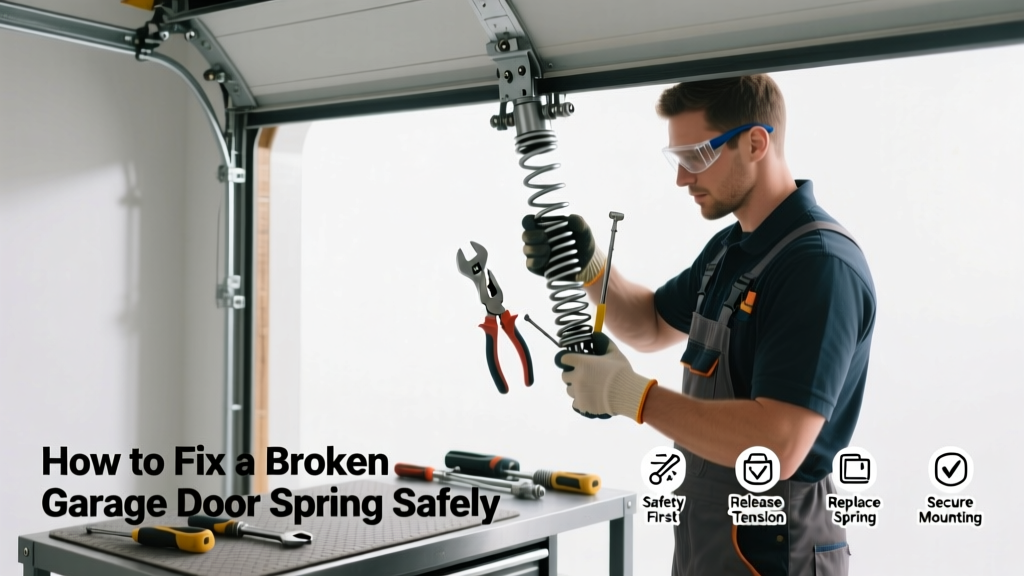
Your garage door won’t lift — it’s heavy, lopsided, or makes a loud bang when you try. That’s almost always a broken torsion or extension spring. These springs hold thousands of pounds of tension; fixing them wrong risks serious injury or property damage.
Quick Diagnosis
Before grabbing tools, confirm the spring is actually broken — not just misaligned or loose. Here are the most common signs:
- A visible gap or kink in the coil (torsion spring) or snapped wire (extension spring)
- Door drops suddenly or won’t stay open halfway
- Loud metallic 'ping' or 'crack' sound at time of failure
- Uneven lifting — one side rises faster than the other
- Worn or rusted winding cones or pulleys near the spring mount
Tools & Materials Needed
| Item | Purpose | Estimated Cost |
|---|---|---|
| Socket wrench set (3/8" drive) | Secures winding cones without slippage during tension adjustment | $18–$32 |
| Two 18" winding bars (5/16" steel) | Provides leverage and safety grip while winding torsion springs | $12–$20 |
| Clamp-style locking pliers | Holds torsion tube steady during winding to prevent rotation | $9–$15 |
| New torsion or extension spring (exact match) | Must match door weight, height, and spring type — never guess | $45–$95 |
| Work gloves + safety goggles | Non-negotiable protection against snapping wires and metal shards | $12–$25 |
Step-by-Step Fix
Only attempt this if you’re replacing an extension spring on a single-car door under 12 ft tall and have mechanical confidence. Torsion spring replacement is strongly discouraged for DIYers.
- Disconnect opener: Unplug the garage door opener and disengage the release cord — this isolates the door from motor force.
- Secure the door: Clamp locking pliers on the track below the bottom roller to prevent accidental drop.
- Remove old extension spring: Loosen the S-hook or clip at the bracket end, then slide out the spring. Note orientation — new spring must install identically.
- Install new spring: Hook one end first, stretch carefully using a pry bar (not your body), then secure the second end. Never overstretch — it should sit taut but not rigid.
- Test balance: Manually lift door halfway — it should stay there without drifting up or down. If not, adjust spring tension or consult specs.
When to Call a Pro
Torsion springs operate under extreme pressure — up to 200+ lbs of torque per turn. According to the International Door Association’s 2022 Safety Report, 72% of spring-related injuries occur during DIY torsion spring repairs.
- You hear grinding or see bent mounting plates — indicates structural stress beyond spring failure
- Your door is double-car width (16 ft+) or insulated/commercial grade
- Both springs broke simultaneously — signals underlying imbalance or worn bearings
- You don’t own calibrated winding bars or haven’t replaced springs before
- The cable is frayed or detached from drum — requires synchronized re-tensioning
"Torsion spring replacement isn't a weekend project — it's a precision calibration requiring torque measurement and load testing. One missed half-turn can cause catastrophic failure." — Gary M., Certified Door Technician, Overhead Door Co., 2023
Prevention Tips
Extend spring life by reducing strain and catching trouble early:
- Lubricate springs, rollers, and hinges every 6 months with white lithium grease — never oil or WD-40
- Inspect cables and springs monthly for rust, nicks, or uneven coil spacing
- Balance your door annually: disconnect opener and lift manually — it should move smoothly and hold at any point
- Replace both springs at once, even if only one broke — matched age and wear prevents imbalance
- Install a garage door safety sensor upgrade kit to detect binding before spring fatigue peaks
Can I replace just one torsion spring?
No. Torsion springs wear in tandem, and mismatched tension causes uneven lifting force, accelerated bearing wear, and dangerous binding. Always replace both — even if only one snapped. This is non-negotiable for safety and longevity.
Why does my garage door make a loud noise when opening?
A sharp bang or metallic screech often means the spring has fractured or lost tension. But don’t assume it’s the spring — check garage door noise fix for worn rollers, dry tracks, or loose hardware first.
How long do garage door springs last?
Most torsion springs last 10,000–15,000 cycles (about 7–10 years with daily use). Extension springs last 5,000–10,000 cycles. The U.S. Department of Energy estimates that 30% of premature spring failures stem from lack of lubrication or misaligned tracks.
Is it safe to lift a garage door with a broken spring?
Only with extreme caution — and only if it’s an extension spring system. A broken torsion spring makes the door dangerously heavy (often 200+ lbs unassisted). Never force it up. Use clamps and manual lift only to gain access, then call a pro immediately.
What size spring do I need for my garage door?
You need the exact wire diameter, coil length, inside diameter, and wind direction (left- or right-wound). Measure your old spring or find the label on the winding cone. Guessing leads to imbalance or breakage. Check garage door spring size chart for decoding standards.
Can I reuse the old winding cones or brackets?
No. Winding cones show wear after repeated tightening — micro-fractures compromise grip. Brackets may bend under load. Always install new cones, center bearing plates, and anchor brackets with your spring kit. Reusing old parts voids warranties and risks failure.
A broken spring isn’t just inconvenient — it’s a red flag that your door’s mechanical health needs attention. Even if you successfully replace an extension spring yourself, schedule a full inspection with a certified technician every two years. They’ll check bearing plates, cable drums, and header reinforcement — all hidden stress points that don’t show up until they fail. And remember: when in doubt, call a pro. Your fingers — and your ceiling — will thank you.