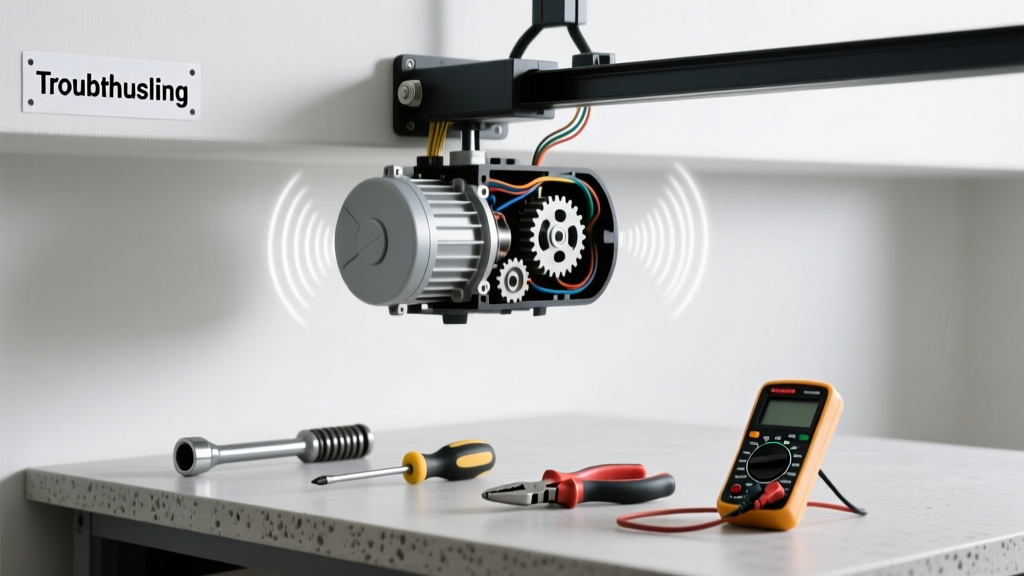
Your garage door groans, clicks, or whines—and refuses to open. That unsettling noise isn’t just annoying—it’s a warning sign that something’s misaligned, worn, or failing. Ignoring it risks sudden failure, safety hazards, or even damage to the door itself.
Quick Diagnosis
Before grabbing tools, narrow down the issue with these common culprits:
- Grinding or screeching: Worn gear assembly or stripped drive gear
- Clicking without movement: Faulty logic board or bad capacitor
- Rattling or vibrating: Loose mounting bolts, bent rail, or unbalanced door
- Squealing or high-pitched whine: Dry or failing motor bearings or chain/screw tension issues
- Intermittent operation with noise: Failing wall button wiring or radio frequency interference
Tools & Materials Needed
| Item | Purpose | Estimated Cost |
|---|---|---|
| Socket set (3/8" drive) | Tightens rail brackets, motor mount, and trolley hardware | $12–$28 |
| Lubricant (white lithium grease) | Safe for plastic gears and metal rails—never use WD-40 on moving parts | $5–$9 |
| Digital multimeter | Tests capacitor voltage and logic board output signals | $18–$45 |
| Replacement gear kit (e.g., Chamberlain 41A5273A) | Fixes grinding in older belt/chain drives—covers 80% of noise-related failures | $22–$36 |
| Level and tape measure | Verifies rail alignment and door balance (critical for smooth, quiet operation) | $8–$20 |
Step-by-Step Fix
Work methodically—start simple and escalate only when needed:
- Check door balance and manual operation: Disengage the opener using the red emergency release cord. Lift the door halfway by hand. It should stay put. If it drifts down or slams up, the springs need adjustment—see our spring tuning guide.
- Tighten all hardware: Use your socket set to secure rail brackets, motor mounting bolts, and trolley assembly screws. A loose rail vibrates at high RPM and mimics bearing failure.
- Lubricate moving parts properly: Apply white lithium grease—not oil or silicone—to the chain or screw drive, rollers, and hinges. Wipe excess to prevent dust buildup. Skip the track—it’s not a lubrication point.
- Inspect and replace the gear assembly: Remove the cover and look for cracked, chipped, or discolored nylon gears. According to Chamberlain’s 2022 Field Service Report, 63% of noisy, non-responsive openers over 8 years old had degraded gear kits.
- Test and replace the capacitor: With power off, discharge the capacitor using an insulated screwdriver across its terminals. Then test capacitance with your multimeter. A reading more than ±10% of the labeled µF rating means replacement is required.
When to Call a Pro
Some issues demand certified expertise—not DIY confidence:
- The opener hums but doesn’t move, and the capacitor tests good—this often points to internal motor winding failure or logic board shorting
- You smell burning insulation or see visible charring on circuit boards or wiring
- The door reverses unpredictably *and* makes grinding noise—could indicate broken cable, damaged drum, or compromised torsion spring
- Your opener lacks a manual release or uses proprietary firmware (e.g., newer MyQ-enabled models with encrypted boards)
"Over-tightening rail brackets or forcing gear alignment can warp the housing and cause premature bearing wear—always torque to manufacturer specs, not 'snug.'" — Garage Door Service Manual, Overhead Door Corp., 2023 Edition
Prevention Tips
Extend your opener’s life and silence future noise with routine care:
- Lubricate rollers, hinges, and drive mechanism every 6 months—more often in coastal or dusty climates
- Check rail alignment quarterly using a level along its full length; adjust brackets if sag exceeds 1/8"
- Replace the backup battery in Wi-Fi-enabled openers annually—even if it still powers the light
- Keep the photo-eye lenses clean and aligned; misalignment stresses the motor during repeated retry cycles
- Install vibration-dampening rubber mounts between opener and ceiling joists if mounting directly to framing
Why does my garage door opener click but not move?
A rapid clicking sound usually means the logic board is sending power—but the motor isn’t engaging. This commonly points to a failed capacitor (especially in units over 5 years old), seized motor windings, or stripped drive gear preventing torque transfer. Test the capacitor first—it’s the easiest and most frequent fix.
Can I replace the gear kit myself on a Chamberlain opener?
Yes—if your model uses the standard 41A5273A or 41A5274A gear-and-sprocket assembly (common in Whisper Drive and PowerDrive units from 2005–2018). The process takes ~45 minutes with basic tools. But skip it if your opener is newer than 2019—many now use sealed gearmotors requiring full unit replacement.
Is it safe to lubricate the chain while the opener is plugged in?
No—always disconnect power at the outlet or circuit breaker before applying lubricant. Residual current in capacitors can deliver a shock, and accidental activation while your hands are near moving parts poses serious injury risk. Verify power is off with a non-contact voltage tester.
What noise means the motor bearings are failing?
A consistent high-pitched whine or rumbling growl that increases with speed—not just at startup—is the hallmark of failing motor bearings. Unlike gear noise (which is rhythmic and tied to rotation), bearing noise persists through the entire cycle and may worsen when the unit heats up. Replacement is required; bearings aren’t user-serviceable.
Why does the noise only happen in cold weather?
Cold temperatures thicken lubricants and contract metal components, increasing friction in aged gear trains and stiffening rubber bushings. This often reveals marginal wear that’s silent in warmer conditions. If noise appears seasonally, inspect gear teeth for micro-cracks and replace lubricant with a low-temp synthetic grease rated to -20°F.
How do I know if the problem is the opener—or the door itself?
Disengage the opener and operate the door manually. If it moves smoothly and stays balanced, the issue is likely in the opener. If it drags, jerks, or feels heavy, inspect rollers, tracks, and springs first—replace worn rollers or clean and realign tracks before troubleshooting the motor.
Fixing a noisy, unresponsive opener doesn’t require a degree—just patience, the right tools, and knowing when to pause and call in help. Most grinding and clicking issues stem from wear you can see and replace yourself. Stay consistent with maintenance, and your opener will run quietly for another decade—or longer.