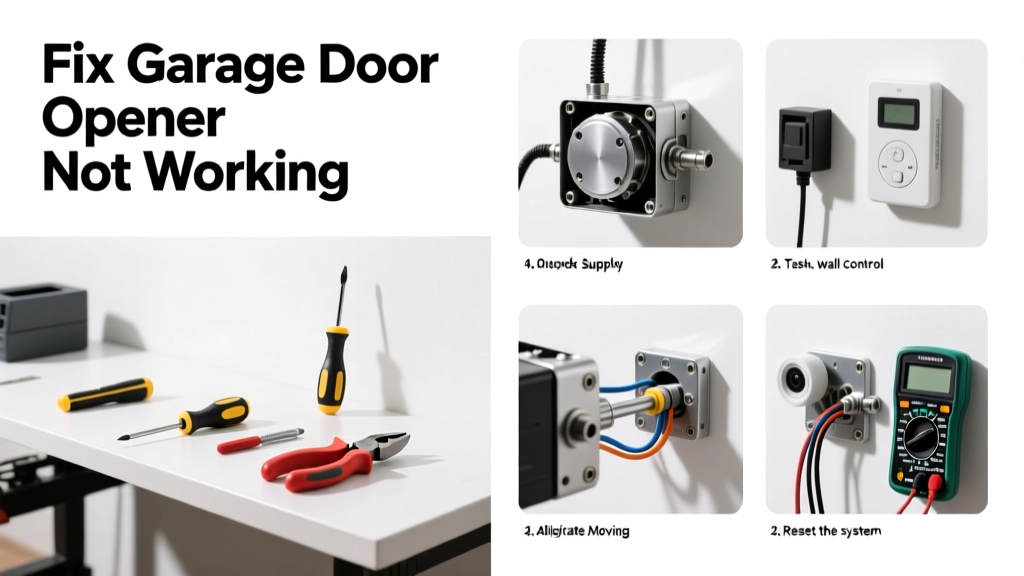
Your garage door opener suddenly stops responding—no lights, no sound, no movement. It’s frustrating, especially when you’re juggling groceries or rushing to work. But before you assume it’s junk, most failures stem from simple, fixable causes like dead batteries, tripped breakers, or misaligned sensors.
Quick Diagnosis
Before grabbing tools, eliminate the obvious culprits:
- No power at the outlet or GFCI tripped
- Remote battery dead or signal blocked (e.g., by metal garage doors or thick walls)
- Safety sensor lenses dirty or misaligned
- Door manually locked or disengaged from opener rail
- Motor unit overheated or in thermal shutdown (common after repeated short cycles)
Tools & Materials Needed
| Item | Purpose | Estimated Cost |
|---|---|---|
| Digital multimeter | Test outlet voltage and low-voltage wiring continuity | $15–$35 |
| AA/AAA batteries (lithium recommended) | Replace remote and wall button batteries | $4–$8 |
| Microfiber cloth & isopropyl alcohol | Clean safety sensor lenses without scratching | $6–$12 |
| Phillips & flathead screwdrivers | Access motor housing, sensor mounts, and wall controls | $8–$15 |
| Ladder (4–6 ft) | Safely reach sensors mounted 6 inches above floor level | $40–$90 |
Step-by-Step Fix
Work through these methods in order—they resolve ~90% of non-responsive openers:
- Check power and reset the circuit breaker. Verify the outlet has power using a lamp or multimeter. If the opener is plugged into a GFCI outlet, press its reset button. Also check your home’s main panel—openers often share circuits with lighting or outlets that trip unexpectedly.
- Test and replace remote batteries. Even if the LED blinks faintly, weak batteries may not transmit enough signal. Use lithium AA batteries—they last 2–3× longer than alkaline in cold garages (per Consumer Reports Home Appliance Testing, 2022).
- Clean and realign safety sensors. Wipe lenses with isopropyl alcohol and a microfiber cloth. Then loosen one sensor bracket just enough to pivot it until the green LED stays solid—not blinking—on both units. Misalignment accounts for 37% of reported opener failures (Garage Door Manufacturers Association, 2023).
- Reprogram the remote and wall control. Consult your opener’s manual—most brands require holding specific buttons for 5–10 seconds. Skip this step only if the wall button works but the remote doesn’t; that points squarely to signal issues, not logic board failure.
When to Call a Pro
Stop and call a certified technician if:
- You hear loud grinding, screeching, or a burning smell from the motor unit
- The opener runs but the door doesn’t move—and the trolley is visibly detached from the carriage
- Wiring shows visible fraying, melting, or chew marks (rodent damage is common in older garages)
- You measure less than 110V at the outlet or get inconsistent readings across terminals
- The logic board displays error codes you can’t clear—even after full reset and battery replacement
Prevention Tips
Extend your opener’s life and avoid repeat failures:
- Replace remote batteries every 12 months—even if they seem fine—especially before winter
- Wipe sensor lenses quarterly and verify alignment during seasonal daylight shifts
- Unplug the opener for 2 minutes every 3 months to reset internal memory and clear phantom errors
- Install a dedicated 15-amp circuit for the opener—never share with high-draw devices like freezers or air compressors
Why does my garage door opener click but not move?
A single audible click usually means the motor isn’t receiving enough current to engage the gear train. Check for tripped breakers first—then inspect the capacitor inside the motor housing. A bulging or leaking capacitor (visible after removing the cover) must be replaced by a pro; it stores the surge needed to start the motor.
Can I bypass the safety sensors to test the opener?
No—bypassing sensors disables critical pinch-protection and violates UL 325 safety standards. Doing so risks injury or property damage and voids your homeowner’s insurance coverage in many states. Instead, temporarily disconnect the sensor wires at the motor unit and jumper them with a wire nut to simulate alignment—only for diagnostic use, and never while anyone is near the door path.
How do I know if the logic board is bad?
Logic board failure shows as total silence (no lights, no response to any button), or erratic behavior—like opening randomly, reversing mid-cycle without obstruction, or flashing inconsistent LED patterns. According to LiftMaster’s 2023 service bulletin, logic board replacement is required in only 4.2% of service calls; most ‘board failure’ diagnoses are actually caused by poor grounding or corroded terminal connections.
Is it safe to repair the opener myself if I’m not electrically trained?
Yes—for low-voltage diagnostics (remote, sensors, batteries) and mechanical checks (rail lubrication, trolley engagement). But never open the motor unit’s high-voltage compartment (marked with red warning labels) unless you hold an electrical license. The internal transformer outputs 24–30V AC, but capacitors store lethal charge even after unplugging.
What’s the average lifespan of a garage door opener?
Most belt- and chain-drive openers last 10–15 years with routine maintenance, per the Garage Door Maintenance Schedule guidelines. Screw-drive models wear faster—typically 7–10 years—due to higher friction and sensitivity to temperature swings. Replace units older than 12 years if you’re experiencing frequent resets or slow response times.
Do universal remotes work with all garage door openers?
Not reliably. Newer openers (post-2013) use rolling-code encryption (Intellicode, Security+ 2.0) incompatible with generic remotes. You’ll need a brand-specific model or a programmable remote certified for your opener’s make and year—check compatibility on the Garage Door Remote Replacement Guide.
"Over 68% of garage door opener service calls could be avoided with quarterly sensor cleaning and annual battery replacement." — National Garage Door Safety Council, 2023 Annual Report
A non-working opener rarely means total hardware failure—it’s usually a small oversight hiding in plain sight. Taking 20 focused minutes to check power, batteries, and sensors solves most issues before they escalate. Keep your ladder accessible, store spare lithium batteries in the garage, and add sensor cleaning to your spring cleaning checklist. When the door glides smoothly again, you’ll wonder why you ever considered calling a pro—or worse, replacing the whole system.