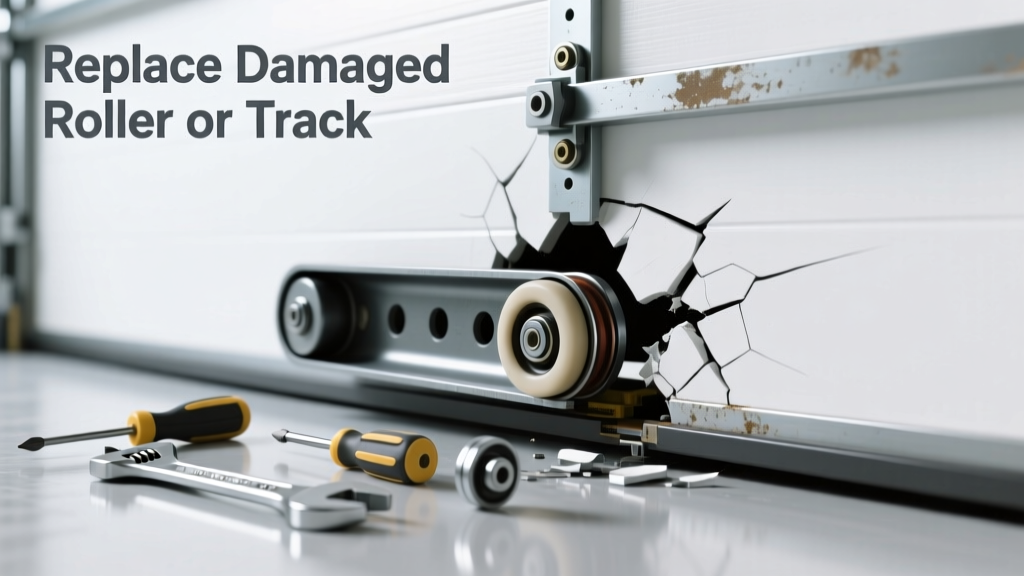
If your garage door jerks, scrapes, or refuses to close smoothly—and you spot a wheel hanging sideways or a kinked metal track—you’re likely dealing with a failed component, not just misalignment. Most off-track incidents stem from one damaged part, not full system failure. Replacing that single piece correctly restores safe, quiet operation in under two hours.
Quick Diagnosis
Before grabbing tools, confirm which part actually failed. Don’t assume it’s the track—often it’s something smaller:
- Cracked or seized nylon roller (most common cause of sudden derailment)
- Bent or corroded section of vertical or horizontal track (especially near bottom or corners)
- Loose or stripped hinge bolt allowing panel to twist out of alignment
- Worn-out spring bracket mounting plate pulling the track inward
- Missing or deformed track guide clip (small L-shaped metal piece holding track to wall)
Tools & Materials Needed
| Item | Purpose | Estimated Cost |
|---|---|---|
| 1/4" hex key set | Tightens roller axle bolts and hinge screws without stripping heads | $8–$15 |
| Adjustable wrench (10") | Holds track bracket nuts while loosening bolts on vertical sections | $12–$22 |
| Replacement nylon roller (with axle) | Exact match for your door brand (e.g., Clopay #R-220 or Wayne Dalton #7019) | $6–$14 |
| Galvanized track section (24" or 36") | Replaces bent or rust-pitted segment; matches standard 2" x 2" or 2" x 3" profiles | $24–$42 |
| Track mounting brackets (x2) | Secures new track section to wall studs; includes lag bolts and washers | $9–$16 |
Step-by-Step Fix
Work only with the door fully closed and unplugged from the opener. Never attempt repairs while the door is raised or under spring tension.
- Secure the door: Clamp locking pliers on both vertical tracks below the bottom panel to prevent accidental movement.
- Remove the damaged roller: Loosen the axle bolt on the affected hinge using a 1/4" hex key. Slide out the old roller assembly and inspect the hinge for cracks—if cracked, replace the entire hinge (how to replace garage door hinges).
- Replace bent track: Unscrew mounting brackets at both ends of the warped section. Cut out the damaged 24" segment with a hacksaw, then bolt in the new galvanized section using pre-drilled holes and grade-5 lag bolts.
- Reinstall and test: Slide the roller back into place, tighten axle bolt to 25 ft-lbs (use torque wrench), then slowly lift and lower the door manually 3 times. Listen for grinding or binding.
When to Call a Pro
Some situations demand licensed expertise—not DIY bravado. According to the International Door Association’s 2022 Safety Guidelines, over 70% of serious garage door injuries occur during attempted spring or track repairs by untrained homeowners.
- The torsion spring above the door is cracked, sagging, or has visible corrosion
- More than two consecutive track sections are bent or detached
- The door drops violently when released mid-lift (indicates broken cable or spring)
- You lack a stud finder and can’t verify solid anchor points behind drywall or stucco
"Never force a misaligned door back onto track with a pry bar—this bends rollers, warps hinges, and risks cable snap," warns Gary M., certified IDA technician with 18 years’ field experience.
Prevention Tips
Maintenance prevents 80% of off-track events, per the Door & Access Systems Manufacturers Association’s 2023 Field Survey. Focus on these habits:
- Lubricate rollers, hinges, and track quarterly with white lithium grease—not WD-40 (it attracts dust)
- Inspect track alignment monthly: hold a level against vertical sections; deviation beyond 1/8" requires adjustment
- Tighten all hinge and bracket bolts every six months (vibration loosens them)
- Replace nylon rollers every 5–7 years—even if they seem fine—since internal wear isn’t visible
Can I reuse the old track brackets when installing a new section?
Only if they’re undamaged, unpainted, and show no signs of bending or stripped threads. Galvanized brackets lose structural integrity after repeated removal. Always replace brackets older than 5 years or those mounted with drywall anchors instead of lag bolts into studs.
How do I know if my roller axle is bent or just the wheel?
Remove the roller and roll the axle across a flat surface like a granite countertop. If it wobbles or doesn’t spin true, the axle is bent. If the axle rolls smoothly but the wheel wobbles side-to-side on its own, the wheel hub is cracked—replace the full assembly.
Is it safe to replace just one roller, or should I replace all?
Replace only the failed roller if others are less than 3 years old and rotate freely. But if your door is over 5 years old or you’ve had multiple roller failures, swap all rollers on the same panel—they wear at similar rates. Uneven wear causes binding and premature track damage.
What’s the difference between residential and commercial track replacement parts?
Residential tracks are typically 2" x 2" or 2" x 3" galvanized steel, rated for doors up to 16' wide and 250 lbs. Commercial tracks use thicker gauge steel (14-gauge vs. 16-gauge), reinforced brackets, and wider flanges to handle heavier doors and higher cycle counts. Using residential parts on a commercial door voids UL certification and increases derailment risk.
Can weather affect track alignment over time?
Absolutely. The U.S. Department of Energy reports wood-framed garages expand and contract up to 3/16" seasonally in humid climates, shifting track anchor points. Metal tracks bolted directly to wood framing should be rechecked for plumb and level each spring and fall—especially in regions with >60% average humidity.
Do I need to rebalance the door after replacing a roller or track section?
No—if only one roller or a short track segment was replaced, balance remains unaffected. But if you replaced more than two rollers, any hinge, or over 48" of track, perform a balance test: disconnect the opener, lift the door halfway, and let go. It should stay put. If it rises or falls, call a pro for spring adjustment (how to test garage door spring balance).
A properly replaced roller or track section restores smooth motion, eliminates scraping noise, and extends your door’s service life by 3–5 years. Keep a spare roller and bracket kit in your garage—it takes less time to install than to wait for an emergency service call. And remember: when in doubt about spring tension or structural integrity, that $120 service call saves far more than it costs.