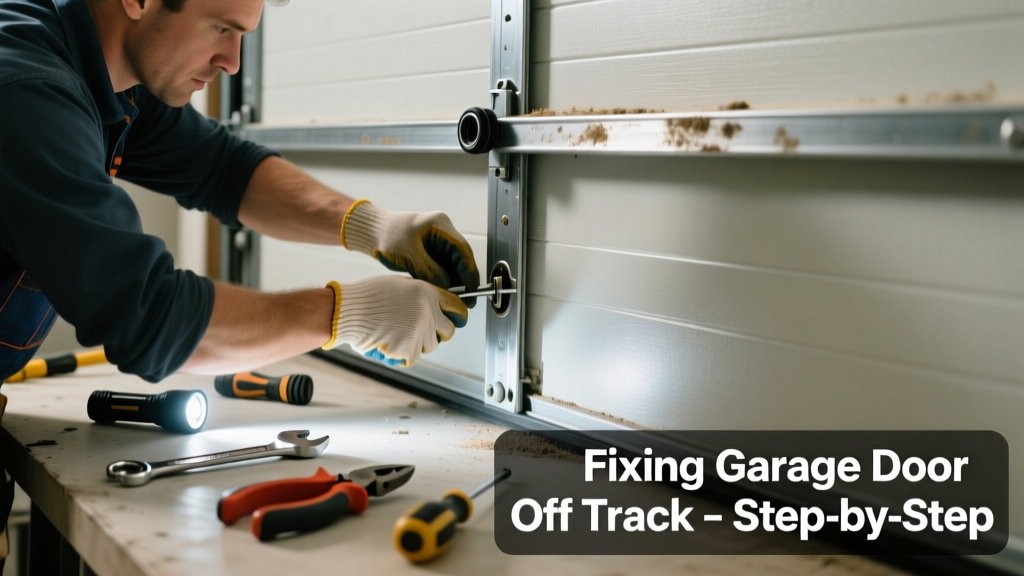
If your garage door is clanging, grinding, or skipping as it moves—and you spot the rollers hanging crooked or the door tilting mid-cycle—you’re likely dealing with a track misalignment. This isn’t just annoying; it’s a safety hazard and a fast-track to broken springs or damaged panels.
Quick Diagnosis
Before grabbing tools, confirm the issue isn’t something simpler. Unusual noise paired with visible misalignment usually points to one or more of these:
- Loose or bent track brackets (especially near the top corners)
- Worn or cracked nylon rollers with exposed metal-on-metal contact
- Debris—grit, rust flakes, or old grease buildup—in the track groove
- Roller stems popped out of the hanger bracket due to impact or vibration
- Warped or dented vertical track section near the floor where the door pivots
Tools & Materials Needed
| Item | Purpose | Estimated Cost |
|---|---|---|
| Adjustable wrench (10–12 inch) | Tightens track bolts without stripping heads | $12–$22 |
| 3-ft level | Verifies vertical/horizontal alignment of track sections | $8–$18 |
| Heavy-duty needle-nose pliers | Reinserts roller stems into hanger brackets | $9–$16 |
| White lithium grease (spray or tube) | Lubricates rollers and track without attracting dust | $5–$10 |
| Shop vacuum with crevice tool | Removes grit and debris from track interior | $30–$65 |
Step-by-Step Fix
Work with the door fully closed and power disconnected. Never attempt adjustments while the opener is engaged.
- Inspect and clear the track: Use the shop vacuum to remove all debris from both vertical and horizontal tracks. Wipe interior surfaces with a dry rag—no solvents, which degrade rubber rollers.
- Check roller alignment: With the door closed, examine each roller. If any sit at an angle or hang below the track lip, gently lift the door panel slightly and use needle-nose pliers to reseat the roller stem into its bracket slot.
- Realign the vertical track: Loosen (don’t remove) the top three track bracket bolts on the affected side. Place your level against the track’s outer edge. Adjust until plumb, then retighten bolts in sequence—top first, then middle, then bottom.
- Test and lubricate: Manually lift the door halfway and let go. It should stay put. If it drifts, springs may be unbalanced—stop and call a pro. If stable, apply lithium grease sparingly to rollers and track contact points.
When to Call a Pro
Some issues look simple but carry serious risk. Call a certified technician if:
- The torsion spring above the door is cracked, sagging, or has visible gaps between coils
- You hear loud metallic pinging during operation—this often signals imminent spring failure
- The door won’t stay in place when lifted manually past the midpoint
- Track is visibly bent beyond 1/4 inch or welded sections show stress fractures
According to the International Door Association’s 2022 Safety Report, 73% of garage door-related injuries occur during DIY spring or track repairs gone wrong.
"Never force a roller back into a bent track—it’ll only worsen misalignment and wear out the wheel faster." — Mike R., certified door technician with 18 years’ field experience
Prevention Tips
Misalignment rarely happens overnight. Catch it early with routine care:
- Inspect tracks and rollers monthly—look for rust, chips, or uneven wear patterns
- Tighten track bracket bolts every 6 months using a torque setting of 25–30 ft-lbs
- Replace nylon rollers every 5–7 years, even if they seem fine—fatigue isn’t always visible
- Avoid slamming the door shut; use the opener’s soft-close setting if available
Can I straighten a bent track with a hammer?
No. Hammering distorts metal grain and weakens structural integrity. Even minor bends compromise roller guidance and accelerate wear. Replace bent sections entirely—most manufacturers sell 2-ft vertical track segments for under $25. See our garage door track replacement guide for compatible part numbers by brand.
Why does my door only make noise when opening—not closing?
This often means the upper track section near the header is misaligned or has accumulated debris where the curved radius meets the horizontal run. That’s where rollers transition from vertical to horizontal motion and are most sensitive to friction. Clean and level that junction first.
Is it safe to lubricate the track with WD-40?
No. WD-40 is a solvent and water displacer—not a long-term lubricant. It washes away factory-applied grease and attracts dust, creating abrasive sludge. Use white lithium grease instead, like the kind found in our recommended lubrication guide.
How do I know if the rollers are worn out?
Look for flat spots on the wheel tread, cracks in the nylon housing, or excessive wobble when spinning by hand. Also check for brass-colored scoring marks on the track—those indicate metal-on-metal contact from failed roller bearings. Replace all rollers as a set, not individually.
Will tightening loose brackets stop the noise immediately?
Sometimes—but only if the noise is purely from vibration. If grinding persists after tightening, the rollers themselves are likely damaged or the track has micro-bends invisible to the naked eye. In those cases, cleaning and realignment must come first.
Can weather affect track alignment?
Absolutely. Seasonal expansion and contraction of wood framing (especially in attached garages) can shift track mounting points up to 1/8 inch over time. Homes built on slab foundations see less movement, but steel-framed garages still flex with temperature swings. Recheck alignment twice yearly—spring and fall.
Fixing an off-track garage door doesn’t require a full rebuild—but it does demand patience, precision, and respect for the forces involved. A few minutes of careful inspection and adjustment now saves hundreds in panel or spring replacements later. And if the noise returns within two weeks, revisit your roller condition and track level before assuming the problem’s solved.