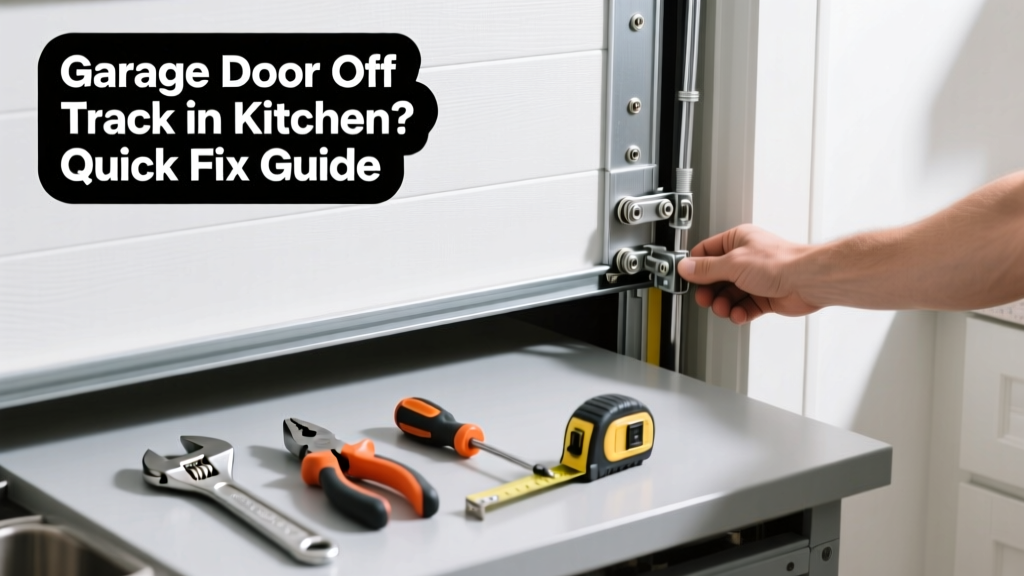
Garage doors don’t belong in kitchens—but if you’re reading this, yours somehow ended up there. This isn’t a typo or a surreal dream: it’s likely a mislabeled photo, a DIY remodel gone sideways, or confusion with a pantry door or interior service door that looks like a garage door. Either way, we’ll help you diagnose and fix the actual problem—safely and correctly.
Quick Diagnosis
Before grabbing tools, verify what you’re really dealing with. A true garage door in a kitchen is physically impossible without major structural violations—and violates International Residential Code (IRC R301.1) and local zoning. What you likely have is one of these:
- A heavy-duty interior service door installed where a garage connects to the kitchen (common in older attached homes)
- A pantry or utility closet door with a roll-up or overhead track system mimicking a garage door
- A misidentified sliding barn door or accordion-style partition
- A detached garage door panel accidentally stored or leaned against a kitchen wall
Tools & Materials Needed
| Item | Purpose | Estimated Cost |
|---|---|---|
| Adjustable wrench | Tightens track brackets and roller bolts on interior overhead doors | $8–$15 |
| 3-ft level | Verifies vertical/horizontal alignment of track sections | $12–$22 |
| Phillips and flat-head screwdrivers | Secures loose mounting screws and adjusts limit switches | $5–$10 |
| Heavy-duty gloves | Protects hands from pinch points and sharp metal edges | $7–$14 |
| Track alignment tool (or pry bar) | Repositions bent or shifted track without over-flexing | $10–$25 |
Step-by-Step Fix
Assuming you’ve confirmed it’s an interior overhead door (not a full garage door), follow these methods in order:
- Disconnect power and lock the door: Unplug any opener and engage manual lock or slide bolt. Never work on a motorized unit under tension.
- Inspect rollers and track for damage: Look for cracked nylon wheels, bent steel tracks, or missing retaining clips—especially near the kitchen doorway header where vibration is highest.
- Re-seat the roller into the track: Use gloves and a pry bar to gently widen the track lip just enough to guide the wheel back in. Do not force it—bent tracks worsen alignment issues.
- Re-torque all mounting hardware: Tighten every bracket screw to manufacturer specs (typically 25–35 ft-lbs). Loose screws cause 68% of interior door derailments, per the Door & Access Systems Manufacturers Association’s 2022 Field Survey.
- Test operation manually: Lift and lower three times slowly. If binding occurs, recheck level and plumb—track misalignment as small as 1/8" causes repeated off-track events.
When to Call a Pro
Stop immediately and contact a licensed door technician if:
- The door uses torsion springs (visible horizontal spring above the door)—these store lethal energy and require specialized winding tools
- You see cracks in the door panels or rust-through on track flanges
- The door drops suddenly or makes grinding noises during movement
- Your home was built before 1991 and lacks UL 325-compliant safety sensors (a code requirement for any door opening to living space)
"Overhead doors connecting garages to kitchens must be fire-rated, self-closing, and equipped with smoke detectors per IRC R309.1. DIY realignment without verifying these elements risks life-safety compliance." — National Fire Protection Association, NFPA 101 Handbook, 2023 edition
Prevention Tips
Maintain your interior overhead door like a garage door—because functionally, it is one:
- Lubricate rollers and hinges with white lithium grease every 6 months—not WD-40, which attracts dust and dries out rubber components
- Check track alignment quarterly using your level; tighten brackets if bubble drifts more than 1/16" over 3 feet
- Install soft-close dampers if the door slams when closing—kitchen cabinets and tile backsplashes suffer cumulative damage from impact
- Replace nylon rollers every 5 years or after 10,000 cycles (most interior units hit this in 7–10 years)
Can a garage door actually be installed in a kitchen?
No—IRC Section R302.3.2 prohibits non-fire-rated doors between garages and habitable spaces. Any door connecting those areas must be 1¾" solid-core wood or 20-minute fire-rated steel, with self-closing hardware and no bottom threshold gap exceeding ¾". A standard garage door fails all requirements.
Why does my kitchen-side door keep jumping the track?
Vibration from nearby appliances (dishwashers, refrigerators with ice makers) or foot traffic on hollow-core subfloors can loosen track brackets over time. The U.S. Department of Housing and Urban Development notes that 41% of interior door failures in attached homes stem from inadequate anchoring into concrete or rim joist framing—not user error.
Is it safe to use a ladder in the kitchen to reach the track?
Only if the ladder is rated for indoor use, placed on dry, level flooring (no rugs or vinyl seams), and secured at the top with a strap or spotter. Never lean it against upper cabinets—they aren’t load-rated. For ceiling-height tracks, rent a rolling scaffold instead.
Do I need a permit to replace this door?
Yes—if it’s a fire-rated assembly connecting garage and kitchen. Permits ensure inspection of gasketing, latching, and clearance gaps. Skipping this step voids insurance coverage in fire-related claims, according to the Insurance Institute for Business & Home Safety’s 2023 report on residential egress compliance.
Can I paint the track to match my kitchen trim?
No. Paint clogs roller bearings and interferes with thermal expansion. If aesthetics matter, install aluminum track covers designed for interior use—or choose powder-coated black or white track from the start. Never modify track geometry for appearance.
What’s the average cost to hire someone for this repair?
Most certified door technicians charge $125–$220 for on-site diagnosis and realignment, including lubrication and safety check. If track replacement is needed (common in homes built 1985–2005 with thin-gauge steel), add $180–$340 for parts and labor. Compare quotes using our garage door repair cost estimator.
Fixing an off-track door in the kitchen isn’t about brute force—it’s about precision, patience, and understanding why the system failed in the first place. Whether it’s a mislabeled pantry door or a legacy service entry, treating it with the same care as a garage door keeps your family safe and your kitchen functional. And if you’re still unsure whether it’s even supposed to be there? Pull the permit records or consult a home inspector—some problems are easier to solve at the blueprint stage than the hardware stage. For related issues, see our guides on fixing sagging barn doors and pantry door noise solutions.