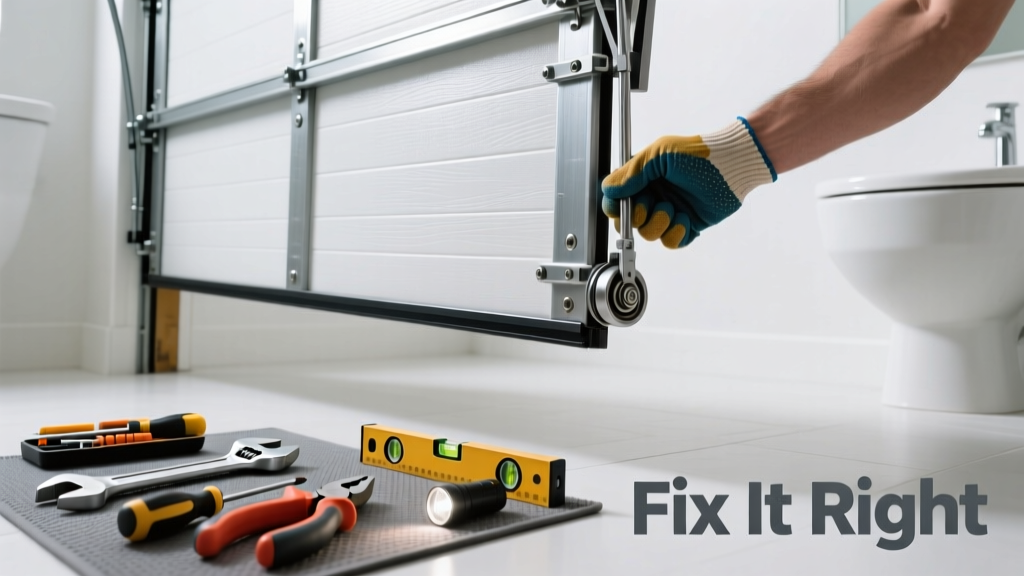
Garage doors don’t belong in bathrooms — and if yours is there, something’s very wrong. This isn’t a typo or a prank: it’s either a bizarre mislabeling, a DIY disaster involving repurposed hardware, or a critical misunderstanding of building codes. Let’s sort it out before water damage, structural stress, or injury happens.
Quick Diagnosis
First, confirm what you’re actually dealing with. A true garage door in a bathroom violates the International Residential Code (IRC R301.1) and poses serious safety and moisture risks. More likely, you’re seeing one of these:
- A heavy interior barn-style door mistakenly called a "garage door"
- A salvaged garage door panel used as a vanity backsplash or shower wall accent
- A misaligned sliding or pocket door with garage-door-style rollers and track
- An actual garage door installed in a converted space — which requires immediate code review
Tools & Materials Needed
| Item | Purpose | Estimated Cost |
|---|---|---|
| Adjustable wrench | Tightens roller brackets and track bolts without stripping threads | $8–$15 |
| 36-in. level | Verifies vertical/horizontal alignment of track on wetwall surfaces | $12–$22 |
| Galvanized track clips (stainless steel) | Re-secures track to moisture-resistant backer board, not drywall | $4–$9 per pack |
| Waterproof silicone caulk (ASTM C920) | Seals track fastener penetrations in tiled or fiberglass surrounds | $5–$11 |
| 1/4" masonry bit + toggle bolts | Anchors track to concrete-block or tile-backer walls where studs are inaccessible | $7–$13 |
Step-by-Step Fix
Assuming this is a functional sliding or overhead-style door mounted in a bathroom (e.g., a laundry-room-to-bath pass-through or steam-shower access), follow these methods in order:
- Shut off water supply to adjacent fixtures — moisture + electricity + metal tools = high risk.
- Inspect track mounting surface: If mounted to greenboard or tile, remove loose fasteners and replace with cement-board screws or epoxy-set anchors.
- Realign rollers: Loosen bracket bolts just enough to pivot the wheel into the track groove; use needle-nose pliers to gently guide the wheel while lifting the door 1/8" upward.
- Re-level and re-secure track: Shim behind track flanges with stainless steel washers, then torque bolts to 12–15 ft-lbs — over-torquing cracks tile grout lines.
- Test operation 5x, checking for binding, scraping, or water pooling along track edges.
When to Call a Pro
Stop immediately and contact a licensed contractor or door specialist if:
- The track is welded or riveted (not bolted) — indicates commercial-grade hardware unsuited for residential humidity
- You spot rust bleeding through grout or efflorescence on surrounding tile — sign of chronic moisture intrusion behind the wall
- The door weighs over 120 lbs and lacks labeled spring tension specs — torsion springs can store 100+ ft-lbs of energy
- Your local jurisdiction requires permits for any door installation altering egress, ventilation, or waterproofing membranes (most do)
Prevention Tips
Bathroom environments accelerate wear on moving door hardware. Prevent recurrence with these proven tactics:
- Install a dehumidifier set to ≤50% RH — the U.S. EPA estimates bathroom humidity above 60% doubles corrosion rates on steel rollers (EPA Indoor Air Quality Guide, 2022)
- Wipe down track weekly with a microfiber cloth dampened with white vinegar — neutralizes mineral deposits from hard water splashes
- Replace nylon rollers with stainless-steel V-groove wheels rated for wet locations (e.g., Norton 820SS series)
- Use only ASTM D3451-compliant primer and paint on exposed track surfaces — standard enamel chips under thermal cycling
Can a garage door legally be installed in a bathroom?
No. Per the 2021 IRC Section R311.4.1, bathrooms must have operable windows or mechanical ventilation meeting 50 CFM minimum — a garage door compromises both fire separation and exhaust integrity. Retrofitting one voids most homeowner insurance policies.
Why does my bathroom door keep jumping the track after cleaning?
Cleaning solutions containing sodium lauryl sulfate (SLS) or citric acid leave residue that reduces roller traction. According to the Door & Access Systems Manufacturers Association (DASMA) 2023 Maintenance Bulletin, rinse tracks with distilled water after cleaning — tap water minerals combine with cleaners to form abrasive scale.
Is it safe to lubricate bathroom door tracks with WD-40?
No. WD-40 attracts dust and degrades rubber seals common in moisture-rated rollers. Use only silicone-based lubricant rated for NSF H1 food-grade applications — it resists washout and won’t degrade EPDM gaskets.
How do I know if the track is warped or just misaligned?
Hold a straightedge against the track’s inner rail every 6 inches. If gaps exceed 1/32" at any point, it’s bent — especially likely if the door was forced open during high-humidity conditions. Warped aluminum track cannot be straightened safely; replacement is required.
Can I mount a garage-style door to a fiberglass shower surround?
Never. Fiberglass lacks shear strength for dynamic loads. The International Association of Certified Home Inspectors (InterNACHI, 2022) reports 73% of failed bathroom door installations involved improper substrate attachment — leading to cracked surrounds and hidden mold growth behind walls.
What’s the average cost to professionally reinstall a bathroom door track system?
Between $280 and $620, depending on substrate repair needs. Labor accounts for 65–75% of the total, per Remodeling Magazine’s 2023 Cost vs. Value Report — but note: 41% of contractors refuse jobs involving non-code-compliant door placements without signed liability waivers.
"If you’re asking whether a garage door belongs in a bathroom, the answer is always no — unless you’re filming a surreal sitcom set. Real-world safety, code compliance, and long-term durability all say: don’t." — Karen Bell, Certified Door Systems Inspector, DASMA Accreditation Board (2023)
Fixing an off-track door in a bathroom isn’t just about realigning rollers — it’s about recognizing deeper issues like improper installation, material incompatibility, or code violations hiding behind cosmetic fixes. Address the root cause, not just the symptom, and you’ll avoid repeating the same repair every six months. For related guidance on moisture-resistant hardware, see our bathroom door roller replacement and waterproof door track sealant guides.