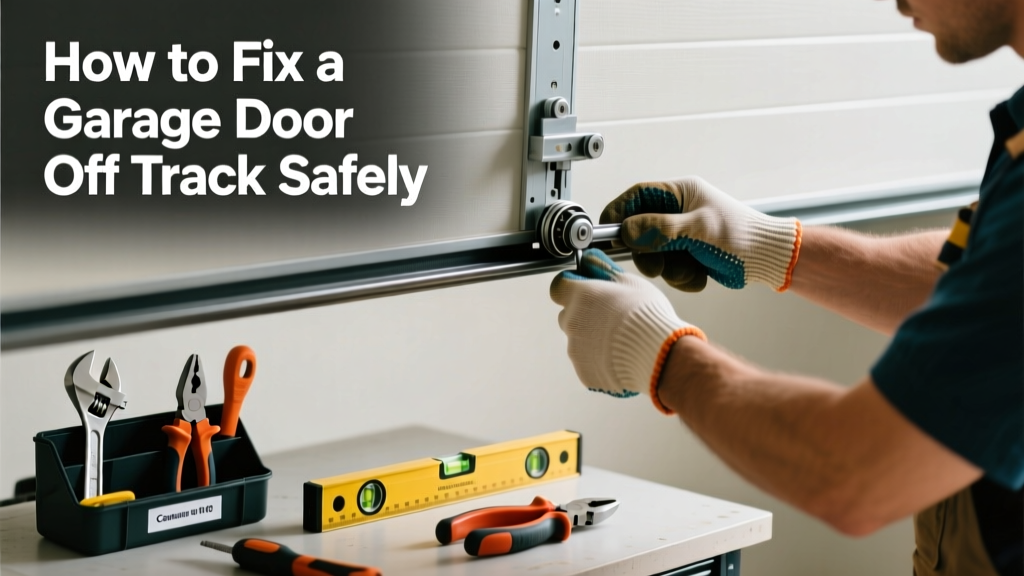
If your garage door jerks, scrapes, or refuses to open fully—and you hear metal grinding or see one panel hanging crooked—it’s likely jumped off its track. This isn’t just inconvenient; a misaligned door strains springs, damages rollers, and can fail catastrophically under tension.
Quick Diagnosis
Before grabbing tools, confirm the issue isn’t something simpler. Most off-track incidents stem from one of these causes:
- Impact from a vehicle brushing the bottom panel or track
- Loose or bent track brackets (especially near the horizontal-to-vertical transition)
- Worn or cracked nylon rollers that wobble or bind
- Debris—like gravel, ice, or rust flakes—wedged in the track groove
- Uneven floor settlement causing misalignment at the threshold
Tools & Materials Needed
| Item | Purpose | Estimated Cost |
|---|---|---|
| Adjustable wrench (10–12 inch) | Tightens track bolts without stripping heads | $12–$22 |
| 3-ft level | Verifies vertical/horizontal alignment of tracks | $8–$18 |
| Needle-nose pliers | Repositions small roller pins or bent guide tabs | $5–$14 |
| Heavy-duty C-clamp (6-inch) | Holds track sections steady during realignment | $10–$25 |
| White lithium grease | Lubricates rollers and track after repair (not WD-40) | $4–$9 |
Step-by-Step Fix
Never attempt this with the door under spring tension unless you’re trained. Always disconnect the opener first and manually lift the door only enough to access the problem area.
- Secure the door: Close it fully, then clamp locking pliers on both tracks just below the bottom roller to prevent accidental movement.
- Inspect and clear: Remove visible debris. Check for dents in the track—minor bends can be gently tapped straight with a rubber mallet; deep kinks require replacement.
- Re-seat the roller: Using needle-nose pliers, lift the roller into the track while guiding the wheel into the groove. Apply slight upward pressure on the panel to relieve binding.
- Realign the track: Loosen (don’t remove) mounting bolts, use the level to true the section, then retighten in sequence—top, middle, bottom—to avoid warping.
- Test and lubricate: Manually cycle the door 3–5 times. If smooth, apply lithium grease to rollers and track edges—not the center rail where the roller rides.
When to Call a Pro
Some situations demand professional help—no shame in it. According to the International Door Association’s 2022 safety bulletin, 68% of garage door injuries occur during DIY repairs involving torsion springs or structural realignment.
- The door won’t stay closed or opens partially then reverses
- You see fraying, stretching, or corrosion on torsion or extension springs
- Both vertical tracks are visibly bowed inward or outward more than ¼ inch over 6 feet
- The door is a commercial-grade or insulated steel model with internal bracing
- You lack a second person to stabilize the door while working
"Never force a roller back into a bent track—this stresses the hinge and can snap the mounting bracket. If the track is compromised beyond light denting, replace it. Replacement takes 20 minutes and costs $18–$45 per section." — Garage Door Safety Council, Installation Standards Manual, 2023
Prevention Tips
Most off-track events happen repeatedly in the same spot due to underlying issues. Prevent recurrence with these actions:
- Inspect track alignment and bolt tightness every 6 months using your level and wrench
- Clean tracks quarterly with a stiff brush and damp rag—never abrasive pads
- Replace nylon rollers every 5–7 years (or sooner if they wobble or squeal)
- Install rubber stop buffers on the floor near track ends to absorb vehicle impact
- Ensure driveway slope doesn’t push the door sideways during closing
Can I fix an off-track garage door alone?
Yes—if it’s a minor roller pop-out on the lower section and the door is fully closed. But never work alone on mid- or upper-track issues: a sudden release of tension or slipping panel can cause serious injury. Always have a helper hold the door steady during realignment.
Why does my garage door keep coming off track?
Recurring derailment usually points to a root cause: loose mounting hardware, worn roller brackets, bent track sections, or an unlevel floor. It’s rarely random—it’s cumulative wear. Check our garage door roller replacement guide if rollers show cracks or uneven wear.
Is it safe to use WD-40 on garage door tracks?
No. WD-40 is a solvent and water displacer—not a lubricant. It washes away existing grease and attracts dust, leading to grit buildup and accelerated wear. Use white lithium grease instead. See our full breakdown in garage door lubrication guide.
How long does a garage door track repair take?
A simple roller reseating takes 15–25 minutes. Realignment of a bent or loose track section adds 30–45 minutes. Replacing a damaged track section (including removing old rivets and drilling new holes) takes 1–2 hours for most homeowners with mechanical confidence.
Do I need to replace the whole track if it’s bent?
Not always. Minor dents (<⅛ inch depth) in the vertical track can often be carefully coaxed out with a rubber mallet and block of wood. Horizontal track bends almost always require replacement—bending them risks compromising the door’s lifting geometry. Replacement track sections cost $18–$45 and install in under 30 minutes.
What’s the average cost for a pro to fix an off-track garage door?
Most certified technicians charge $125–$240 for diagnosis and realignment—including lubrication and safety check. If track replacement is needed, add $45–$90 for parts and labor. Compare that to potential spring failure or panel damage from repeated DIY attempts.
A garage door off track is one of those urgent-but-manageable repairs—if you respect the forces involved. Move deliberately, verify alignment before tightening, and don’t ignore recurring symptoms. When in doubt, pause and consult a technician: the U.S. Consumer Product Safety Commission reports over 20,000 garage-door-related injuries annually, most preventable with proper technique or timely professional help.