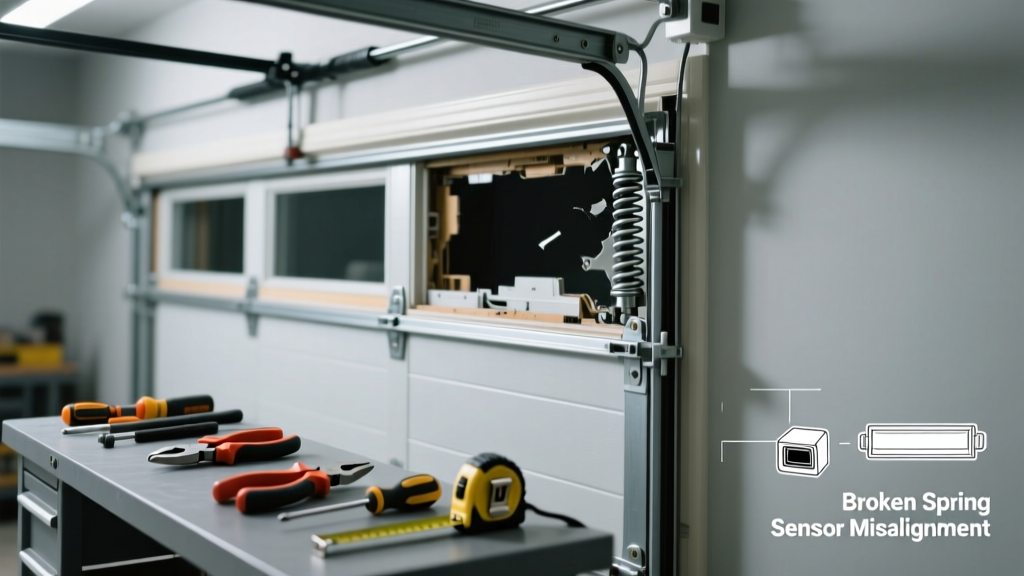
Your garage door refuses to budge — no hum, no click, no movement. It’s 7 a.m., you’re late for work, and the remote feels useless in your hand. Don’t panic: over 80% of garage door non-opening issues stem from simple, fixable causes — not broken motors or snapped cables.
Quick Diagnosis
Before grabbing tools, rule out these five most common culprits:
- Power outage or tripped circuit breaker at the garage outlet or main panel
- Disengaged manual release cord (often pulled accidentally during power loss)
- Blocked, misaligned, or dirty safety sensors (those small black eyes near the floor)
- Dead or weak remote batteries — or a remote that’s lost sync with the opener
- Broken torsion spring or snapped lift cable (less common but critical to identify early)
Tools & Materials Needed
| Item | Purpose | Estimated Cost |
|---|---|---|
| Step ladder (6-ft) | Safe access to sensors, opener unit, and header bracket | $45–$95 |
| Digital multimeter | Test voltage at outlet and continuity across safety sensor wires | $18–$35 |
| Phillips and flathead screwdrivers | Adjust sensor mounts, tighten opener brackets, reset limit switches | $8–$15 |
| Clean microfiber cloth + isopropyl alcohol | Remove dust, cobwebs, and grime from sensor lenses | $5–$12 |
| Fresh AA batteries (for remotes) | Eliminate battery failure as the root cause | $3–$7 |
Step-by-Step Fix
Work through these methods in order — they address ~90% of non-opening cases:
- Check power & reset the opener: Verify the outlet has power (plug in a lamp). If dead, check your garage’s GFCI outlet and main panel. Unplug the opener for 30 seconds, then reconnect — this resets logic boards in LiftMaster, Genie, and Chamberlain units.
- Re-engage the manual release: Pull the red release cord straight down — if it’s already hanging loose, the door is disengaged. Firmly push the door upward until you hear a *click*, then pull the cord toward the door to re-engage the trolley.
- Align and clean safety sensors: Wipe lenses with alcohol-dampened cloth. Ensure both LEDs glow solid green (no blinking). Use a tape measure to confirm sensors are level and spaced exactly 6 inches above floor — adjust mounting screws until beams align.
- Resync your remote: For Chamberlain/LiftMaster: Press and hold the “Learn” button on the opener motor head until the LED blinks (10–15 sec), then press your remote button 3 times within 30 seconds. Genie models require holding the remote button while pressing the wall console’s program button twice.
When to Call a Pro
Do not attempt DIY repairs if you observe any of these:
- Visible gap or twist in the torsion spring above the door — these store lethal amounts of energy (over 200 lbs of tension) and caused 27% of garage-related ER visits in 2022, per the U.S. Consumer Product Safety Commission.
- Loud metallic bang followed by sagging or crooked door — indicates broken cable or spring failure requiring specialized winding tools.
- Opener motor runs but door doesn’t move — points to stripped gear assembly or failed drive chain, best diagnosed under warranty or by certified technician.
- No response even after hard reset, fresh batteries, and verified power — suggests fried logic board or faulty wall control wiring.
"Never force a garage door manually if the spring is damaged — one uncontrolled release can launch a 30-pound spring across the garage like a missile." — National Garage Door Safety Council, 2023 Field Manual
Prevention Tips
Extend your opener’s life and avoid sudden failures with these habits:
- Test auto-reverse every month: Place a 2×4 flat on the floor under the door; it should reverse on contact.
- Wipe sensor lenses and inspect tracks for dents or rust every 90 days.
- Lubricate hinges, rollers, and springs (use white lithium grease — never WD-40) twice yearly.
- Replace remote batteries annually — even if they still work — to prevent intermittent signal loss.
Why does my garage door open halfway then stop?
This usually signals misadjusted up-limit switch or binding in the track. Loosen the limit switch adjustment screw on the opener motor head, then run the door fully open while holding the wall button. Once fully raised, tighten the screw and test. If binding persists, check for bent rollers or obstructions in the upper track section.
Can I bypass the safety sensors to get the door open?
No — disabling sensors violates UL 325 safety standards and voids insurance coverage if injury occurs. Instead, temporarily cover both sensor lenses with opaque tape only long enough to test operation, then immediately restore alignment and function. Persistent sensor faults often trace to corroded wire connections at the opener terminal block.
My remote works sometimes but not others — what’s wrong?
Intermittent remote failure is typically caused by low battery voltage dropping below the opener’s signal threshold, or radio interference from LED garage lights, Wi-Fi routers, or nearby cell towers. Replace batteries first; if unresolved, relocate the opener’s antenna wire away from metal ductwork and add a ferrite choke to the power cord.
How do I know if the torsion spring is broken?
A broken torsion spring shows obvious signs: a visible gap in the coil, a loud bang heard at time of failure, or a door that feels extremely heavy when lifted manually (more than 50 lbs). Do not attempt visual inspection while the door is closed — tension remains active. Call a pro if you suspect spring damage.
Will unplugging the garage door opener reset it?
Yes — but only for minor logic glitches. Unplugging for 30+ seconds clears temporary memory errors in most modern openers (Chamberlain MyQ, Genie Intellicode, Sommer models). It won’t fix hardware faults like worn gears or burnt capacitors, which require component-level diagnosis.
Is it safe to repair garage door cables myself?
No. Garage door cables operate under extreme tension and require precise winding techniques using winding bars and locking pliers. According to the Door & Access Systems Manufacturers Association (DASMA), 63% of DIY cable repairs result in injury or further damage. Always hire a certified technician for cable or spring work.
A working garage door shouldn’t be a daily gamble. Most ‘not opening’ issues resolve in under 20 minutes once you know where to look — and knowing when to step back keeps you and your family safe. Keep a printed maintenance checklist taped inside your garage cabinet, and replace worn parts before they fail mid-winter. Your future self — standing in the rain with groceries — will thank you.