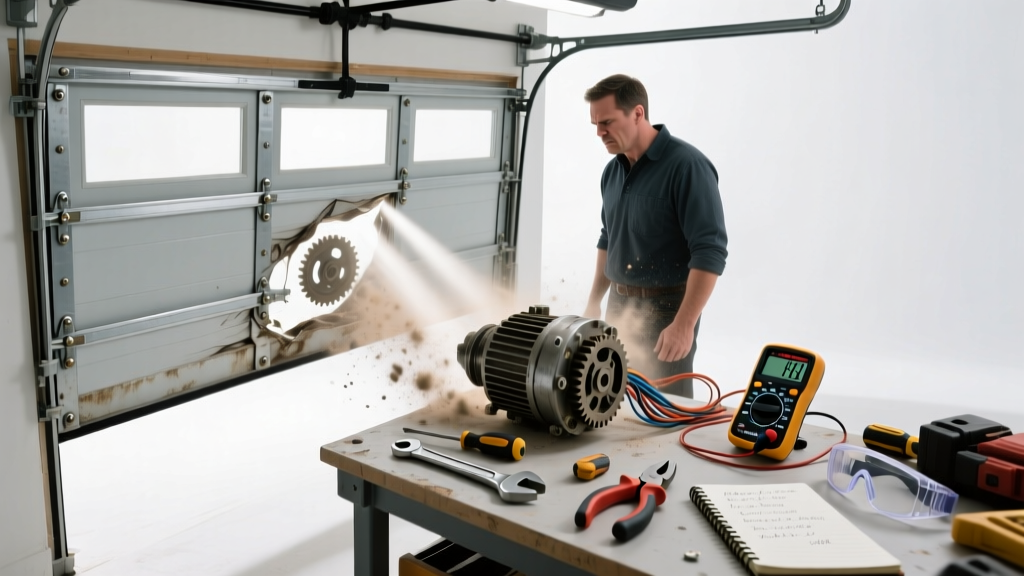
Your garage door grinds, rattles, or screeches—and refuses to budge. That’s not just annoying; it’s a warning sign. Most noise-plus-no-motion issues stem from simple mechanical problems you can address in under an hour—with the right tools and safety awareness.
Quick Diagnosis
Before grabbing tools, identify the sound and behavior:
- Grinding or scraping: Worn rollers, misaligned tracks, or failing bearings
- Squealing or high-pitched whine: Dry hinges, springs, or opener motor gear wear
- Banging or clunking on startup: Loose hardware, broken spring tension, or opener chain/screw drive slippage
- Clicking but no movement: Safety sensor obstruction, stripped gear in opener, or seized trolley
- Door lifts partially then stops: Binding rollers, track debris, or unbalanced torsion springs
Tools & Materials Needed
| Item | Purpose | Estimated Cost |
|---|---|---|
| 1/4" hex key set | Tightens roller brackets, hinge screws, and opener mounting bolts | $8–$15 |
| White lithium grease (not WD-40) | Lubricates rollers, hinges, and springs without attracting dust | $5–$9 |
| Socket wrench + 7/16" and 1/2" sockets | Adjusts torsion spring cones and secures track bolts | $12–$22 |
| Digital level (24") | Verifies vertical/horizontal track alignment within ±1/8" tolerance | $18–$35 |
| Flashlight + safety glasses | Inspects overhead components safely—especially near springs | $6–$12 |
Step-by-Step Fix
Work methodically—from bottom to top—and always disconnect power to the opener before touching moving parts.
- Inspect and clean tracks: Wipe interior track surfaces with a dry cloth; remove rust flakes or dried grease with a wire brush. Vacuum debris from track ends and roller paths.
- Check and lubricate all moving parts: Apply white lithium grease to roller stems, hinge pins, spring coils (both extension and torsion), and the opener’s chain or screw drive. Avoid oil-based lubes—they attract grit and degrade rubber bushings.
- Tighten hardware: Using your hex key and socket set, snug all hinge screws, roller bracket bolts, and track fasteners. Pay special attention to the top three hinge sets and the header bracket anchoring the track to the wall.
- Test balance and alignment: Disengage the opener (pull red emergency release cord). Manually lift the door halfway—it should stay put. If it drifts down or rises, torsion spring tension is off.
"Over 62% of garage door service calls involve misalignment or improper spring tension—not motor failure," says the Door & Access Systems Manufacturers Association (DASMA) 2022 Field Report.
When to Call a Pro
Some repairs demand specialized training and equipment. Don’t risk injury or further damage if you encounter:
- A visibly cracked, bent, or twisted torsion spring (especially if it’s snapped and dangling)
- Shattered or delaminated fiberglass or wood panels with structural warping
- Opener motor humming but not engaging—could indicate capacitor failure or internal gear stripping
- Door dropping suddenly when manually disengaged (indicates dangerous spring imbalance)
- Cracked or corroded track sections, particularly at splice joints or wall anchors
According to the U.S. Consumer Product Safety Commission, garage door-related injuries send over 20,000 people to ERs annually—most involving spring or cable failures during DIY attempts.
Prevention Tips
Maintain your door quarterly to prevent recurrence:
- Lubricate rollers, hinges, and springs every 3 months (never use silicone spray—it breaks down rubber)
- Wipe down tracks and vacuum debris monthly—especially after windstorms or pollen season
- Check for loose hardware biweekly—vibration loosens bolts faster than most realize
- Test auto-reverse sensors monthly: place a roll of paper towels in the door’s path—it should reverse within 2 seconds
- Replace nylon rollers every 5–7 years; steel rollers last longer but require more frequent lubrication
Why does my garage door make a grinding noise only when opening?
Grinding during upward travel usually points to worn nylon roller wheels contacting rough track edges—or debris trapped between the roller and track flange. Inspect each roller for flat spots or cracking, and run your finger along the inside edge of both vertical tracks for burrs or corrosion.
Can I replace garage door rollers myself?
Yes—if your door uses standard 2" or 2.5" nylon or steel rollers with accessible bracket bolts. Replacement takes 20–40 minutes per side. But if your door has proprietary or integrated bearing assemblies (common on Clopay and Amarr premium models), order exact-match replacements using your door’s serial number—and verify bracket compatibility before ordering.
Is it safe to adjust torsion springs without experience?
No. Torsion springs store lethal amounts of energy—even when the door is closed. DASMA strongly advises against homeowner adjustment. A single slip can cause severe injury or death. Hire a certified technician for any spring tension work.
What kind of lubricant should I use on garage door springs?
Use only white lithium grease (e.g., CRC White Lithium Grease or Permatex 80070). It resists washout, handles temperature swings from -20°F to 250°F, and won’t degrade rubber bushings. Never use WD-40 as a lubricant—it’s a solvent that dries out components and attracts dust.
How do I know if my garage door sensors are misaligned?
Look for blinking LED lights on each sensor unit. Steady green means aligned; rapid blinking or no light indicates obstruction or misalignment. Test by covering one sensor—door should not close. Then, use a tape measure to confirm both sensors sit at identical heights and face each other squarely. Adjust mounting brackets with a Phillips screwdriver until LEDs glow steadily.
Why does my garage door click repeatedly but not move?
This often signals a failed logic board, stripped gear in the opener head, or blocked safety sensors. First, clean sensor lenses and check for spider webs or cobwebs. Next, inspect the gear housing—open the cover and look for white plastic shavings (a telltale sign of gear wear). If present, replace the entire gear kit—gear replacement instructions are available for Chamberlain, LiftMaster, and Genie models.
Fixing a noisy, non-opening garage door isn’t about brute force—it’s about precision, patience, and respecting the physics involved. Most issues resolve with cleaning, tightening, and proper lubrication. When in doubt, pause and consult a certified technician—especially before touching springs or cables. And remember: a well-maintained door opens smoothly, quietly, and reliably for 15+ years.