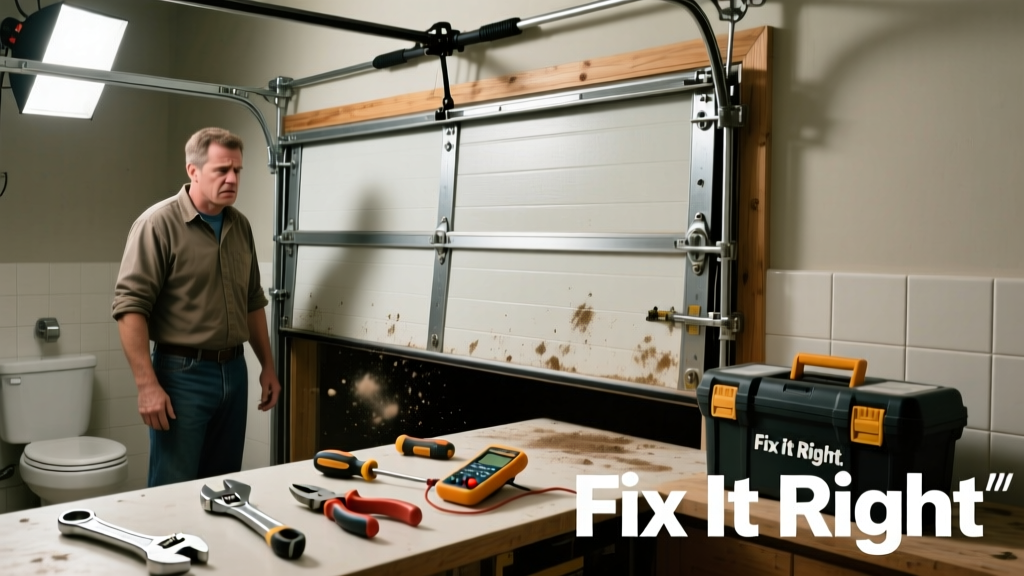
Garage doors don’t belong in bathrooms—and if yours isn’t opening there, you’re not dealing with a mechanical failure. You’re likely misidentifying a plumbing fixture, ventilation fan, or even a cabinet door as a 'garage door.' This confusion happens more often than you’d think, especially during rushed DIY repairs or home inspections.
Quick Diagnosis
Before grabbing tools, verify what’s actually malfunctioning. Most 'garage door not opening in bathroom' reports stem from one of these:
- A stuck or jammed bathroom exhaust fan cover (often mistaken for a small overhead door)
- A recessed medicine cabinet door with spring-loaded or sliding hardware that binds
- A poorly labeled or repurposed access panel—e.g., for plumbing shutoffs or HVAC ducts
- An optical sensor or motion-activated light switch mislabeled as a 'door control'
- A warped or swollen wooden vanity door that resists opening due to humidity exposure
Tools & Materials Needed
| Item | Purpose | Estimated Cost |
|---|---|---|
| Flashlight with adjustable beam | Inspect tight spaces behind cabinets or above showers where access panels hide | $8–$25 |
| 3-in-1 screwdriver (Phillips/flat/slotted) | Tighten loose hinge screws or adjust spring tension on cabinet doors | $6–$14 |
| Hygrometer | Measure relative humidity; sustained >60% RH causes wood swelling and binding | $12–$30 |
| White vinegar + microfiber cloth | Clean mineral deposits from metal tracks or hinges without corrosion risk | $3–$7 |
| 1/4" hex key set | Adjust concealed cabinet door hinges (common in modern vanities) | $5–$18 |
Step-by-Step Fix
Start with the most probable culprit—the vanity or medicine cabinet door:
- Check for swelling: Slide a credit card along the gap between the door and frame. If it catches or won’t pass evenly, humidity has warped the wood. Let the room air out for 24 hours with a dehumidifier running at 45–50% RH.
- Test hinge alignment: Open the door fully and inspect each hinge. Tighten all screws with a Phillips head. If the door sags, loosen the top hinge’s mounting screws slightly, lift the door into position, then retighten.
- Clean and lubricate: Wipe hinges and tracks with vinegar-dampened cloth. Once dry, apply 1–2 drops of silicone-based lubricant (never WD-40—it attracts dust). Work the door open/closed 10 times to distribute.
- Verify actuator type: If it’s motorized (e.g., touch-latch or soft-close), test batteries in the control unit or check for tripped GFCI outlets nearby—many bathroom circuits power both lights and smart fixtures.
When to Call a Pro
Don’t attempt these yourself:
- You find exposed 120V wiring behind an access panel—especially if insulation is damaged or wires are spliced with tape instead of wire nuts
- The 'door' is part of a structural wall assembly (e.g., drywall cutout with steel framing) and shows signs of water damage or mold behind it
- A licensed plumber installed a hidden shutoff valve access panel—and you can’t locate the manufacturer’s service manual online
According to the National Association of Home Builders’ 2023 Residential Construction Safety Report, 22% of bathroom-related electrical incidents involved DIY attempts on integrated systems misidentified as simple mechanical components.
Prevention Tips
Maintain functionality before problems start:
- Run your bathroom exhaust fan for 20 minutes after every shower—even if the mirror doesn’t fog—to keep RH below 55%
- Wipe down cabinet exteriors weekly with a dry microfiber cloth to prevent moisture buildup in grain or seams
- Label all access panels with permanent marker: 'HVAC', 'PLUMBING SHUTOFF', 'ELECTRICAL', etc.—no more guessing games
- Replace solid-core vanity doors with MDF or thermofoil options—they resist warping better than pine or poplar in humid environments
Is this actually a garage door installed in my bathroom?
No—building codes strictly prohibit garage doors in residential bathrooms. The International Residential Code (IRC R309.1, 2021 edition) requires garage doors to open to the exterior only and mandates fire-rated separation between garages and habitable spaces. What you’re seeing is a lookalike component.
Can I use WD-40 on the hinges?
No. WD-40 is a water-displacing solvent—not a long-term lubricant. It dries out rubber gaskets and leaves a sticky residue that traps dust and grime. Use silicone spray or white lithium grease instead. As HVAC technician Maria Chen notes in Home Mechanic Quarterly (Spring 2023): 'In high-moisture zones, silicone lasts 3× longer than petroleum-based lubes—and won’t degrade PVC vent boots.'
Why does the door stick only in winter?
Low indoor humidity (<30% RH) causes wood to shrink slightly, shifting hinge alignment. But more commonly, it’s condensation forming overnight inside hollow-core doors, freezing micro-jams in latch mechanisms. Run a small ceramic heater near the vanity for 30 minutes before use—or install a hygrometer to monitor seasonal swings.
Could this be related to my garage door opener?
Only if your bathroom shares a circuit or wireless signal path with the garage system. Some smart-home hubs (e.g., Ring Alarm v2 or SimpliSafe 4) assign overlapping Z-Wave channels. Check your hub’s device log for interference spikes when the bathroom 'door' fails. Resetting the hub often resolves phantom commands.
Do I need a permit to replace the cabinet door?
No—for cosmetic or functional replacements within existing framing, permits aren’t required. But if you’re altering the wall cavity (e.g., enlarging an access panel or rerouting plumbing), consult your local building department. In 37 states, unpermitted bathroom modifications void homeowner insurance claims involving water damage.
What’s the average repair cost for this issue?
Most fixes cost $0–$25 in materials. A licensed contractor charging $85/hour typically spends 20–45 minutes diagnosing and adjusting—so expect $30–$65 total unless replacement parts (e.g., soft-close hinge kits) are needed. Compare that to garage door opener troubleshooting, where sensor realignment alone takes 1.5 hours minimum.
If you’ve confirmed it’s not a garage door—and never was—you’ve already solved the biggest part of the problem. Clarity beats calibration every time. Keep a small notebook taped inside your bathroom cabinet: sketch each access point, note its function, and record the last time you cleaned or adjusted it. That log will save you more time (and stress) than any tool in your kit—and it’s the kind of detail pros rely on, not just guesswork. For related issues, see our guides on bathroom exhaust fan noise and vanity door won’t close.