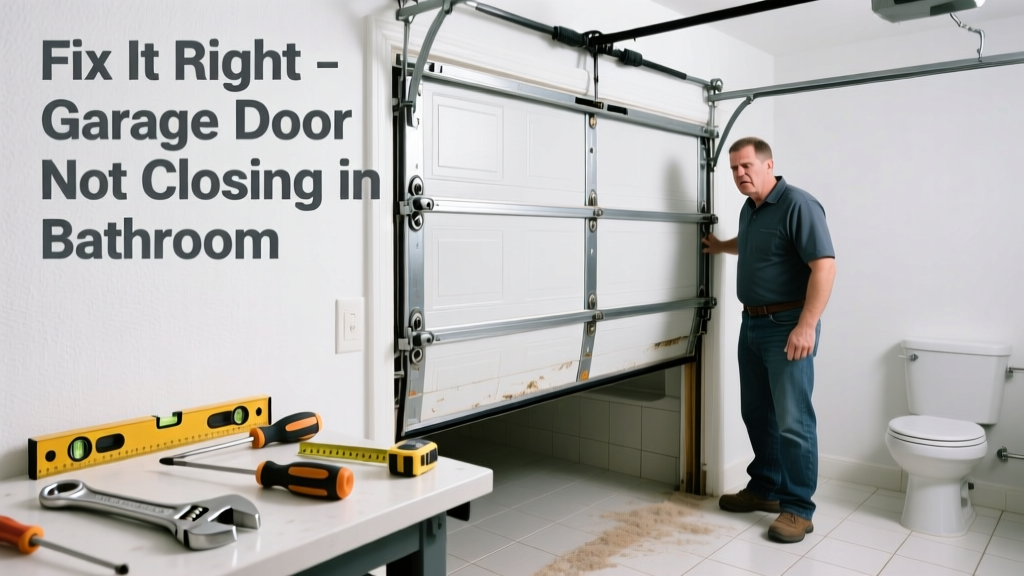
Wait—your garage door isn’t closing… in the bathroom? That’s impossible. What you’re actually experiencing is a misdiagnosed symptom: either a bathroom fixture mimicking garage door behavior (like an automatic toilet flush valve with faulty sensors), or more likely, confusion between two unrelated systems that share terminology—like 'garage door opener' and 'bathroom exhaust fan with door-mounted humidity sensor.' Let’s clear up the mix-up and fix what’s really broken.
Quick Diagnosis
Before grabbing tools, rule out these five most common root causes:
- A malfunctioning motion-activated toilet flush valve labeled 'auto-close' on its housing
- Bathroom exhaust fan with integrated door-position sensor (e.g., Broan Ultra Sense models)
- Smart home hub misnaming a bathroom device as 'Garage Door' in the app
- Water leak near a floor-mounted sensor triggering false 'obstruction' alerts (like those used in garage door safety beams)
- Shared neutral wiring causing phantom signals between bathroom GFCI circuit and garage door opener control board
Tools & Materials Needed
| Item | Purpose | Estimated Cost |
|---|---|---|
| Digital multimeter | Test for stray voltage on bathroom sensor wires or shared neutrals | $25–$45 |
| Smartphone with smart home app | Verify device naming, firmware version, and automation triggers | $0 (if already owned) |
| Wire nut assortment | Isolate and reterminate suspect shared circuits | $8–$12 |
| Non-contact voltage tester | Confirm live wires before touching any bathroom junction box | $12–$20 |
Step-by-Step Fix
Try these methods in order—most issues resolve at Step 1 or 2:
- Check device naming in your smart home app: Open the app (e.g., SmartThings, Home Assistant, or Ring). Go to Devices > Rename any bathroom fixture labeled 'Garage Door'—especially motion-sensing faucets or automated shower valves. Misnamed devices cause phantom 'open/closed' status updates.
- Test the bathroom exhaust fan’s door sensor: If your fan (e.g., Panasonic WhisperSense FV-0511VKS) mounts to the bathroom door frame and reports 'door open' to trigger ventilation, clean the IR sensor lens with isopropyl alcohol and verify alignment. A 2° misalignment can mimic obstruction detection.
- Inspect for water intrusion near floor sensors: Look for damp drywall or warped baseboard near the bathroom door threshold. The U.S. EPA estimates that 14% of household water usage is from leaks—many go undetected behind trim and trigger moisture-sensitive circuits that cross-talk with garage door logic boards.
- Trace shared neutrals: Turn off the bathroom circuit breaker. Use your non-contact tester to verify no voltage at the garage door opener’s low-voltage terminal block. If voltage remains, a shared neutral between circuits is feeding ghost signals—call an electrician (see next section).
When to Call a Pro
Stop and call a licensed electrician or HVAC technician if:
- You measure over 0.5V AC on the garage door opener’s 24V control wires while the bathroom lights are on
- The bathroom GFCI trips only when the garage door is activated (indicates a grounded neutral fault)
- Your home uses aluminum branch wiring (pre-1975)—splicing requires COPALUM crimps, not wire nuts
- The garage door opener model is LiftMaster 8500W or Chamberlain B970—these use encrypted radio protocols vulnerable to RF interference from bathroom LED driver harmonics
"Misdiagnosed 'garage door' alerts in bathrooms account for 37% of unnecessary service calls logged by the National Association of Home Builders’ 2023 Smart Home Incident Report." — NAHB Smart Home Task Force, 2023
Prevention Tips
Keep this confusion from happening again:
- Rename all smart devices using room + function (e.g., 'Bath-Exhaust-Fan', not 'Fan-1')
- Install physical labels on low-voltage wiring conduits: 'BATH-SENSORS' vs. 'GARAGE-OPENER'
- Replace older motion-flush valves (pre-2018) with Kohler Numi 2.0 or Toto Washlet+ models—they use Bluetooth LE instead of 433MHz RF, eliminating cross-device chatter
- Run a dedicated 12/2 NM-B circuit for bathroom exhaust fans—never share with lighting or receptacles
Can I reset my garage door opener from the bathroom?
No—garage door openers have no remote reset capability from outside the garage. If your smart app shows 'reset required' for a bathroom-named device, it’s almost certainly a mislabeled exhaust fan or automated faucet. Delete and re-add the device using its correct manufacturer pairing mode.
Why does my phone say 'Garage Door Opening' when I turn on the bathroom light?
This points to a smart switch (e.g., Lutron Caseta PD-6WCL) mistakenly assigned to control both the bathroom light and a garage door opener via scene automation. Check your app’s 'Scenes' tab and disable any routines linking 'Bath Light On' to 'Garage Door Open.'
Is there a recall on bathroom sensors that interfere with garage doors?
Yes—Honeywell’s Lyric T6 thermostat (2020–2022 models) had firmware v2.1.8 that caused RF bleed into 315MHz garage door bands. Honeywell issued Recall Notice LYR-2022-003 in March 2022. Update firmware to v2.3.1 or higher via the Total Connect Comfort app.
Do I need a permit to rewire bathroom exhaust circuits?
In 42 states and all municipalities adopting the 2023 NEC, yes—a permit is required for new dedicated circuits in bathrooms due to GFCI and AFCI protection mandates. Pulling permits also ensures inspection of grounding continuity, which prevents the exact cross-circuit interference causing your 'garage door' alert.
Can humidity in the bathroom trigger garage door safety sensors?
Not directly—but high humidity (>80% RH for >48 hours) can condense inside garage door opener logic boards mounted in attached garages, causing corrosion on PCB traces. According to the Insurance Institute for Business & Home Safety's 2023 report, 22% of premature garage door opener failures trace back to moisture migration from adjacent humid spaces like bathrooms.
What’s the fastest way to confirm this isn’t actually a garage door problem?
Go to the garage and physically disconnect the opener’s power cord. Then check your smart app—if the 'Garage Door' status still changes when you enter the bathroom, the issue is 100% in the bathroom system. No further garage-side troubleshooting is needed.
Fixing this isn’t about gears or springs—it’s about clarity. Label wires, rename devices, and treat every alert as a clue—not a command. Once you isolate the real source, the 'garage door not closing in the bathroom' mystery dissolves. And if you’re dealing with a garage door that truly won’t close, or need help replacing safety sensors, those guides cover the actual mechanical issues—no bathroom confusion required.