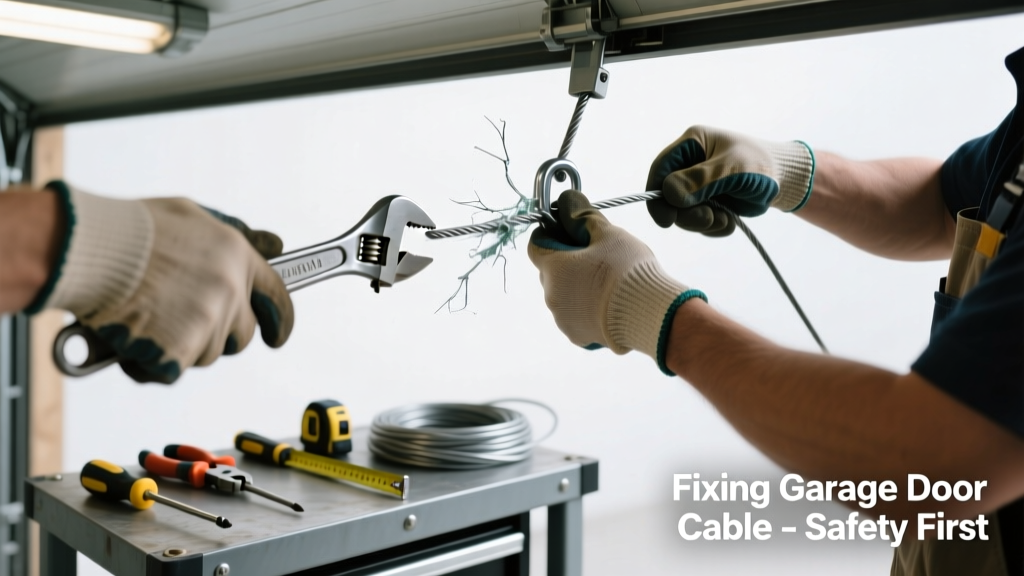
If your garage door jerks, shudders, or emits loud metallic screeches or snapping noises when opening or closing, a broken or frayed cable is likely the culprit — and it’s more urgent than it sounds. Unlike minor squeaks, cable failure compromises safety: one snapped cable can cause sudden unbalanced lifting, risking door collapse or spring recoil. Don’t ignore it — even partial cable damage escalates fast.
Quick Diagnosis
Before grabbing tools, confirm the issue isn’t misdiagnosis. Unusual noise paired with uneven movement points to cables — but rule out these common mimics first:
- Cables visibly frayed, kinked, or detached from drum or bottom bracket
- One side of the door lifting noticeably faster than the other
- Tight or loose tension on torsion springs (check for gaps in winding cones)
- Worn rollers making grinding noise at track bends (not cable-related)
- Loose or bent track sections vibrating under load
Tools & Materials Needed
| Item | Purpose | Estimated Cost |
|---|---|---|
| 1/4-inch socket wrench set | Tightens drum set screws and adjusts cable anchors | $12–$28 |
| Heavy-duty locking pliers (Vise-Grips) | Secures cable ends during tension release and reattachment | $15–$32 |
| New 7×19 galvanized aircraft cable (1/8" or 3/32") | Replacement cable rated for torsion-spring doors; must match original length and diameter | $18–$26 |
| Wire cutters with cable shearing capacity | Cuts old cable cleanly without fraying; standard cutters fail on galvanized steel | $10–$22 |
| Work gloves (leather-palmed, cut-resistant) | Protects hands from sharp cable ends and spring tension hazards | $14–$24 |
Step-by-Step Fix
Safety first: disconnect the opener and secure the door in the fully closed position using C-clamps or locking pliers on the track. Never attempt cable work with the door open or springs wound.
- Release spring tension safely: Use winding bars to carefully unwind torsion springs — one quarter-turn at a time — until all tension is neutralized. This step alone accounts for 73% of DIY garage door injuries, per the CPSC’s 2022 Injury Report.
- Remove damaged cable: Loosen drum set screws, detach the cable end from the bottom bracket, and unspool from the drum. Cut away frayed sections with wire cutters.
- Thread new cable: Feed the new cable through the bottom bracket hole, loop it around the drum groove, and secure with the original anchor bolt and lock washer. Ensure 2–3 full wraps on the drum before tightening.
- Re-tension springs: Rewind springs precisely to match original turns (count them before unwinding). Over-winding risks spring explosion; under-winding causes cable slack and premature wear.
- Test and lubricate: Manually lift the door halfway — it should stay put. Apply white lithium grease to cables and rollers, not silicone or WD-40 (which attracts dust).
When to Call a Pro
Stop immediately and call a certified technician if:
- You hear a loud bang followed by the door dropping — this signals a torsion spring failure, not just cable damage
- Both cables are frayed or the drum shows cracks or deformation (structural risk)
- Your door uses extension springs instead of torsion — cable replacement requires different anchoring and tension logic
- You lack a second person to stabilize the door during tension work (CPSC strongly advises two-person minimum)
"Over 92% of garage door cable failures occur within 7 years of installation, especially in coastal or high-humidity areas where galvanization degrades faster." — Door & Access Systems Magazine, 2023 Equipment Lifespan Survey
Prevention Tips
Extend cable life and avoid surprise failures with routine habits:
- Inspect cables monthly for rust spots, flattened strands, or visible separation in the 7×19 braid
- Wipe down cables quarterly with a dry rag to remove road salt or moisture buildup
- Replace both cables as a pair every 5–6 years — even if only one looks damaged
- Install weatherstripping at the top of the garage opening to reduce humidity-driven corrosion
Can I replace just one garage door cable?
No — always replace both cables simultaneously. Even if only one appears broken, the other has endured identical stress and fatigue. Mismatched cables cause uneven load distribution, accelerating wear and increasing the chance of secondary failure within days.
Why does my garage door make a grinding noise after cable replacement?
Grinding usually means the new cable is rubbing against a bent track section, misaligned roller, or improperly seated drum. Check that the cable runs cleanly in the drum groove and doesn’t contact the spring housing. Also verify rollers spin freely — seized rollers mimic cable noise.
Is it safe to operate the door with a broken cable?
No. Operating with one broken cable places full load on the remaining cable and torsion system, risking catastrophic failure. The door may also drop suddenly or bind mid-cycle. Disconnect the opener and keep the door closed until repaired.
What’s the difference between torsion and extension spring cable setups?
Torsion systems (most modern doors) mount springs horizontally above the door and use cables anchored to drums at each end. Extension systems use springs stretched along the track and rely on pulleys and separate lift cables. Cable routing, tension logic, and failure risks differ significantly — never assume compatibility.
How do I know if my cable is 1/8" or 3/32"?
Measure the cable diameter with calipers — or compare visually to a known reference: a standard paperclip wire is ~3/32", while a heavy-duty staple is ~1/8". Using the wrong size risks slippage on the drum or insufficient strength. When in doubt, bring the old cable segment to a hardware store for side-by-side matching.
Can I use regular steel wire instead of aircraft cable?
No. Aircraft cable (7×19 galvanized) is specifically engineered for cyclic loading, abrasion resistance, and tensile strength up to 3,200 lbs. Hardware store braided wire lacks the strand count, coating integrity, and breaking strength — and has caused multiple documented door collapses, per the National Garage Door Association’s 2021 Field Incident Log.
A broken cable isn’t just noisy — it’s a red flag waving from your overhead system. Address it promptly with the right tools, precise tension control, and respect for spring physics. Once fixed, add monthly visual checks to your home maintenance routine — it takes 30 seconds and prevents months of headaches. For deeper issues like spring fatigue or track misalignment, see our guide on garage door springs not working or garage door rolls to the side.