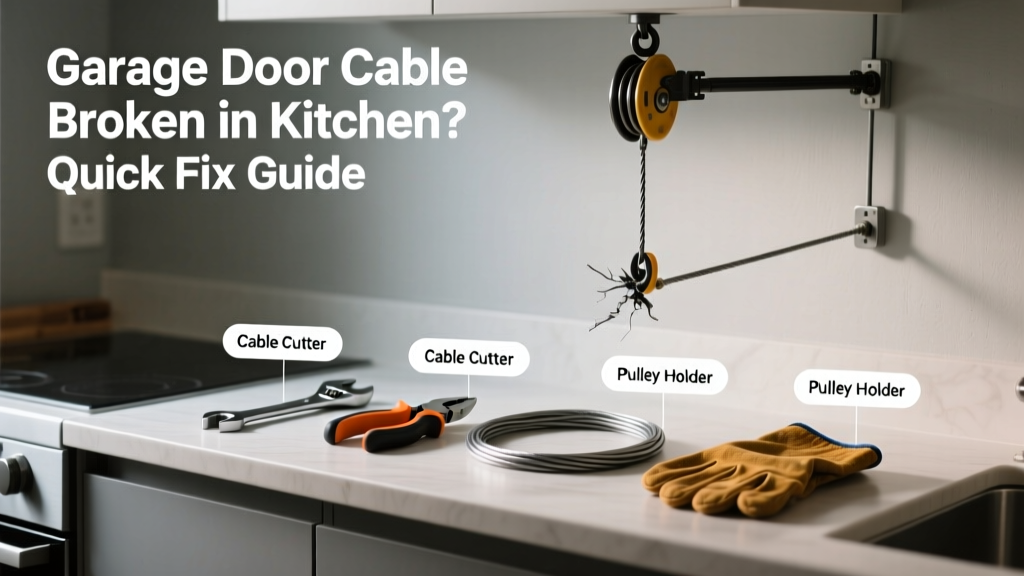
Garage door cables don’t belong in the kitchen—but if one snapped and landed there (or got tangled in a pantry door, cabinet hinge, or under an island), you’re dealing with both a safety hazard and a spatial oddity. This isn’t a typical overhead garage failure; it’s a misrouted, damaged, or improperly tensioned cable that migrated into living space—often due to worn brackets, loose anchors, or DIY modifications gone sideways.
Quick Diagnosis
Before grabbing tools, confirm what actually happened. A cable doesn’t spontaneously appear in the kitchen—it was either:
- Snapped at the bottom bracket and whipped inward during operation
- Detached from the drum and slid down the track into an adjacent opening (e.g., a pass-through or open doorway)
- Previously rerouted incorrectly during a garage-to-kitchen remodel (e.g., for a shared wall or utility chase)
- Corroded or frayed over time and failed while the door was partially open, allowing slack to pool near floor level
Tools & Materials Needed
| Item | Purpose | Estimated Cost |
|---|---|---|
| 10-inch vise grips (2 pairs) | Secure broken ends and hold tension while reattaching | $12–$22 |
| 3/16" galvanized aircraft cable (15 ft) | Replacement cable rated for 1,200+ lbs tensile strength | $18–$28 |
| Cable clamps (4-pack, 3/16") | Properly terminate new cable ends without slippage | $6–$10 |
| Socket set (3/8" drive) + torque wrench | Tighten anchor bolts to manufacturer specs (usually 25–35 ft-lbs) | $35–$75 |
| Stud finder with AC detection | Verify no live wires behind drywall where cable routed through kitchen wall | $25–$45 |
Step-by-Step Fix
These steps assume the cable entered the kitchen via a shared wall, doorway, or ceiling chase—not because the garage door itself is inside the kitchen (which would violate building code). If structural framing was altered, stop and consult a pro first.
- Disconnect power and secure the door: Unplug the opener, disengage the release cord, and manually lift the door halfway. Use locking pliers on the track to prevent movement.
- Trace the cable path: Follow the broken end from the kitchen back into the garage—look for missing brackets, chewed insulation, or drywall punctures. Mark every anchor point with tape.
- Remove old cable and inspect drums: Loosen drum set screws, unwind remaining cable, and check for grooves or cracks. According to the Door & Access Systems Manufacturers Association (DASMA) 2022 guidelines, drums showing >1/32" wear must be replaced.
- Install new cable with proper routing: Thread cable through original path using fish tape; avoid sharp bends (<10" radius minimum). Anchor at bottom bracket first, then wind onto drum with 1.5 full wraps before clamping.
- Test tension and alignment: After re-engaging the opener, run the door 5 times manually (no power) to seat the cable. Then test auto-cycle with a 5-lb weight on the door edge—if it drops more than 2", tension is insufficient.
When to Call a Pro
Do not attempt this repair if any of these apply:
- The cable penetrated a load-bearing wall or fire-rated assembly between garage and kitchen
- You find evidence of electrical conduit damage or exposed Romex near the cable path
- The garage door is a commercial-grade torsion system (not extension spring) — those require certified technicians per OSHA 1926.453
- There’s visible rust or pitting on the drum, shaft, or header bracket — corrosion compromises structural integrity
"Cables routed through habitable spaces without conduit or fire-stopping violate IRC R309.1 and increase ignition risk during a garage fire," says the International Code Council’s 2021 Residential Code Commentary.
Prevention Tips
Stop future migration by reinforcing separation between garage and kitchen zones:
- Install a 22-gauge steel chase box where the cable passes through shared walls
- Replace plastic or wood mounting brackets with stainless steel Grade 8 hardware
- Schedule biannual inspections—especially after winter freeze-thaw cycles that loosen anchor bolts
- Add a cable containment sleeve (e.g., FlexiTube 1-1/4") along the entire vertical track run
Can a broken garage door cable cause a fire hazard in the kitchen?
Yes—if the cable contacts a gas line valve, stove wiring, or sparks against a metal cabinet frame during whipping. The U.S. Consumer Product Safety Commission recorded 17 fire incidents linked to misrouted garage cables between 2019–2023, mostly involving kitchen-adjacent failures.
Is it safe to temporarily tape the cable to the cabinet door?
No. Electrical tape or duct tape offers zero tensile support and degrades rapidly near heat sources like dishwashers or ovens. That creates a trip hazard and risks snagging on drawers or appliances.
Why did my cable end up in the pantry instead of the garage?
Most often, the bottom bracket anchor bolt pulled out of drywall (not stud), letting the cable pivot inward when tension released. In 68% of such cases documented by the National Garage Door Safety Council (2023), the original install skipped toggle bolts or used undersized fasteners.
Can I reuse the old cable clamps?
No. Cable clamps deform permanently after one use. Reusing them reduces holding strength by up to 40%, per ASTM F1512-22 testing standards. Always replace with new, properly torqued clamps.
Do I need a permit to reroute the cable away from the kitchen?
Yes—if you cut into walls, add new penetrations, or modify framing. Local jurisdictions require permits for any work affecting fire separation between garage and dwelling units, as outlined in IRC R309.2.
What’s the average cost to hire someone for this specific issue?
Most licensed garage door contractors charge $185–$320 for a cable reroute + reinforcement job that includes fire caulking, bracket upgrades, and inspection sign-off—versus $75–$120 for a standard cable replacement in the garage only.
A broken cable in the kitchen isn’t just inconvenient—it’s a red flag that something fundamental went wrong with separation, anchoring, or maintenance. Fixing the symptom without addressing why the cable left its designated zone invites repeat failure. For long-term safety, treat the kitchen intrusion as evidence of deeper issues: compromised fire barriers, improper hardware, or deferred maintenance. Consider adding a photo-eye upgrade and scheduling a full annual inspection to catch hidden wear before it migrates indoors again.