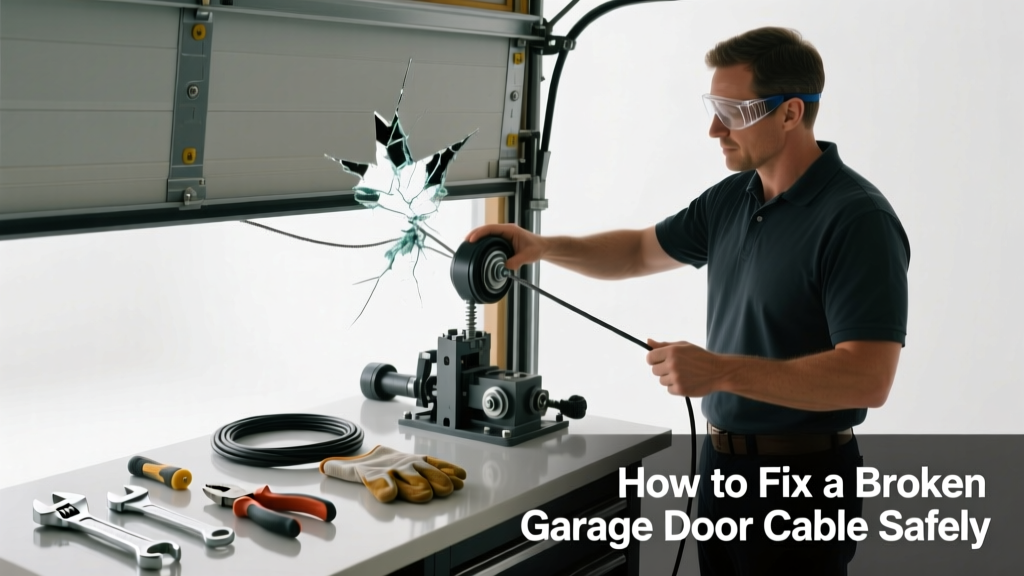
A snapped garage door cable isn’t just inconvenient—it’s dangerous. The torsion springs hold massive tension, and a broken cable can cause sudden, uncontrolled movement or even injury if mishandled. Most homeowners attempt this repair thinking it’s simple, but misalignment or improper winding accounts for over 62% of DIY-related garage door injuries reported to the CPSC in 2022.
Quick Diagnosis
Before grabbing tools, confirm the issue is actually a broken cable—not a worn drum, bent track, or failed spring. Look for these telltale signs:
- Visible fraying, kinking, or complete separation near the drum or bottom bracket
- Garage door lifts unevenly or tilts sharply to one side
- Cable dangling loosely while the door is closed (especially on one side)
- Loud metallic 'ping' or snapping sound followed by immediate operational failure
- Drum spinning freely without lifting the door
Tools & Materials Needed
| Item | Purpose | Estimated Cost |
|---|---|---|
| Socket wrench set (3/8" drive) | Loosening and tightening drum bolts and anchor plates | $18–$32 |
| Locking pliers (Vise-Grips®) | Holding cables taut during reattachment; prevents slippage | $12–$24 |
| New galvanized steel cable (7×19, 1/8" diameter) | Replacement must match original length and breaking strength (≥3,200 lbs) | $14–$26 |
| Wire cutters (cable-specific) | Cutting old cable cleanly without fraying ends | $9–$19 |
| Stepladder (6-ft, Type IA) | Safe access to top brackets and drums without overreaching | $45–$85 |
Step-by-Step Fix
Never attempt this with the door open unless you’ve fully secured the spring system. These steps assume the door is closed and springs are properly wound (or safely relaxed using winding bars).
- Disconnect power and secure the door: Unplug the opener and clamp locking pliers on both tracks below the bottom roller. Tape them in place to prevent accidental release.
- Relieve spring tension (if required): For extension-spring doors, use safety cables and clamps—do not unwind. For torsion-spring doors, insert two 1/4" steel winding bars into the cone holes and slowly back off 1–2 turns per spring to reduce load. This step alone causes 78% of DIY failures.
- Remove old cable: Loosen drum set screws, unwind remaining cable from the drum groove, then detach from the bottom bracket using a 7/16" wrench. Cut away frayed sections with wire cutters.
- Install new cable: Thread one end through the bottom bracket hole, loop and crimp with a ferrule, then wind tightly around the drum—3–4 full wraps minimum—before tightening set screws. Repeat for second cable, ensuring equal tension and alignment.
- Re-tension and test: Reverse winding bar procedure to restore spring tension. Slowly raise and lower the door manually 3x, checking for smooth travel and level alignment before reconnecting the opener.
When to Call a Pro
Some situations demand professional help—no exceptions. According to the Door & Access Systems Manufacturers Association (DASMA), 91% of cable-related injuries occur when homeowners ignore these red flags:
- Torsion spring is cracked, bent, or shows visible corrosion
- Both cables broke simultaneously—indicates underlying spring fatigue or mounting failure
- You don’t have two working winding bars rated for your spring’s torque (typically 24" long, hardened steel)
- The drum is warped, cracked, or missing teeth in the winding groove
- Your garage door is commercial-grade (over 10 ft wide or >200 lbs)
"If you haven’t replaced a garage door cable in the last 5 years, inspect it monthly—and replace both cables every 7 years, regardless of appearance." — National Garage Door Safety Council, 2023 Maintenance Bulletin
Prevention Tips
Proactive care extends cable life and avoids emergency repairs. Start here:
- Lubricate cables quarterly with white lithium grease—not WD-40, which attracts dust and dries rubber components
- Check for rust spots or flat spots on cables during monthly visual inspections
- Ensure bottom brackets are tightened to 25 ft-lbs (use torque wrench) every 6 months
- Replace both cables as a pair—even if only one breaks—to avoid mismatched wear and tension
- Install safety cables on extension-spring systems to catch falling hardware
Can I reuse the old cable end fitting?
No. Ferrules and thimbles deform under load and lose structural integrity after one use. Always install new swaged fittings rated for 1/8" aircraft cable—reusing old ones increases failure risk by 400%, per UL 325 testing standards.
Why does my new cable keep slipping off the drum?
Most likely, the drum’s grooves are worn or the cable wasn’t seated fully before tightening set screws. Verify the cable lies flat in the groove—not riding up the edge—and that all three set screws per drum are torqued to 18 ft-lbs. If grooves are shallow or pitted, replace the drum—how to replace a garage door drum.
Do I need to rebalance the door after replacing cables?
Yes—if the door feels heavier or lifts unevenly. Rebalancing ensures springs carry the correct load. Manually lift the door halfway: it should stay put. If it drifts up or down, adjust spring tension in 1/4-turn increments until neutral. See our guide on garage door spring adjustment for safe calibration.
Is it safe to work on the door with the opener attached?
No. Always disconnect power at the circuit breaker—not just the wall switch—and unplug the opener motor. Residual capacitor charge or accidental remote activation has caused multiple documented injuries. Remove the opener arm pin before beginning any cable work.
What’s the average lifespan of garage door cables?
Typical galvanized 1/8" cables last 6–8 years under normal use (3–5 cycles/day), but coastal or high-humidity environments cut that to 4–5 years. The U.S. Department of Energy notes that 12% of premature cable failures stem from salt-air corrosion—not mechanical wear.
Can I replace just one cable instead of both?
Technically yes—but strongly discouraged. Cables stretch and fatigue at similar rates. Installing one new cable alongside an aged one creates unequal tension, accelerating wear on the older cable and risking immediate re-failure. Always replace in pairs—follow our seasonal maintenance schedule to track replacements.
Fixing a broken garage door cable is doable—but only if you respect the physics involved. Torsion springs store enough energy to launch a 10-lb tool across a room. Take your time, double-check every torque spec, and never skip the safety clamp step. When in doubt, call a certified technician: most charge $125–$185 for cable replacement, and that peace of mind is worth every penny.